1813 Dump struck using the A/1 dies and extremely rare in this quality

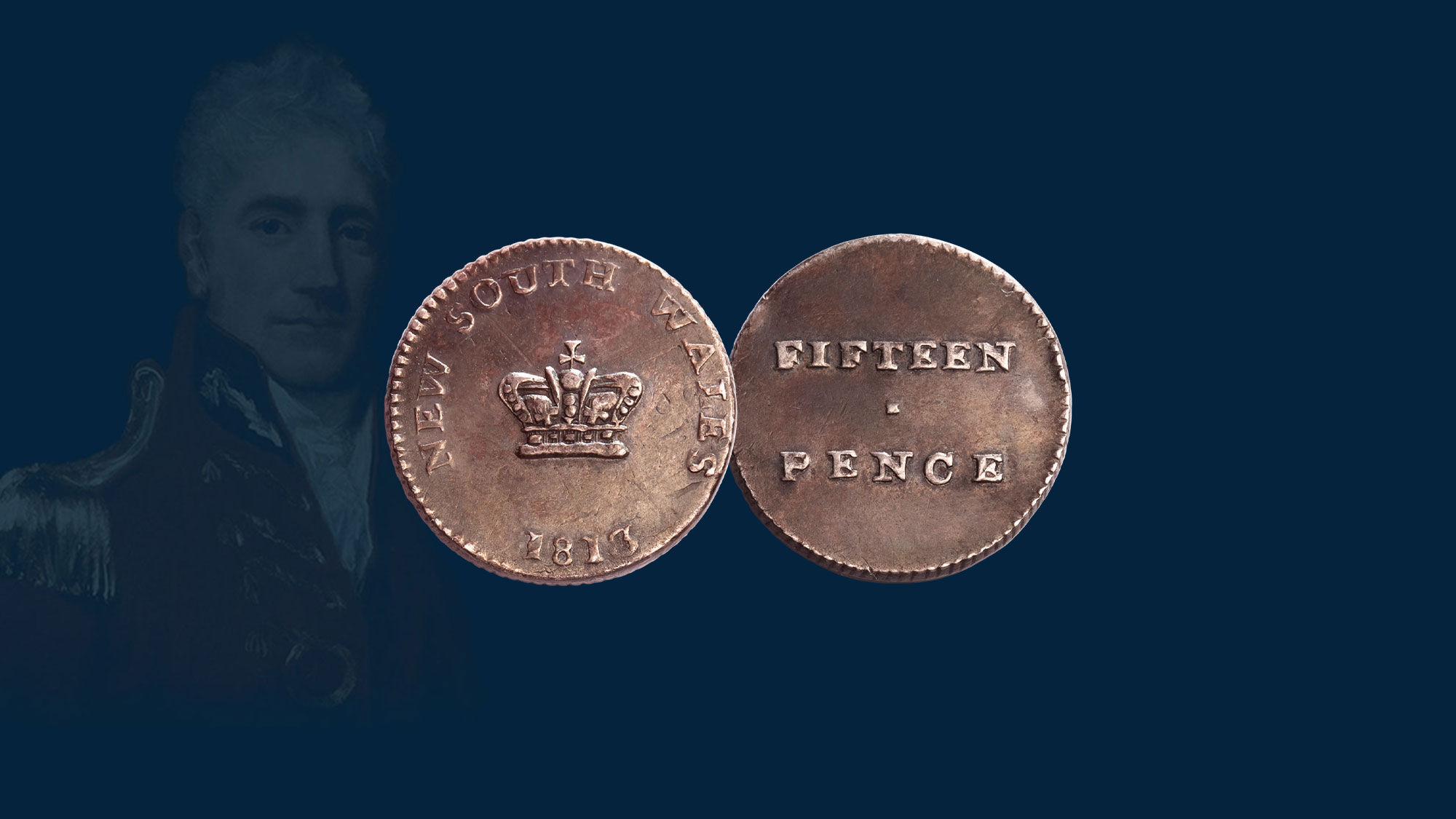
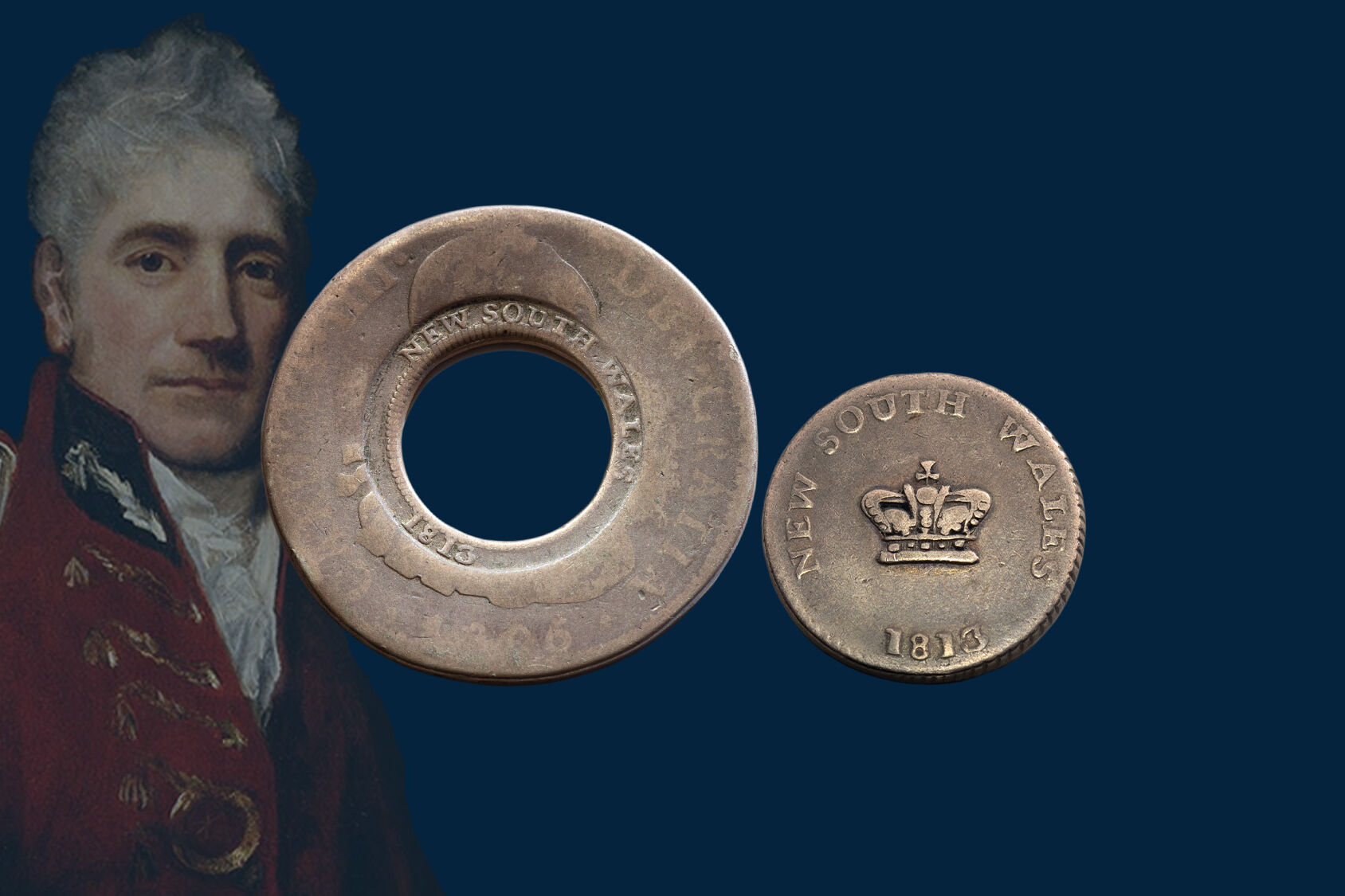
When you look at this 1813 Dump in your hand, the fields are like glass and very reflective. The design details are super-fine and clearly visible to the naked eye. And that’s a sign of a high-quality coin. This is a superior quality example of the nation’s first coin, technically ranked in the top five per cent. Over and above its quality ranking this coin has attributes that are highly prized, traits that you simply don't see in every Dump. For a start there is the 'H’ for Henshall on the reverse, the mark left by the nation’s first mint master that guaranteed his fame. On the obverse, there also is evidence of the original Spanish Dollar design from which it was created. Intact edge milling, the minting authority's ploy to prevent clipping of slivers of silver from the edges. And the elusive dot above the ‘3’ in the date 1813. A Dump that offers the lot.
The buyer that pursues a top quality Dump will find the task extremely challenging. It can be years before a premium quality example comes onto the market and decades before the very best becomes available. And that statement is said in the knowledge that there are perhaps 800 Dumps, across all quality levels, available to private collectors.
The Dump with a value of fifteen pence circulated widely in the colony, the extreme wear on most Dumps evidence that they saw considerable use. The Holey Dollar being a higher valued piece, at five shillings, had a narrower band of circulation.
So, while the Dump may seem the diminutive partner of the Holey Dollar, the reality is top quality Dumps have authority. They are extremely rare, in fact far rarer than their holed counterpart in the same quality level. Official Bank of New South Wales records show that in 1820 the bank held 16,680 Holey Dollars and only 5900 Dumps. Considering that 39,910 of each were released into circulation, the figures reflect the greater circulation of the smaller denomination Dump.
Top quality Dumps are extremely rare and highly valued.
Documentation as to the method of manufacture of the Holey Dollar and Dump has never been found. It is however safe to assume that whatever machinery was employed, it was hand operated as the first steam engine did not become operational in the colony until 1815.
Likely production options were the screw press, drop hammer or hand-held punch with the drop hammer method onto a pre-heated plug generally regarded as the most likely.
There is no doubt that heat was involved in the creation of the Dump. When the disc fell out of the centre of the Spanish Dollar, it still bore the original dollar design of a four quadrant shield, housing a lion and castle in each quadrant. And the shield's cross-bars. High temperatures obliterated the original Spanish Dollar design from most examples.
Those Dumps that retain the original dollar design elements are highly prized.
The high temperatures also caused an expansion of the metal disc that fell out of the dollar. The very reason why the Dump is always larger than the hole in the Holey Dollar.
The haphazard, obliquely grooved edge milling found on the dumps indicates that a 'fiddle method' was the final step in the production process whereby a roll of Dumps was rotated under pressure against a grooved cylinder.
While no one knows the method of manufacture, history records that convicted forger and emancipist, William Henshall, was hired to create the nation's first currency, effectively our first Mint Master. He declared his involvement in the creation of the Dump - and the Holey Dollar - by inserting his initial, an 'H' for Henshall, on some - but not all - of the reverse dies of the Dump. And some - but not all - of the Holey Dollar counter stamp dies.
Amazing to think that a convicted forger created the first 'mint mark' on Australia's first coinage!
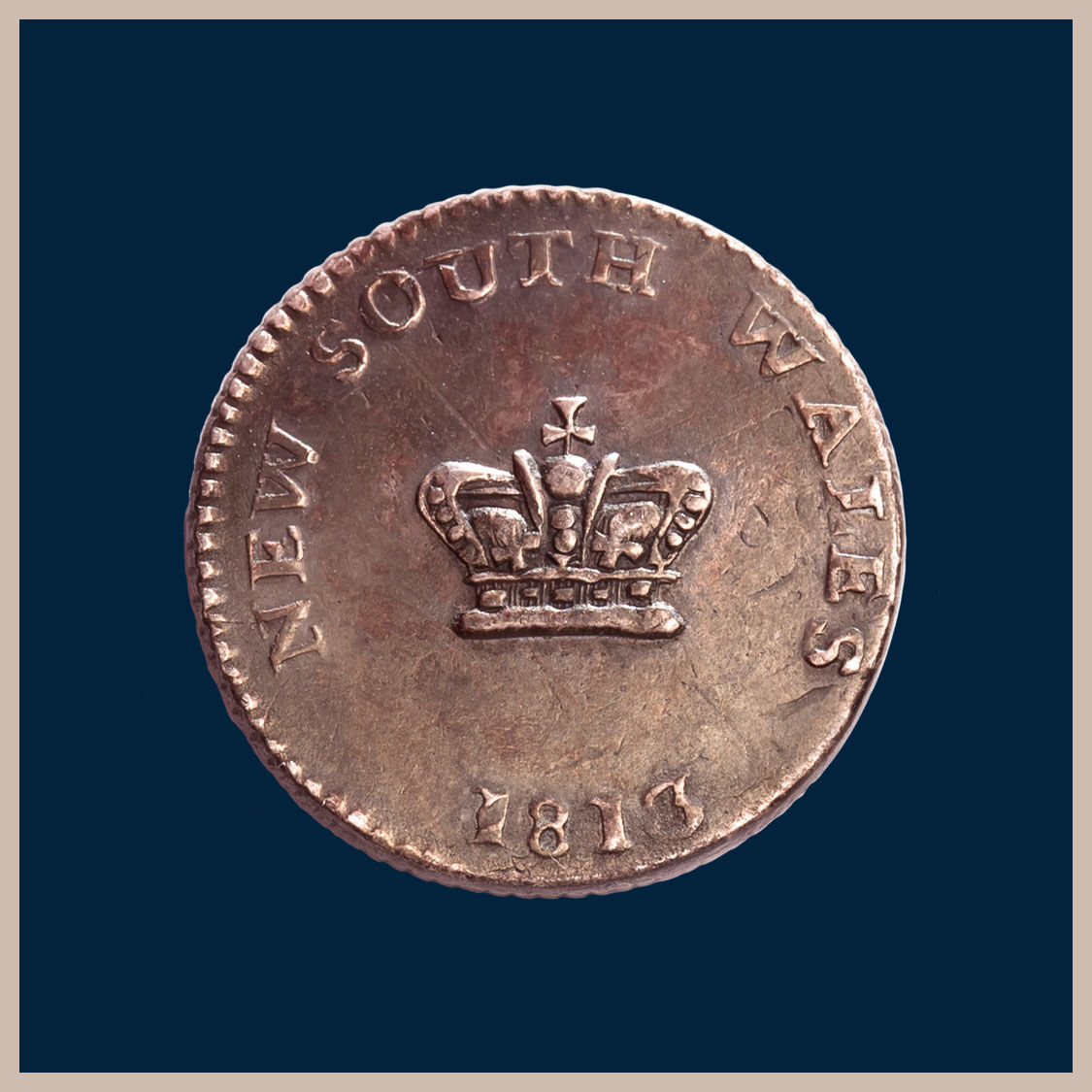
1813 Dump
struck using the A/1 dies
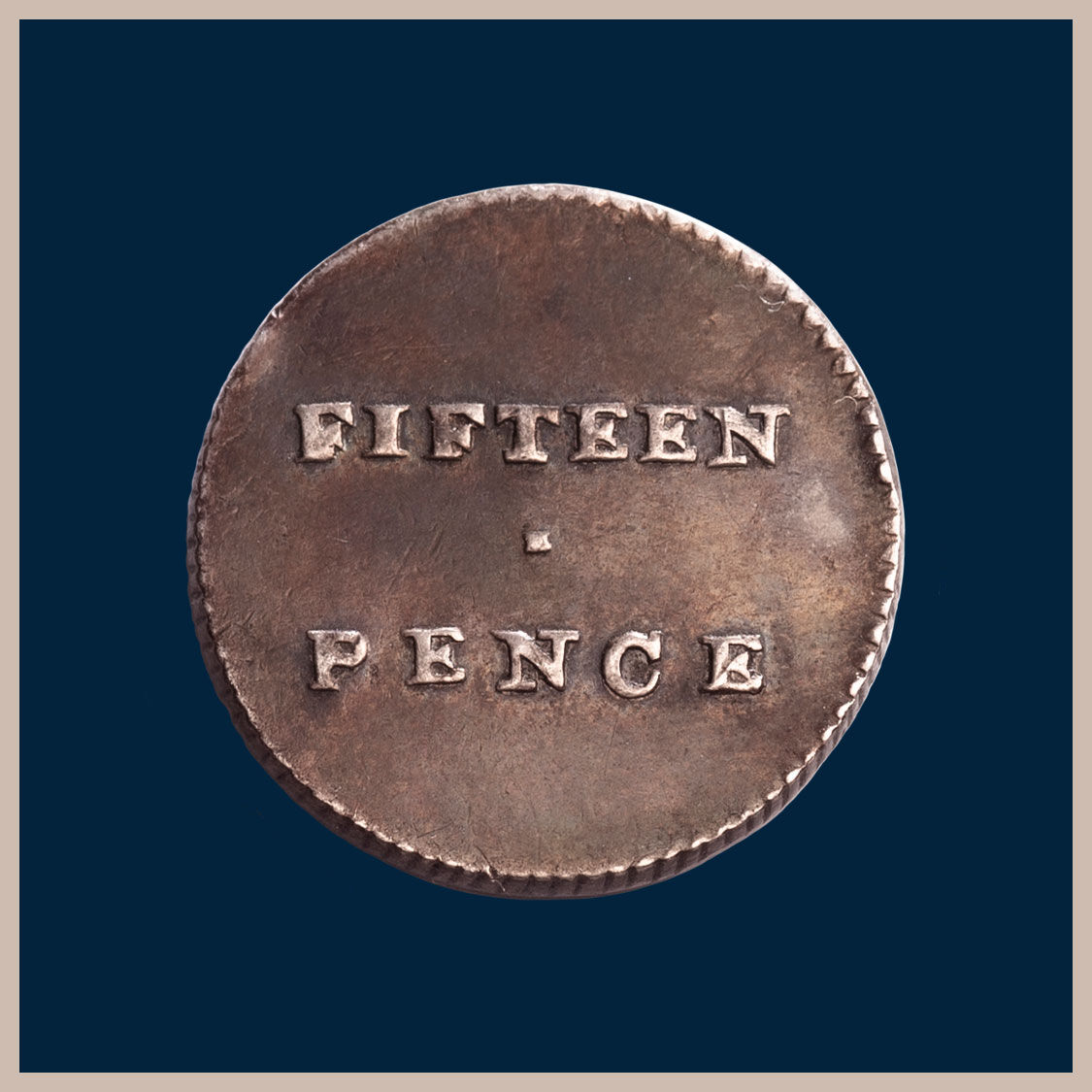
1813 Dump
struck using the A/1 dies
This is a classic example of the 1813 Dump.
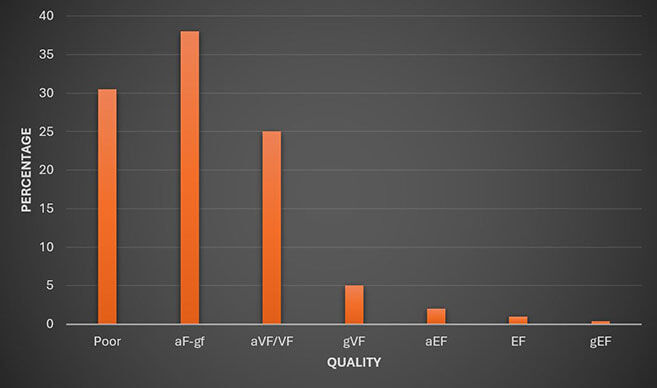
1. The 1813 Dump circulated widely in the colony, the extreme wear on most Dumps evidence of its extensive use. The average quality Dump is graded at Fine to Good Fine, with this coin at least four grades higher at Nearly Extremely Fine / Extremely Fine. (See chart below)
2. Struck with the A/1 dies, the crown is classically well-centred and well struck, the design definition strong.
3. William Henshall inserted an 'H' into some (but not all) of the dies used during its striking. The 'H' is strong and three dimensional.
4. The denticles around the edge of the coin are evident, almost half way around. Complete denticles, all the way round, is a phenomenon that is rarely seen on the 1813 Dump.
5. The oblique milling around the edge is fully evident. (The edge milling was used as deterrent against clipping whereby the unscrupulous shaved off slivers of silver, reducing the silver content of the Dump. And making a small profit on the side.)
6. While the Holey Dollar clearly shows that it is one coin struck from another, in a less obvious way so too can the Dump. The design detail of the original Spanish Dollar from which this Dump was created is evident on the obverse. We refer to it as the under-type and it is not always present. Its existence re-affirms the origins of the Dump and is highly prized.
7. This Dump shows a 'dot' above the '3' in the date '1813'. This is almost certainly due to a pit in the die and only occurs in those coins struck with the type A/1 dies. And even then it is identified in very few type A/1 examples.
1813 Dump struck from A/1 dies, Nearly Extremely Fine / Extremely Fine and rare in this quality
When you look at this 1813 Dump in your hand, the fields are like glass and very reflective. The design details are crisp and clearly visible to the naked eye.
And that’s a sign of a high-quality coin.
This is a superior quality example of the nation’s first coin, technically ranked in the top five per cent.
Over and above its quality ranking this coin has attributes that are highly prized, traits that you simply don't see in every Dump.
For a start there is the 'H’ for Henshall on the reverse, the mark left by the nation’s first mint master that guaranteed his fame. There also is evidence of the original Spanish Dollar design from which it was created on the obverse. Intact edge milling, the minting authority's ploy to prevent clipping of slivers of silver from the edges. And there is evidence of the elusive dot above the ‘3’ in the date 1813.
Highlights of our Inventory
© Copyright: Coinworks