The 1852 Government Assay Office Adelaide Gold One Pound Type II, struck with the scalloped inner circle reverse die, edge with wide milling

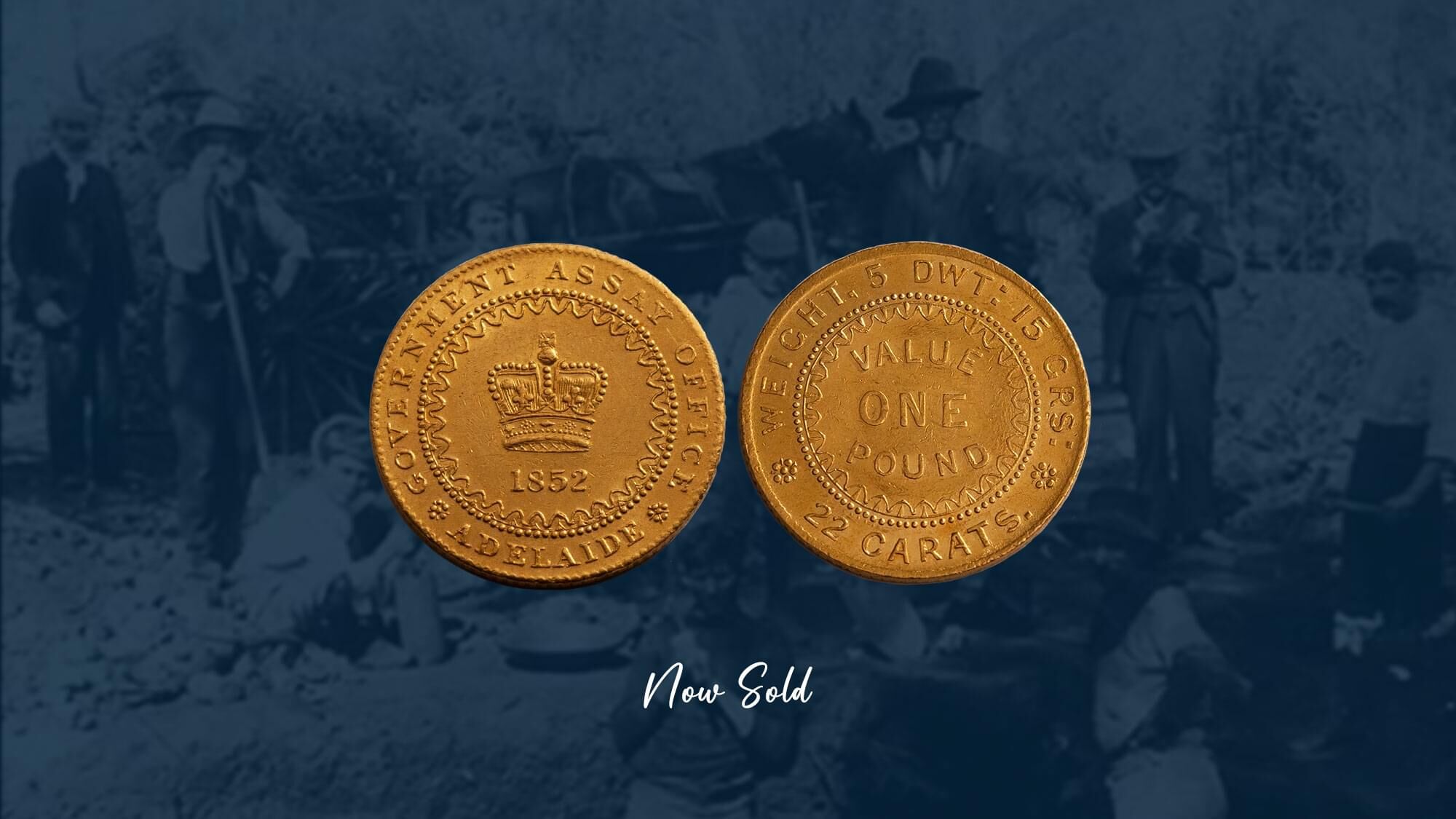
There is everything to like, and nothing to dislike, about this 1852 Adelaide Pound. Including the price. The coin is highly lustrous on both obverse and reverse and the prime design details of the crown and the legend, Government Assay Office Adelaide, are well defined. So too is the date '1852'. We also note that the fields and the edges are not marred by heavy knocks or gouges. A miracle given the factory environment in which it was struck. This Adelaide Pound is graded Good Extremely Fine, with just whisper touches to the high points. And is priced accordingly. Held in the one collection for the last twenty-six years, this 1852 Adelaide Pound is available now.
The Adelaide One Pound is the nation’s first gold coin, struck in 1852 at the South Australian Government Assay Office, Adelaide.
Local jeweler and engraver Joshua Payne created the dies for the nation's first gold coins. The obverse declared the issuing authority, Government Assay Office Adelaide, encircling a crown and the date, 1852, the design used continuously throughout production. The reverse declared the fineness and weight encircling it's value.
With its fine design detail, the Adelaide Pound is compelling and a piece of significance, its status as the nation's first gold coin ensuring that it will never be forgotten.
And it is extremely rare with less than forty examples surviving from the first production run and perhaps two hundred and fifty from the second. Either first or second run, the Adelaide Pound is a prized possession, an iconic gold coin revered by local and international buyers.
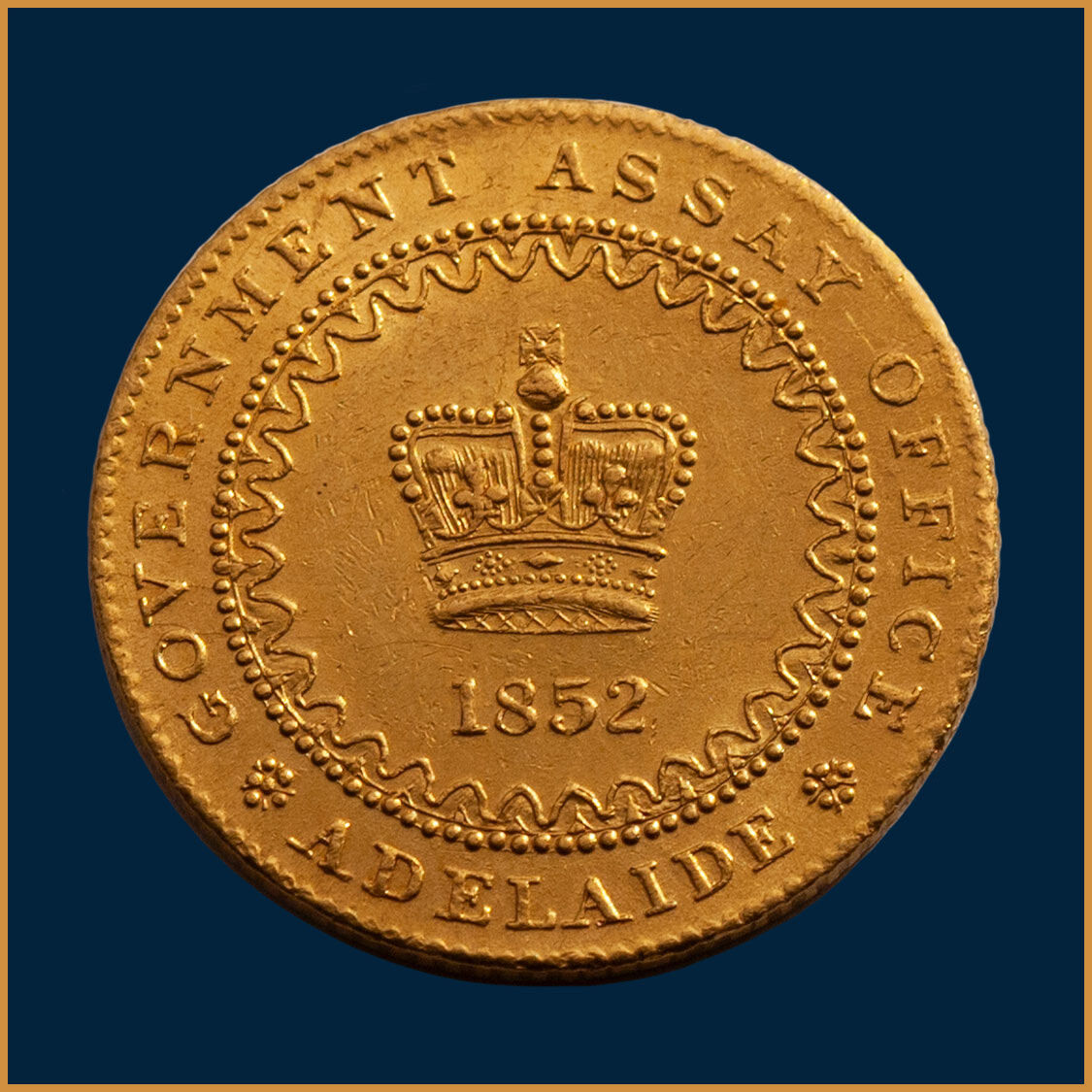
1852 Adelaide Pound Type II
Obverse
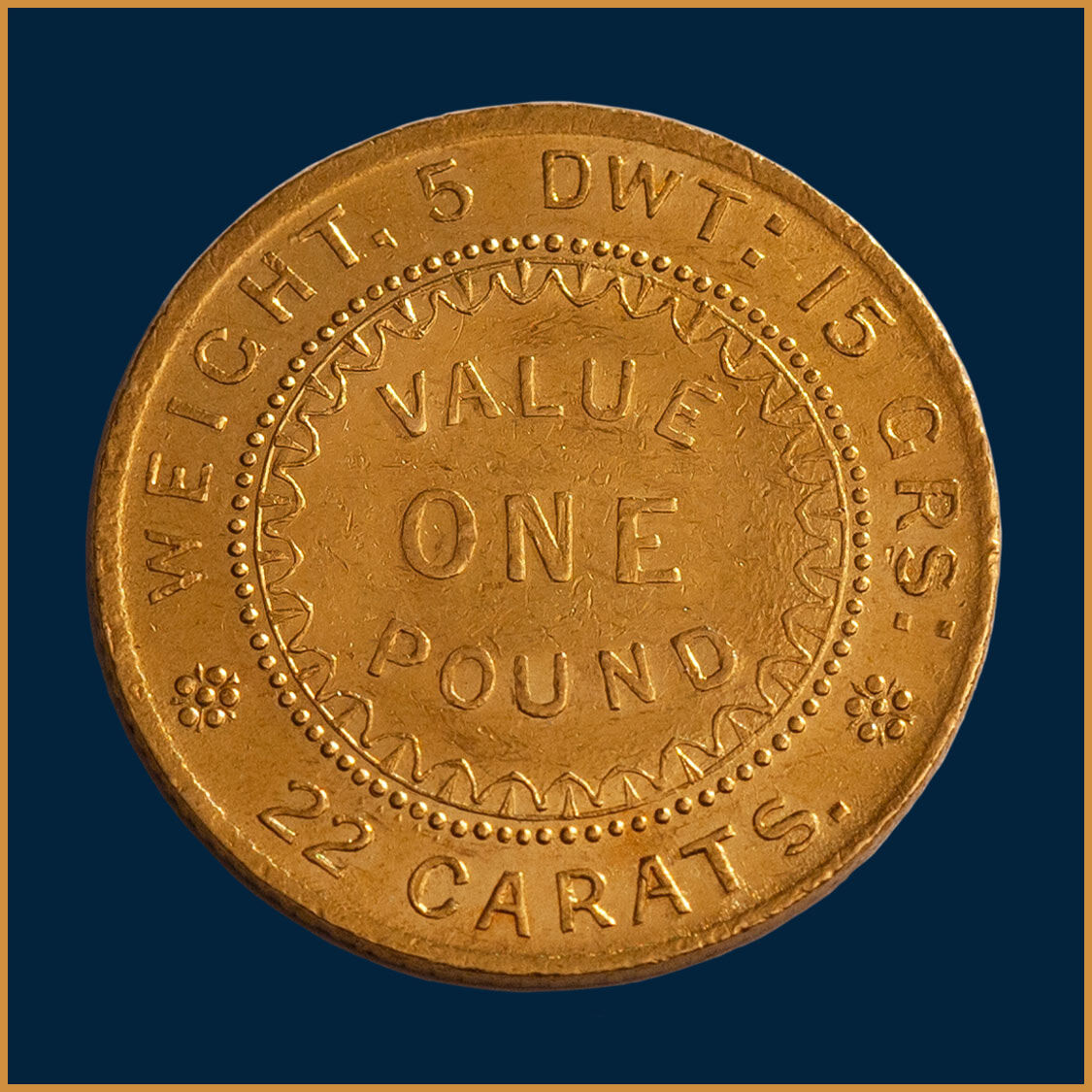
1852 Adelaide Pound Type II
Reverse
The first production run of Adelaide Pounds was short and eventful. A cracking of the reverse die during the striking of the first fifty coins halted production.
The impaired die, featuring a beaded inner circle, was replaced and production resumed, staff electing to use a die with a different design to that used in the first run. The second die featured a scalloped inner border. The move to use differently designed dies was profound for it clearly differentiates those coins struck in the first and second run.
In the second production run, pressure was relaxed on the edges to lengthen the die usage and re-focused on the central area of the design. The reduction in pressure on the edges meant that the edge perfection achieved in the first run of coins was simply not achievable. Most Adelaide Pounds from the second run therefore show some form of weakness in the edges, particularly in the Government Assay Office area. Occasionally the weakness is exhibited all the way round. Due to the re-focus of pressure away from the edges and to the centre of the coin, the crown design is almost always well executed with flattened areas simply due to wear.
The official recorded mintage of the nation’s first gold coin is 24,648, a relatively small number given the amount of gold deposited at the Assay Office. Very few out of the mintage actually circulated, with many of them ending up in the melting pot. Assaying of the one pound samples sent to London determined that the intrinsic value of the gold contained in each piece exceeded its nominal value. The coin therefore became the target of profiteers and were exported to London and melted down.
The Adelaide Gold One Pound, struck in the first production run, is known as the Type I Adelaide Pound and fewer than forty examples survive from the first production run in varying degrees of quality.
The Adelaide Gold One Pound, struck in the second production run, is known as the Type II Adelaide Pound. It is an iconic gold coin with perhaps two hundred and fifty available to collectors.
The clear advantage of the Type II over the Type I is its affordability.
The 1852 Government Assay Office Adelaide Gold One Pound Type II, struck with the scalloped inner circle reverse die, edge with wide milling
Good Extremely Fine with lustrous surfaces on both obverse and reverse
Price: $30,000
There is everything to like, and nothing to dislike, about this 1852 Adelaide Pound. Including the price.
The coin is highly lustrous on both obverse and reverse and the prime design details of the crown and the legend are well defined. We also note that the fields and the edges are not marred by heavy knocks or gouges. A miracle given the factory environment in which it was struck.
This Adelaide Pound is graded Good Extremely Fine, with just whisper touches to the high points. And is priced accordingly.
Held in the one collection for the last twenty-six years, this Adelaide Pound is available now.
© Copyright: Coinworks