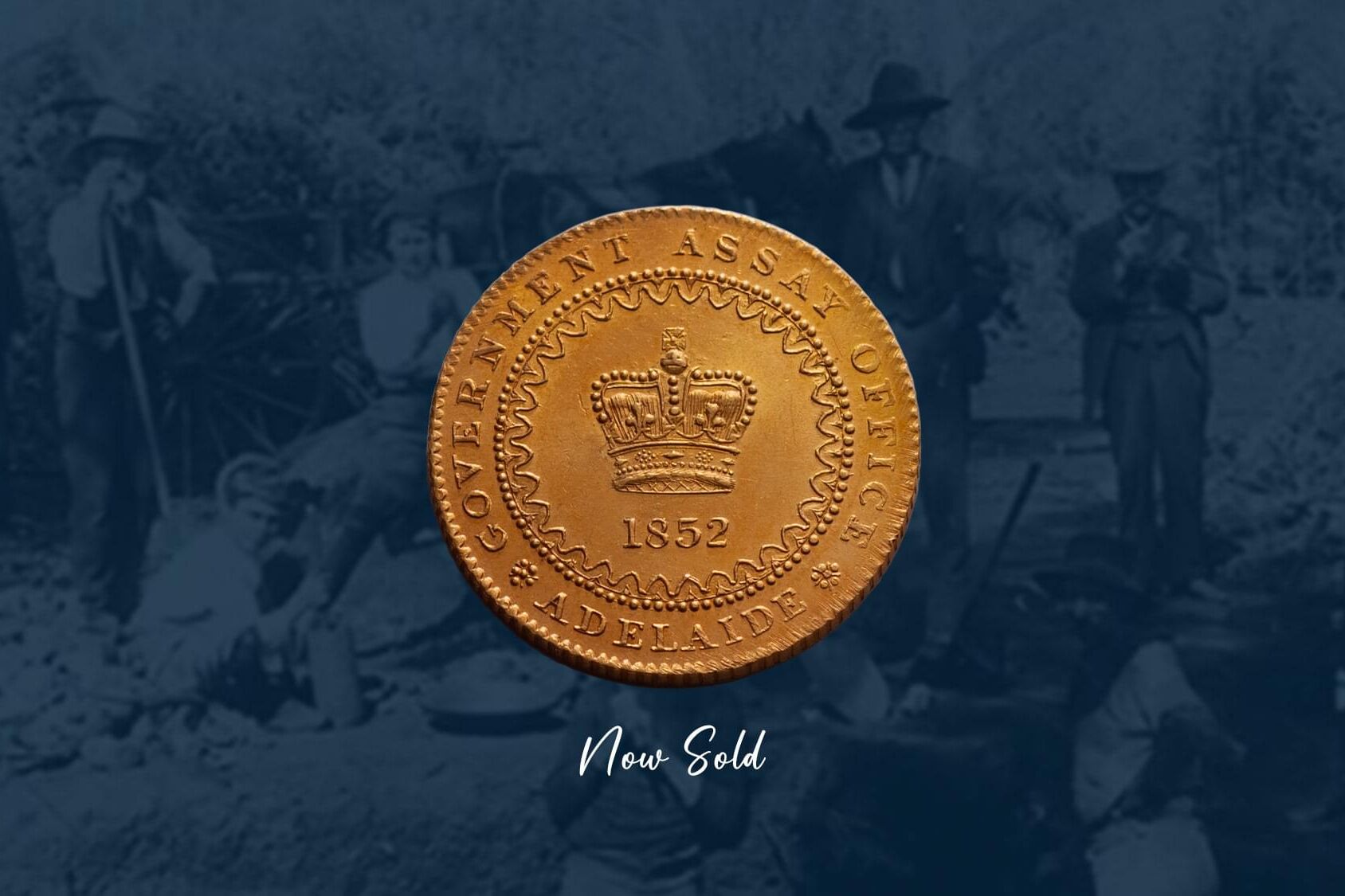
The Nobleman 1852 Government Assay Office Adelaide Gold One Pound Type 1a, struck with the beaded inner circle reverse die, edge with fine milling

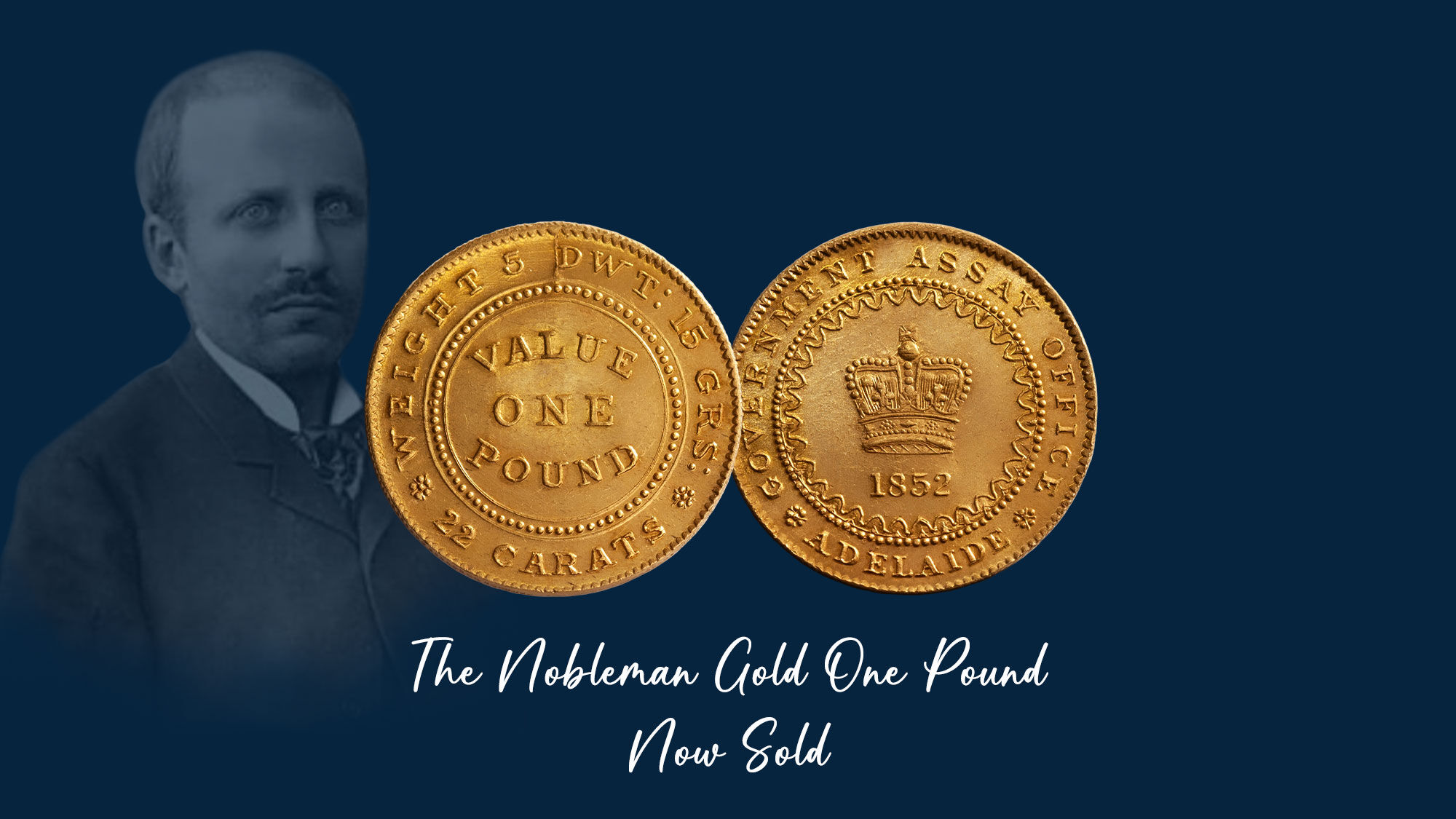
Australia’s Gold Rush of the 1850s had a major impact on Britain, stimulating trade and investment and changing the perception of Australia as a remote penal colony to a land of opportunity. The finest examples of the colony’s gold coins were pursued by Britain’s leading collectors, Montagu Hyman and John G. Murdoch. And Europe's Baron Philippe Ferrari La Renotiere whose collection was sold under the pseudonym, Nobleman. This 1852 Adelaide One Pound coin was struck in the first production run and is from the esteemed Nobleman Collection. On both counts, quality and strike, the Nobleman One Pound is genuinely exceptional and the very reason why it is universally ranked as number one. The coin has never circulated and is presented in a virtually mint state with much original bloom.
When you look at a truly great circulation strike, such as the Nobleman One Pound, you can’t fail to be engaged by its state. The coin has presence and is imposing. The edges are strong. As a picture frame does to a canvass, a coin's edges enhance the visual impact by drawing the viewer's eye to the overall design. The edges also provide a sense of completion. A truly great circulation strike will also have super-fine detail and a three-dimensional design. Original mint bloom and proof-like fields.
On both counts, quality and strike, the Nobleman One Pound is genuinely exceptional and the very reason why it is universally ranked as number one. The Nobleman One Pound has never circulated and retains its mint-state condition with much original bloom.
The Nobleman One Pound is the finest example of the nation's first gold coin and was struck in the very first production run of Adelaide Pounds. And the strike, for a coin that was minted in the first run that history records was challenged with interruptions, is quite extraordinary.
The Nobleman One Pound features fine milling, the reverse crack .1mm wide. This tells us that the coin was produced not just in the first production run but it must have been struck in the first handful, for as the process continued, the crack became broader, up to .2mm in width.
The Nobleman One Pound is the coin for the buyer aspiring to the best. It will be a buyer that respects quality and recognises the importance of a documented provenance, today and into the future. A buyer that will enjoy the history of a coin that has been making headlines, both in Australia and in Britain since 1922.
No other Adelaide Pound can match this coin for its quality, its fame. And its level of public recognition.
How do you attempt to explain the brilliant state of the Nobleman One Pound? You simply can't. And that is the miracle of numismatics.
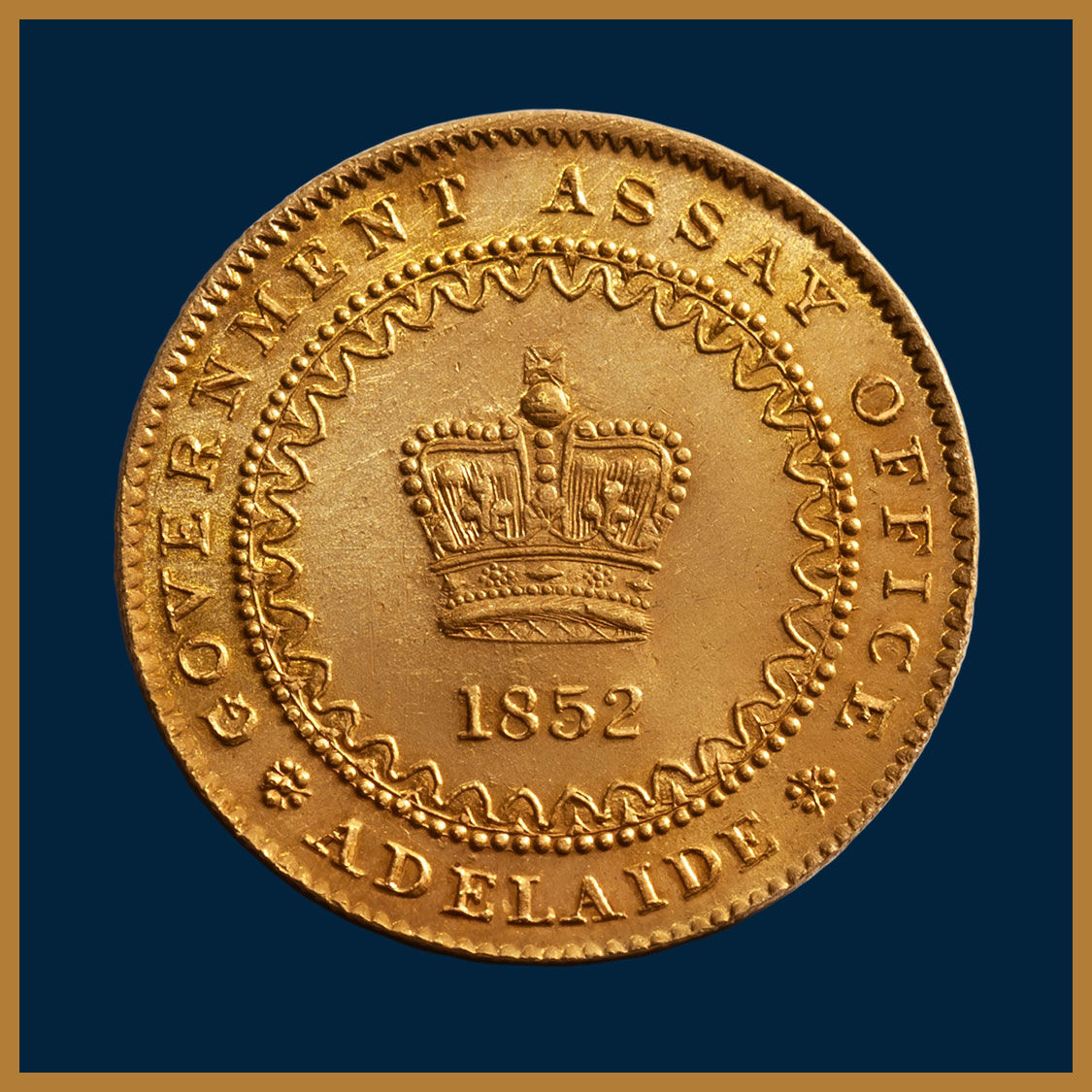
The Nobleman
Gold One Pound Type 1a
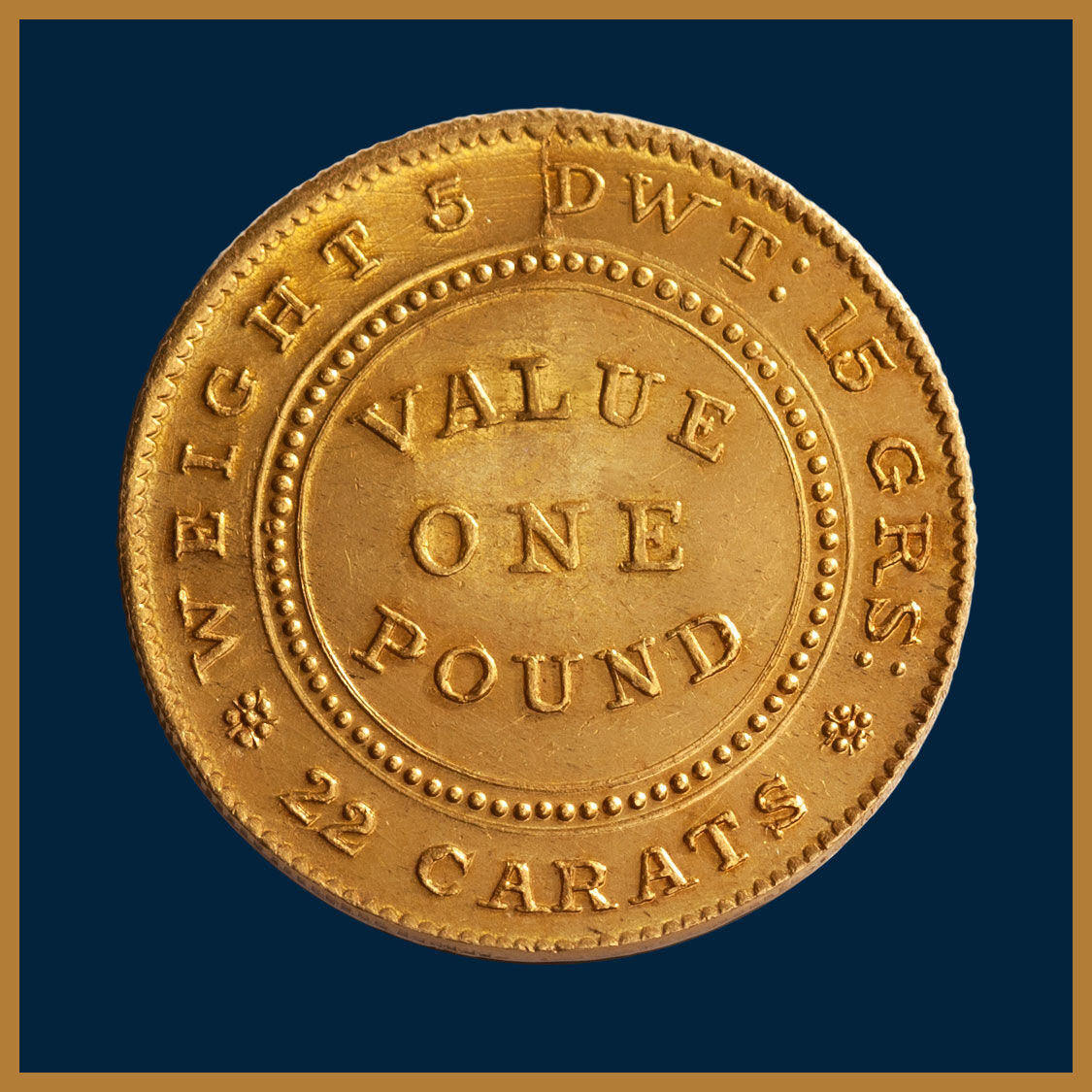
The Nobleman
Gold One Pound Type 1a
The colony of South Australia passed the Bullion Act in January 1852. The Act authorised the opening of a Government Assay Office in Adelaide to produce gold ingots that could be exchanged for banknotes at the rate of £3 11/- per ounce. Production of ingots began in February 1852.
Fielding numerous complaints about the ingots and their efficacy in solving the colony's financial crisis, the Act was amended in November of the same year to allow production of a gold coin, the Government Assay Office Adelaide One Pound. It was Australia's first gold coin.
The transition to producing a coin presented challenges for assaying staff that, while skilled in metal work, had minimal coining skills.
Finding the correct pressure balance on the dies to ensure that the design details and inscriptions were transferred accurately to both sides of the coin while at the same time producing strong edges was a major challenge that staff struggled to achieve. The milling also became an issue and was varied during the process, the belief that the fine milling may have contributed to some of their problems.
Excess pressure applied to the edges cracked the reverse die resulting in an interruption to production of the Adelaide Pound very early on in the process.
Less than fifty coins were believed struck before the crack was discovered, this coin one of them.
As the pressure was initially exerted on the edges, most Adelaide Pounds from the first run have strong edges. The downside of this pressure focus is that Adelaide Pounds from the first run show weakness in the crown.
The Nobleman One Pound has strength in the edges and a strength in the crown unseen in other examples.
Both fleur de lis are complete and three-dimensional, the pleats in the cloth are well formed. The horizontal line in the cross on the orb at the top of the crown is almost intact just tapering off on the right hand side. We also detect ermine flecks in the trim at the base of the crown. Flip the coin over and the lettering declaring its value in the central area of the design is consistently strong.
Exhibited National Museum of Australia 11 March to 24 June 2001.
Canberra's National Museum of Australia opened in 2001 as the centrepiece of the Centenary of Federation celebrations. The museum's first Exhibition, 'Gold and Civilisation', featured eight pieces from the Quartermaster Collection. The Nobleman One Pound was one of the eight and was photographed in the souvenir book.
Exhibited Museum of Victoria 19 July to 21 October 2001.
As part of the Centenary of Federation celebrations, the eight coins from the National Museum of Australia were displayed at the Museum of Victoria, Melbourne.
Exhibited Royal Australian Mint Canberra 22 February to 31 August 2005.
To celebrate the 150th anniversary of the Sydney Mint, the entire Quartermaster Collection was exhibited at the Royal Australian Mint Canberra, the Nobleman One Pound one of the highlights.
The above video of the Nobleman One Pound re-affirms its glorious, original mint state.
Collectors develop a deep connection with a coin by knowing the story behind it, when, how and why it was struck. And becoming familiar with its former owners, particularly if they are noted collectors.
When the coin is photographed in a major historical reference such as the Nobleman Catalogue the connection goes deeper. It is one thing to read about it. But seeing your coin, as featured in 1922, brings a multitude of feelings that only the true collector understands.
The Nobleman Collection was one of the ‘great’ coin holdings of its time and contained the two types of ingots, cast planchet and rolled planchet, the former eventually making its way to the Quartermaster collection via King Farouk of Egypt and USA's John J Pitman. The rolled planchet ingot was bought by the British Museum in 1922, where it still resides. The collection also included an 1852 Type Ia Adelaide Pound (this coin) and a Type II Adelaide Pound. And four Kangaroo Office Gold pieces, an 1853 One Ounce, believed to be the coin coming up in Zurich as part of the Traveller Collection, an 1853 One Quarter Ounce, a circa 1855 Gold Shilling (sold recently by Coinworks) and circa 1855 Gold Sixpence.
The historical significance of these eight pieces is reflected in their current market value of $4.25 million.
Ironically, the discovery of gold in the eastern states almost sent the colony of South Australia broke as the mass movement of population from the cities to the Victorian gold fields drained the banks of coins and brought business almost to a standstill.
As the two main pillars of national activity, labour and capital, literally walked out, prices plummeted, property plunged, mining scrip nosedived. Adelaide took on the air of a ghost town, with row after row of houses untenanted. Public works ceased, Government labourers retrenched to make them available to the private sector. So much coin was withdrawn from the banks by citizens heading for the fields that the colony's financial institutions faced closure, having insufficient coinage to meet their legally binding gold reserves that backed their banknote issues.
And whilst it may be perceived that the economy would bounce back when the diggers returned to their home state with their findings, it only exacerbated the problem. The gold boom created an excess of wealth, one that could not be put into circulation. The problem, which had plagued each colony since the early days of settlement still existed: a lack of hard currency to stimulate and underpin commerce.
The Governor of South Australia devised a two-part solution to the crisis. The first part was to ensure a ready supply of gold. Whereas the diggers were receiving 60/- per ounce in Melbourne, the South Australian Government guaranteed to pay an over-the-top price of 71/- per ounce. And went a step further by providing armed escorts to bring back the gold from the Victorian diggings.
The second part of the solution was the establishment of an Assay Office to convert gold into a useful form, the Legislative Council seeking to deflect Royal disapproval by striking gold ingots rather than sovereigns.
The ingots were not declared legal tender but were intended to form a 'currency' that would back the banknote issues of the banks as if they were gold coin at the rate of £3 11s per ounce. And be used by the banks to increase their note circulation based on the amount of assayed gold deposited.
It was a daring and contentious move. Under the Currency Act the colonies were prevented from being involved in anything affecting their currency "unless urgent necessity exists". The South Australia Government used the 'urgency' loophole in the Currency Act and passed legislation, 'The Bullion Act of 1852', that legitimised the striking of ingots and their backing of banknote issues.
It drew condemnation from the eastern states. Melbourne’s Argus condemned the Act as dangerous, radically unsound and interfering with the natural laws of commerce. But these protests were motivated by self-interest, as South Australia posed a real threat to the Victorian economy by re-directing capital and labour away from the Victorian gold fields.
The Bullion Act No 1 of 1852 has a record unique in Australian history. A special session of Parliament was convened to consider it. Parliament met at noon on the 28 January 1852. The Bill was read and promptly passed three readings and was then forwarded to the Lieutenant Governor and immediately received his assent. It was one of the quickest pieces of legislation on record, with the whole proceedings taking less than two hours.
Thirteen days after the passing of the Act, on 10 February 1852, the Government Assay office was opened. The first ingots appeared on 4 March 1852 and by the end of August 1852, over £1 million worth of gold had been received at the assay office.
The Act had its critics.
Read more
The ingots were said to be easily counterfeited. And their was no uniformity or consistency in their shape and size. The Act also compelled the banks to increase their note circulation to meet all assayed gold deposited, effectively depriving them of control over their currency issues. Three banks operated in Adelaide at the time, the South Australia Banking Company, the Union Bank of Australia and the Bank of Australasia, the latter refusing to issue notes in exchange for ingots placing a huge burden on the other two banks.
In July 1852, the business community began pressing the Government for an issue of gold coins of uniform standard and of a size and character that could be readily used as a circulating medium.
By November of the same year the Bullion Act was amended and the striking of ingots repealed. Instead the Government Assayer was instructed to strike gold pieces of 10/-, £1, £2 and £5 values.
The legislation was assented on the 23 November 1852.
Local jeweler and engraver Joshua Payne created the dies for the £1 coins, the obverse with the issuing authority, Government Assay Office Adelaide encircling a crown and the date. The reverse declared the fineness and weight encircling it's pound value.
Joshua Payne confirmed in an interview that he had created two different styles for the reverse, one with a beaded inner circle with a stylish font. The other using a scalloped inner border and a plain font. As it turns out, both dies were called upon.
The transition to producing a coin presented challenges for assaying staff that, while skilled in metal work and making ingots, had minimal coining skills.
Finding the correct pressure balance on the dies to ensure that the design details and inscriptions were transferred accurately to both sides of the coin while at the same time producing strong edges was a major challenge that staff struggled to achieve.
Excess pressure applied to the edges cracked the reverse die resulting in an interruption to production of the Adelaide Pound very early on in the process. Less than fifty coins were believed struck.
The impaired die was replaced with the second reverse die that had a different design, a scalloped inner border. A total of 24,648 coins were produced from both runs.
Only a small number of Adelaide Pounds were ever struck and very few actually circulated, the official and recorded mintage of the nation’s first gold coin, 24,648. Assaying of the one pound samples sent to London determined that the intrinsic value of the gold contained in each piece exceeded its nominal value, the vast majority were promptly exported to London and melted down.
By producing two different dies Joshua Payne clearly distinguished between those coins struck in the modest first run (referred to as Type I Adelaide Pounds). And those from the more substantial second run (referred to as Type II Adelaide Pounds).
What we know today is that less than forty Gold One Pounds from the first run are in collector’s hands. And perhaps six times that figure of the examples from the second production run. Both rare. But the first run One Pound excruciatingly rare.
The Bullion Act was intended only as a short-term solution, its operation limited to twelve months, expiring in January 1853. No attempt was made to extend it or continue the coinage after the period originally fixed.
© Copyright: Coinworks