Unique 1918 Shilling struck in .500 silver, the only example available to private collectors, ex A. M. Le Souef Collection

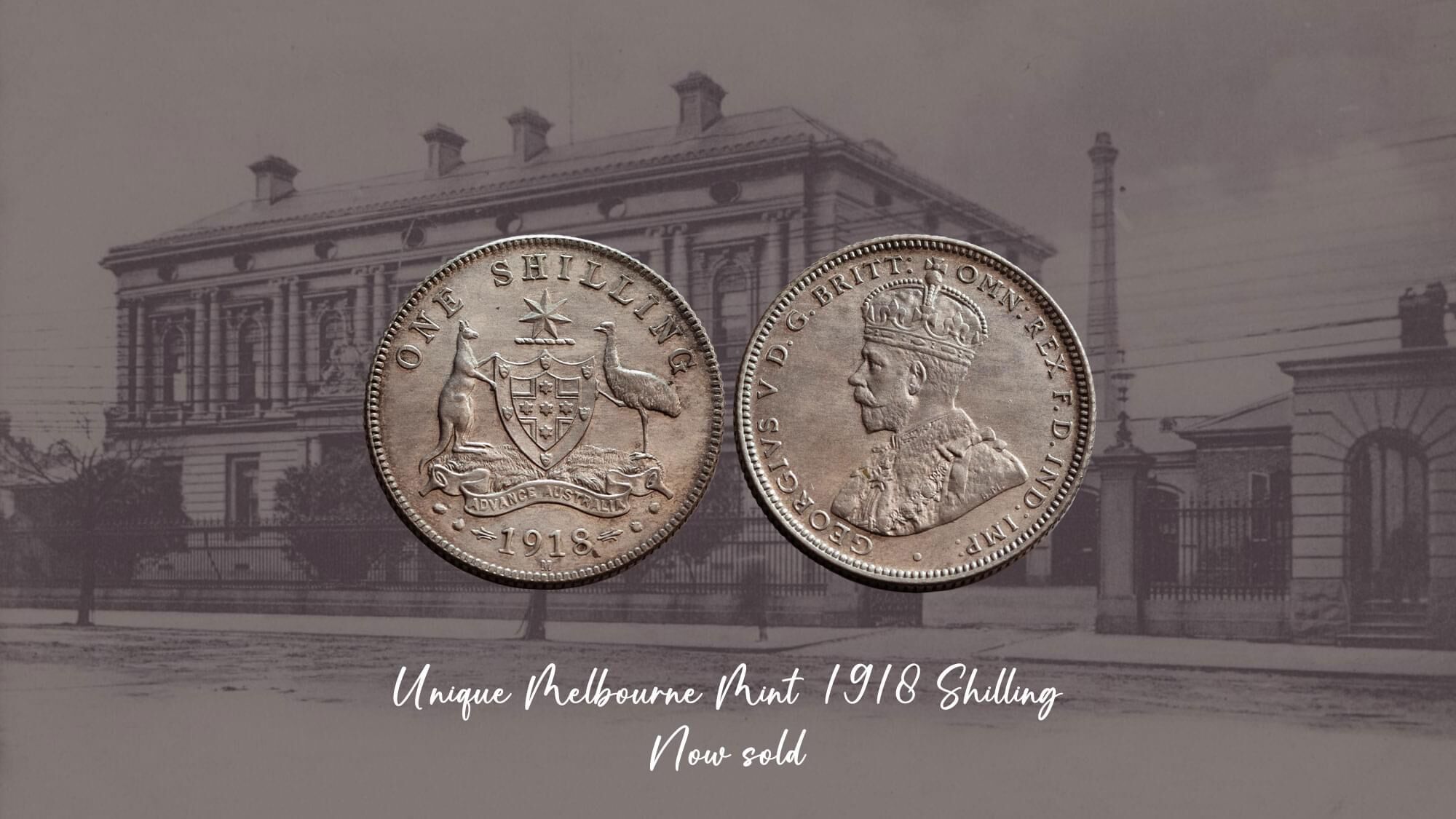
The period 1918 to 1921 produced three of Australia's greatest coin rarities, the 1918 Trial Shilling (this coin), the 1919 Trial Shilling and the 1920 Star Florin. The price of silver was fluctuating wildly at the time and, despite being a silver producing nation, Australia was rocked by the price rise and forced to reassess the silver content of its currency. The Melbourne Mint began testing a reduced silver alloy (.500 fine and .625 fine) and the 1918 Trial Shilling was struck as a consequence. While three examples of the 1920 Star Florin are available to collectors and two of the 1919 Trial Shilling, this is the only example available to collectors of the 1918 Trial Shilling. Its first recorded owner, Mr A M Le Souef, a former Deputy Master of the Melbourne branch of the Royal Mint London. The coin was considered so important that when a second example came to light in 1991, and was offered at Spink Auctions Australia, it was acquired by the Museum of Victoria for their collection, where it is still held.
The 1918 Trial Shilling is a product of a period of serious financial and economic turbulence that saw nations around the world abandon sterling silver as their currency standard.
The fluctuations particularly affected governments like Australia that were still producing their currency in .925 sterling silver. The possibility that the intrinsic value of a coin would exceed its face value was a real one. The Government pondered a debasement of its coinage to lower the costs.
The Government's strategies for coping are well documented in historical records. It is also documented by way of Australia’s coinage.
The Government planned to adopt a new silver coinage alloy and in 1918 began a testing period of striking coins with a reduced silver content.
Consideration was given to a .625 alloy and one struck in .500 fine as taken up by the British during the precious metal crisis.
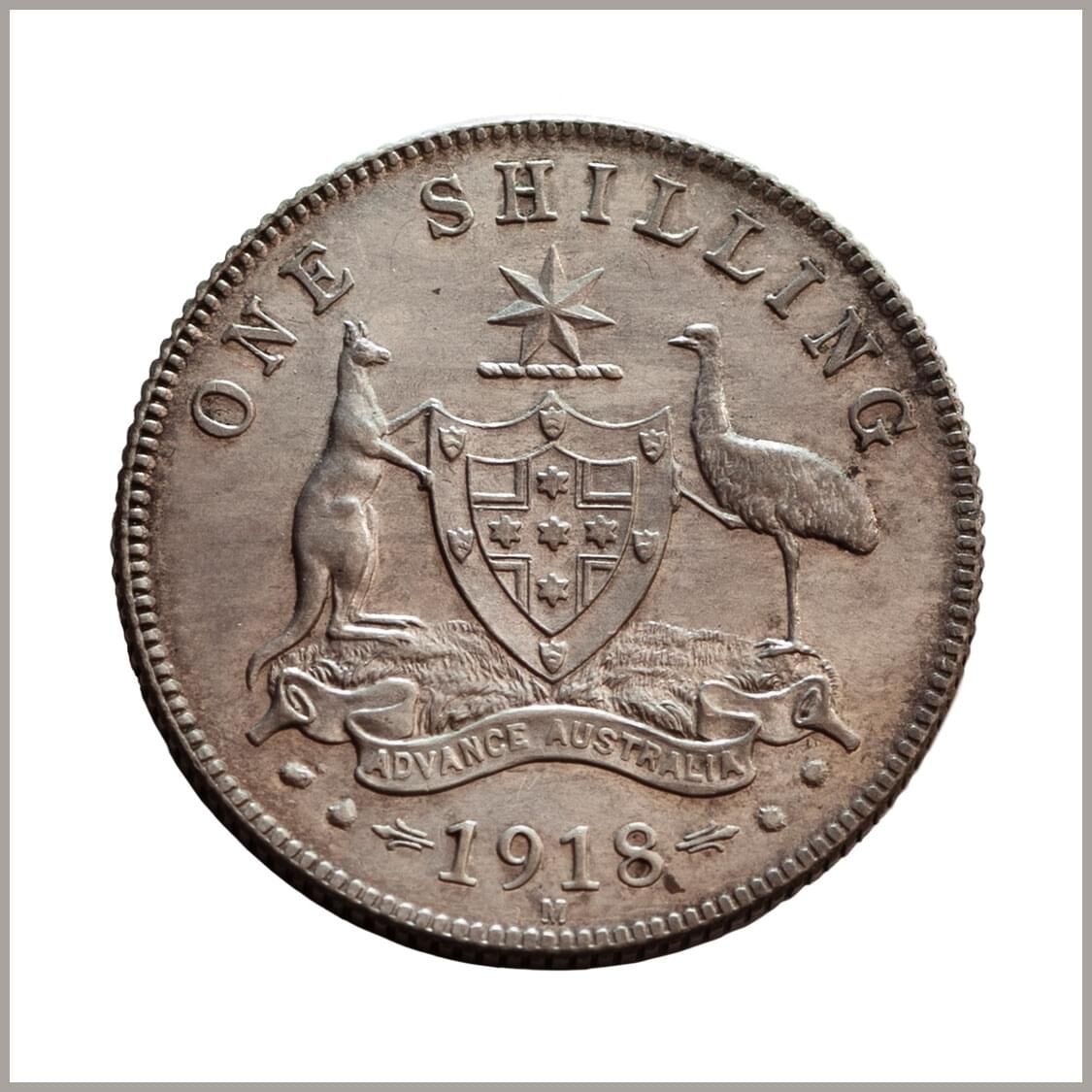
Unique 1918 Shilling, struck in .500 fine silver.
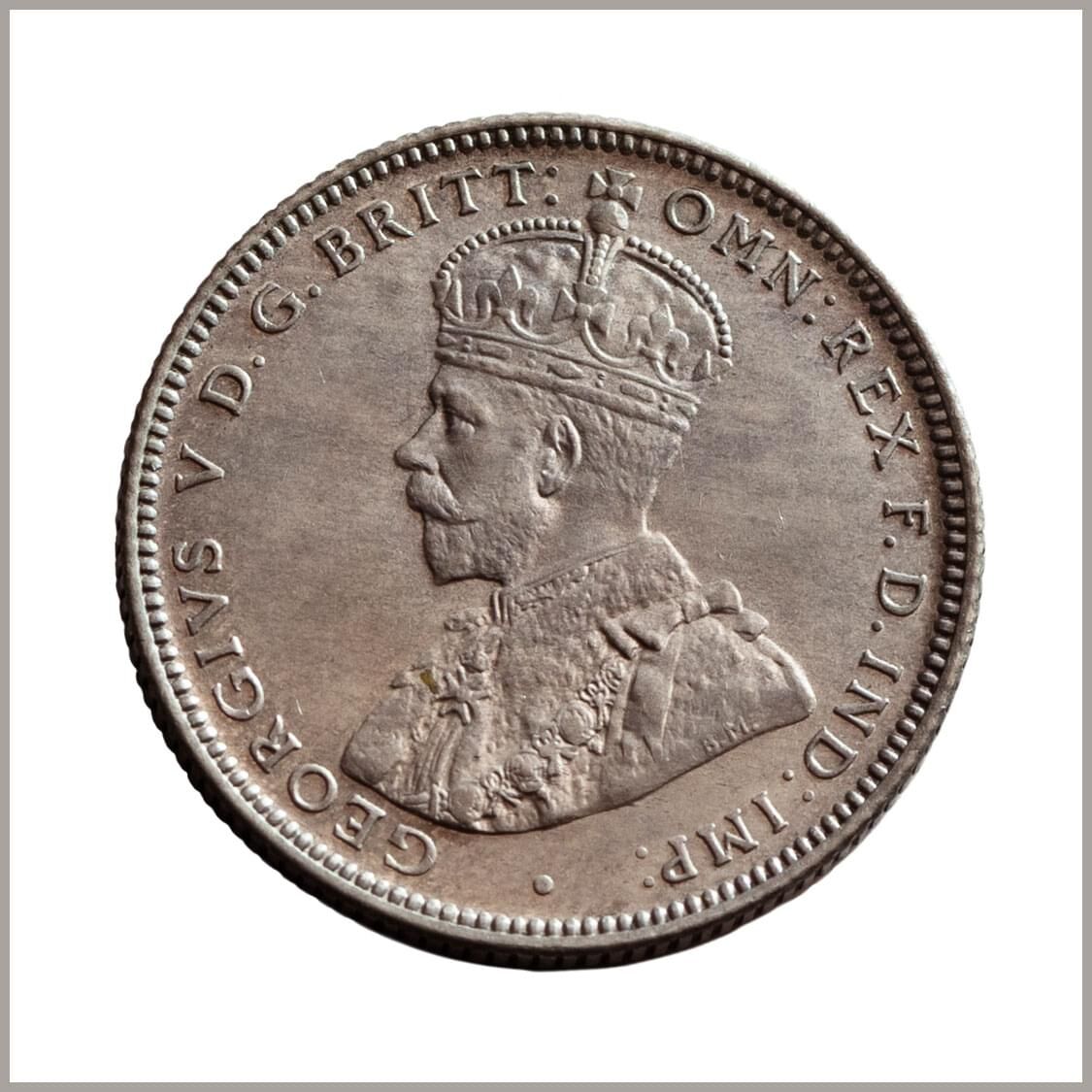
Unique 1918 Shilling, struck in .500 fine silver.
The Government planned to adopt a coinage with a reduced silver content and between 1918 and 1920 the Melbourne Mint undertook a testing program in which the following coins were produced.
The 1918 Shilling
• The testing of a reduced silver alloy commenced in 1918 with the striking of this 1918 Shilling. Struck in .500 fine from the currency dies, the reverse die was punched in the field with two irregular stops on either side of the date.
The 1919 Shilling
• Australia’s rarest Commonwealth coin was created during this testing process, the 1919 Pattern Shilling. The coin was struck in a .625 fine and counter-stamped with two ‘S’s on both sides of the obverse and reverse fields so that it would be easily distinguished and to prevent it from accidentally going into circulation.
The 1920 Star Florin & 1920 Star Shilling
• The Australian Government pursued the testing of alternative alloys into 1920. Dies were ordered, the design to include a star above the date, to reflect a coin with a reduced silver content. To test the dies, seven trial 1920 florins were minted each bearing the distinctive star (Three are held in private hands). The testing continued with the striking of seven star shillings, three of which are privately held.
While the Government dithered about the impending debasement of its coinage, the years passed and precious metal prices settled. There is no doubt that Australia weathered the storm concerning the silver crisis of 1920.
The nation, however, was not so fortunate in 1945 and 1946 when the price of silver was again booming. The year 1946 heralded in a new order for Australia. The nation's florins, shillings, sixpence and threepences were issued in a reduced silver quarternary alloy.
Unique 1918 Shilling, struck in .500 fine silver from the currency dies, the reverse die was punched in the field with two irregular stops on either side of the date.
$50,000
Unique 1918 Shilling, struck in .500 fine silver from the currency dies, the reverse die was punched in the field with two irregular stops on either side of the date.
$50,000
© Copyright: Coinworks