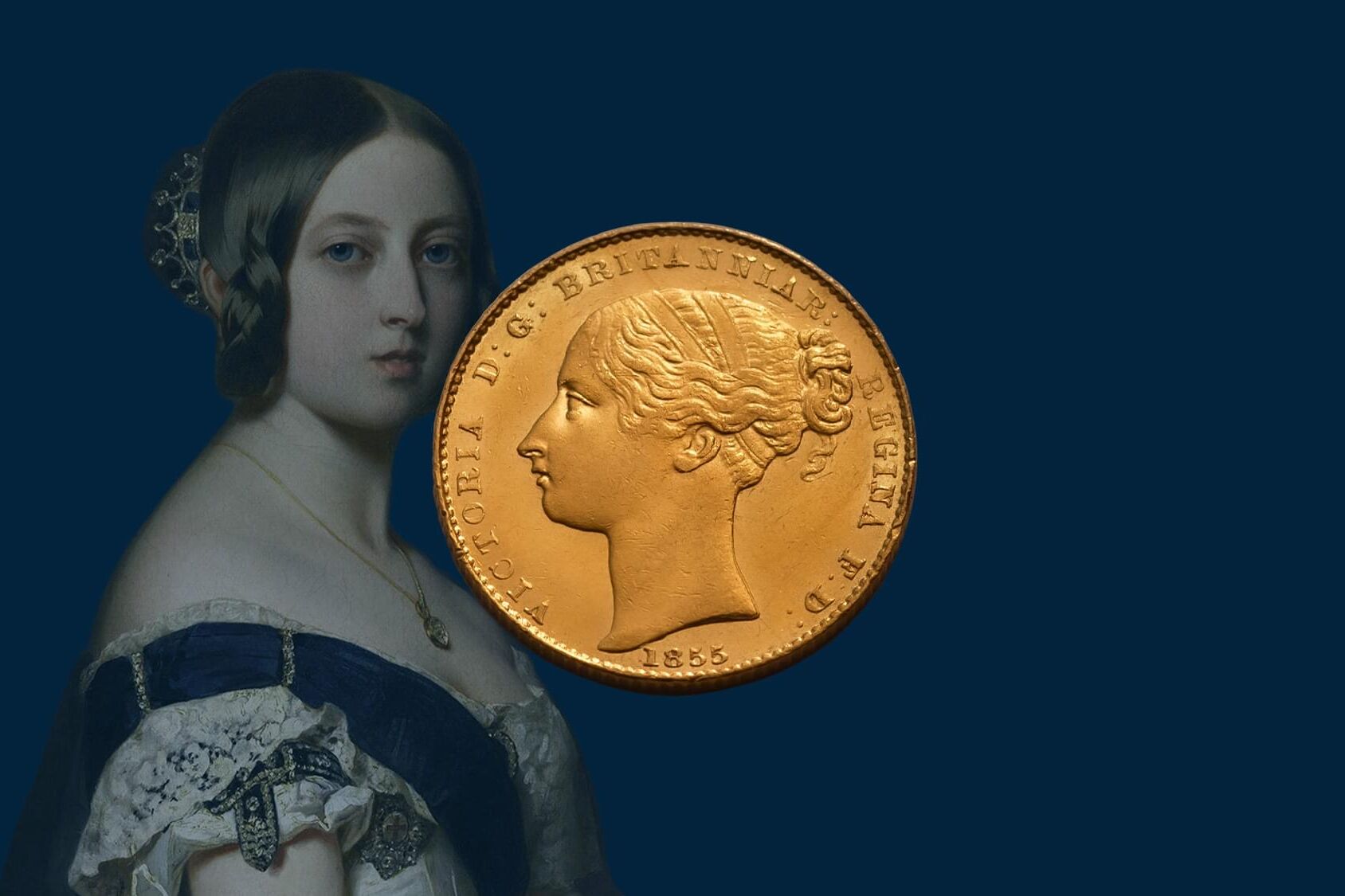
The 1855 Sydney Mint Sovereign and 1855 Sydney Mint Half Sovereign. Australia's first official gold coinage and the first coins of the realm minted at an overseas branch of the Royal Mint London.
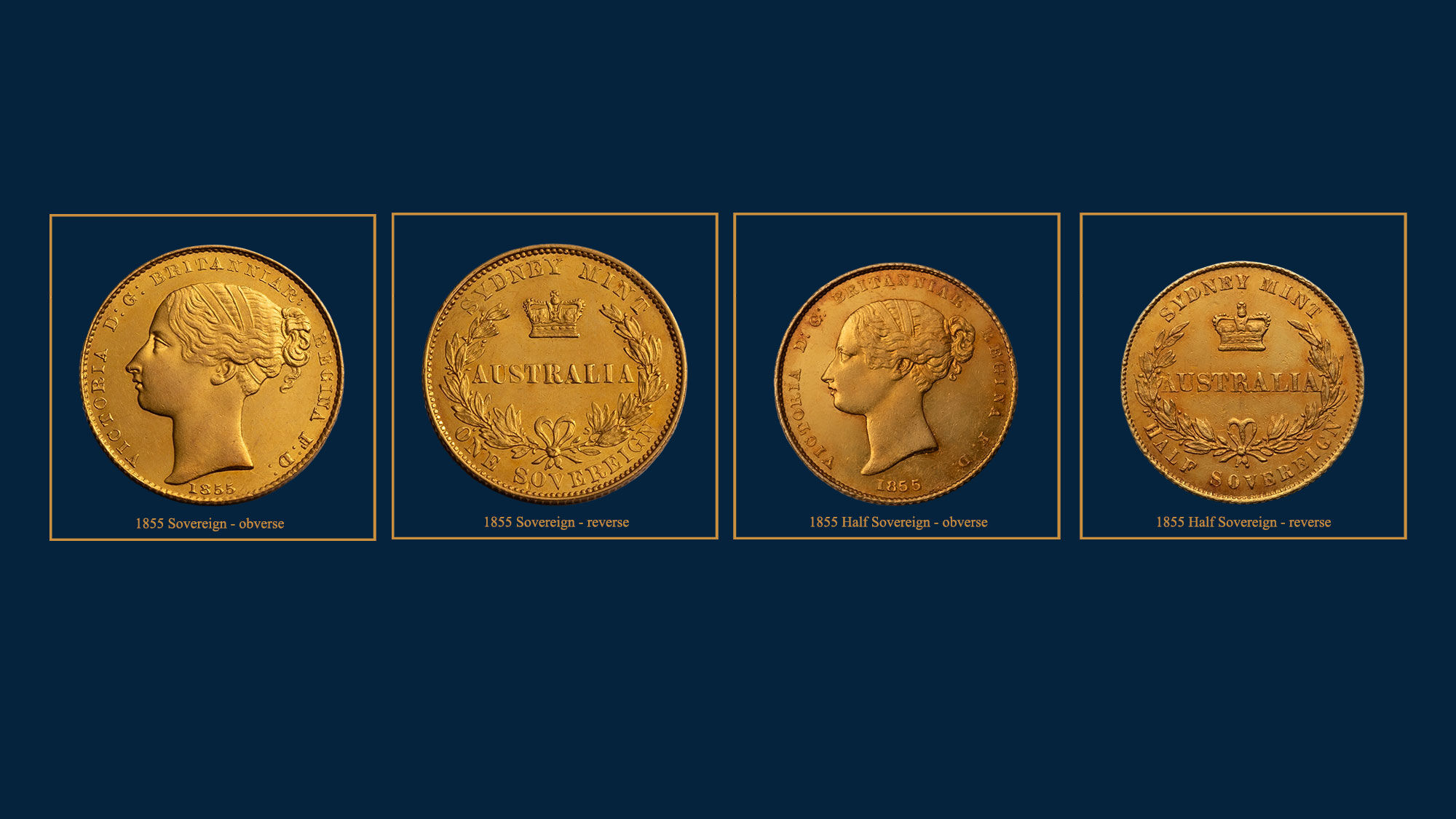
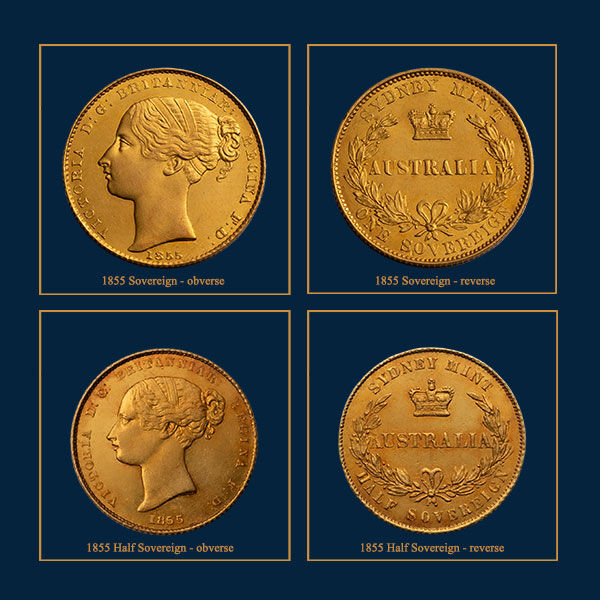
The pathway to an official Australian gold coinage spanned four years, commencing in 1851 with the discovery of gold deposits in New South Wales and Victoria. And finishing in 1855 with the opening of the nation's first mint, the Sydney Mint.
And the striking of our first royally approved gold coinage, the 1855 Sydney Mint Sovereign and 1855 Sydney Mint Half Sovereign.
The discovery of significant gold deposits in Australia in 1851 created sudden wealth and stimulated immigration on a vast scale. The Gold Rush transformed the nation, economically and socially, and marked the beginnings of a modern multi-cultural Australia.
No colony was immune from the dramatic effects of the discovery of gold. Those that were rich in gold. And those, such as the colony of South Australia, that was devoid of the precious metal, its economy collapsing due to the mass exit of manpower and currency lured to the Victorian gold fields.
While enormous potential wealth was being dug out of the ground, there was no immediacy in transforming the gold into currency. Coined money was scarce and the colonial governments had no authority to strike currency. That meant gold had to be shipped to London to convert into sovereigns, involving substantial shipping costs and a round-trip time of about six to eight months. The banks monopolised gold buying on the fields, forcing artificially low prices on the diggers who were powerless to achieve the higher London price. Transport from the fields was dangerous and expensive.
There was unanimous agreement amongst the five colonies, Victoria, Western Australia, Tasmania, South Australia and New South Wales, that a gold coinage had to be locally produced.
Also agreed that the six month turnaround of shipping gold off to London and receiving sovereigns in exchange was unworkable. A more immediate medium of exchange was required to transact commerce.
As each colony was under different pressures however, they failed to agree on the form the exchange medium should take. And to its urgency.
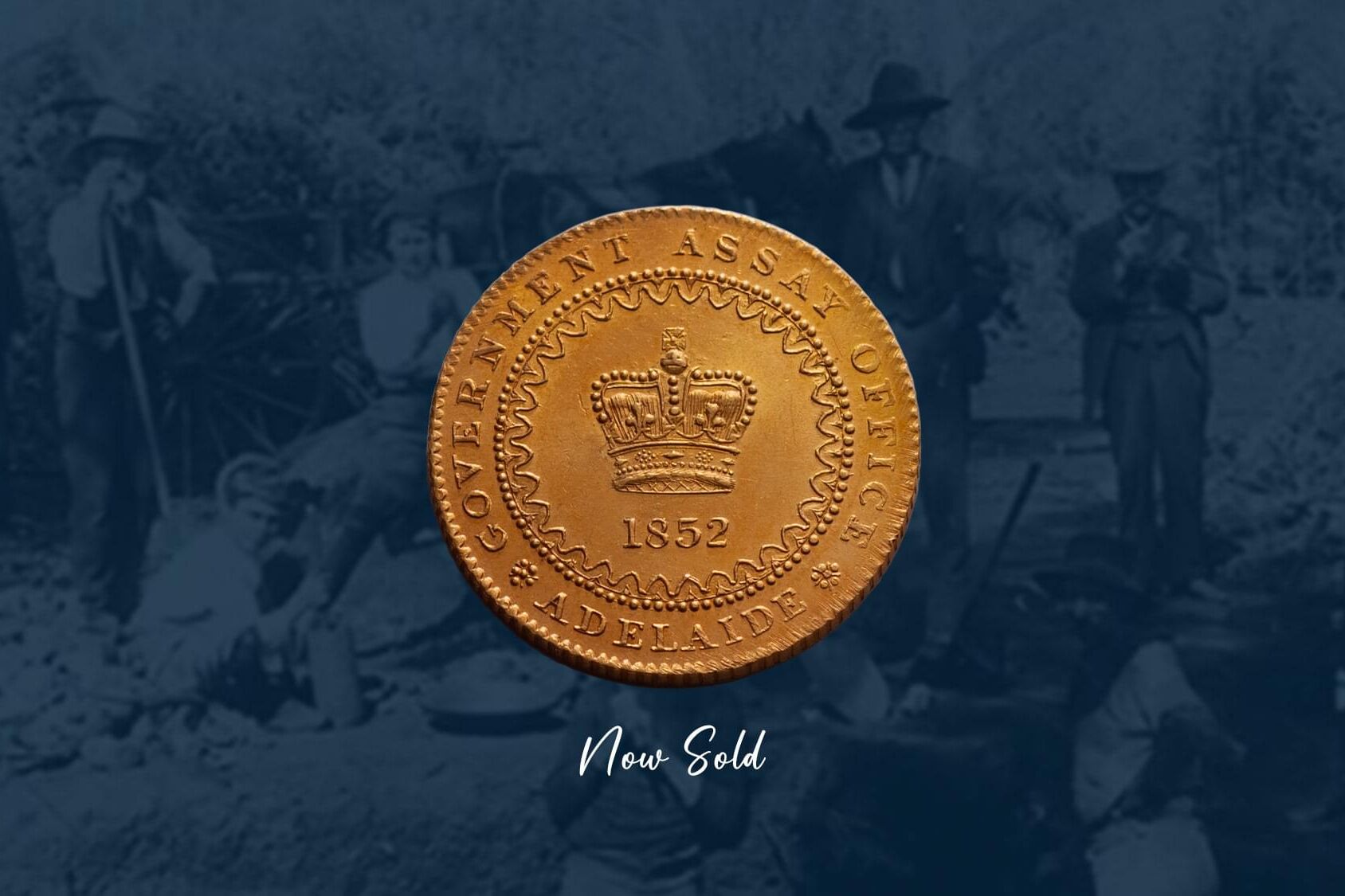
In 1851, the New South Wales legislature debated the establishment of an Assay Office and a Mint, the final decision to follow protocols and request Royal approval for a Mint. In 1852, both the colonial Governments of South Australia, under Governor Henry Young, and that of Victoria, under Charles La Trobe, considered the establishment of an Assay Office, the former eventually pursuing the idea and producing the world famous Adelaide Pound.
In 1853, the British Government approved the opening of a branch mint of the Royal Mint London in Sydney. Approval was granted on the basis that the nation's first mint, the Sydney Mint, would be self sufficient and paid for by the colony. And that its sole purpose was to coin gold. Another two years passed before it was opened.
In its first year of opening, the Sydney Mint struck a modest 502,000 Sovereigns and an even more modest 21,000 Half Sovereigns in 1855. In the second year, sovereign and half sovereign production rose to 981,000 and 478,000 respectively.
Sovereign mintages were cranked up thereafter. In its first ten years of operation, Sydney Mint annual sovereign production averaged 1.45 million coins. Correspondingly, Sydney Mint Half Sovereign mintages remained modest, averaging 285,000 coins.
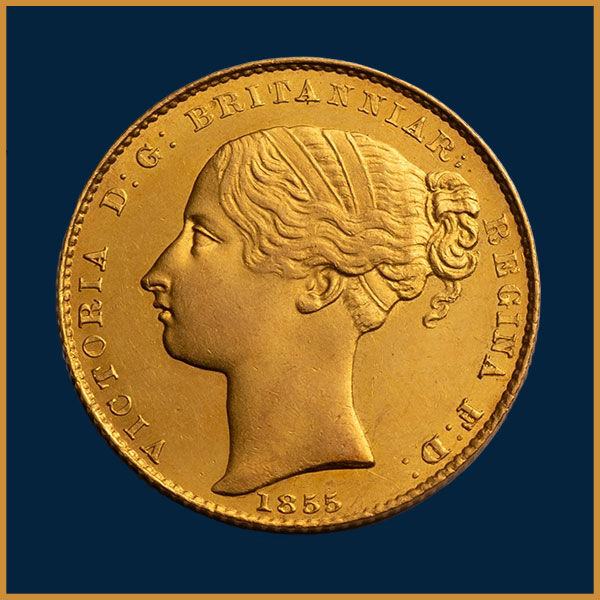
1855 Sovereign
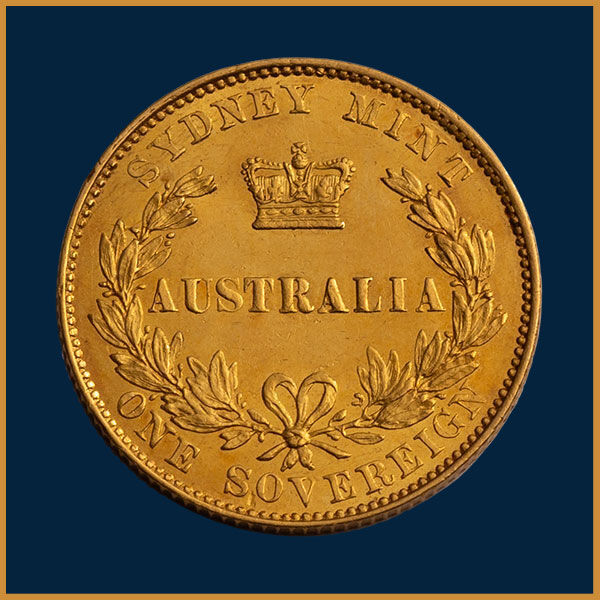
1855 Sovereign
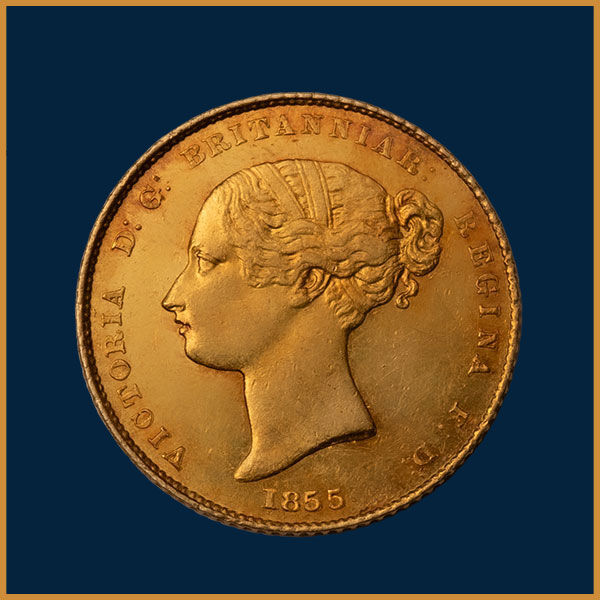
1855 Half Sovereign
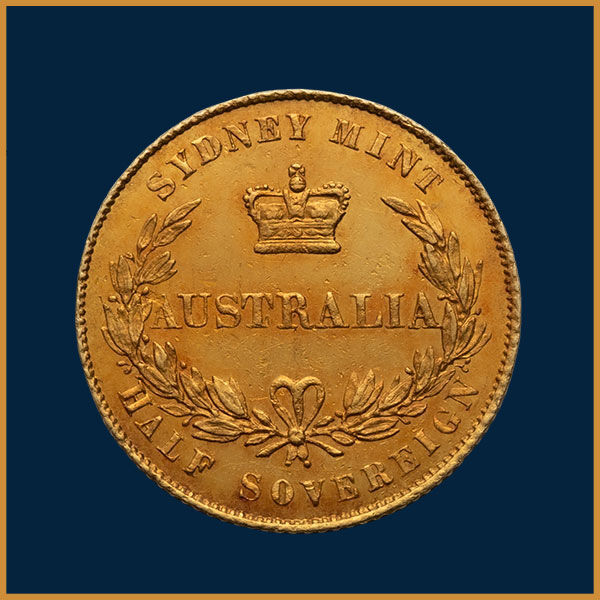
1855 Half Sovereign
Points to consider when acquiring an 1855 Sovereign
Every circulated coin has a grading level at which serious rarity kicks in. That is the point at which the balance between acquiring a coin as a collectible - and as an investment - shifts more towards the latter.
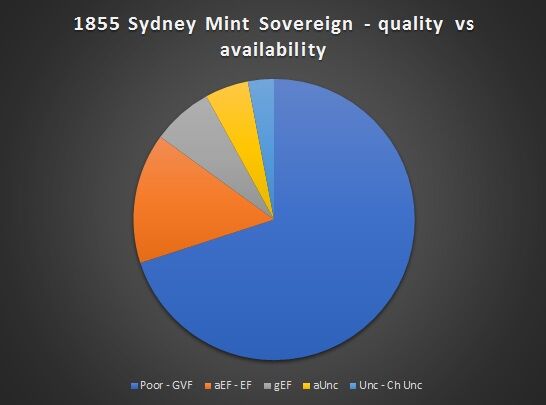
For the 1855 Sydney Mint Sovereign the level at which extreme rarity cuts in is ‘About Extremely Fine’.
At Very Good, the 1855 sovereign is virtually denuded of design. At Fine, the design is recognisable but most of the significant design elements have been worn away. At Good Very Fine, there are signs of wear and the high points are flattened. In a quality range of Very Good to Very Fine and even up to Good Very Fine, the 1855 Sydney Mint Sovereign is reasonably readily available. Refer the blue section of the pie chart.
A buyer could realistically expect to see several well circulated examples offered annually with prices ranging from $2000 to $10,000.
It’s at the quality level of About Extremely fine, through to Uncirculated and Brilliant Uncirculated that the going really gets tough for sovereign collectors and that prices escalate.
Our respect for the 1855 Sydney Mint Sovereign is well documented. It is the nation’s first official gold coin and in the upper quality levels is extremely rare. A rarity that far outweighs demand.
Points to consider when acquiring an 1855 Half Sovereign
As a company that specialises in high quality Australian rarities, the 1855 Sydney Mint Half Sovereign has always presented us with a massive dilemma. Simply because we value a coin's eye appeal very highly. And most 1855 Half Sovereigns come well worn. We acknowledge that the 1855 Sydney Mint Half Sovereign is significant. It is the nation's first half sovereign struck at the nation's first mint, the Sydney Mint. The mintage was a sparse 21,000 making it Australia's rarest circulating coin. (Compare that to the mintage of the 1855 Sovereign of 501,000.)
We also acknowledge its extreme rarity. Perhaps forty examples are available to collectors. And its a coin that has international appeal. It is the quality of the 1855 Half Sovereign that we find confronting. The majority of examples are found today well worn and virtually denuded of detail. Many are damaged with scratches, spade or metal detector marks. We note that a number have been holed.
It is obvious if you have a look at the descriptions that most 1855 Sydney Mint Half Sovereigns are (sadly) defined by their defects. And yet each and everyone of them is rare. And each of them is highly valued. Even examples denuded of detail would probably command somewhere in the range of $6000 to $10,000.
The scarcity and the extensive use, of the 1855 Half Sovereign was evidenced at the Reserve Bank of Australia (R.B.A.) Auction in 2005 when the bank liquidated its holding of gold coins that had been accumulated between 1929 and 1976. Over a 47-year time frame, the R.B.A. had only accumulated seven 1855 Sydney Mint Half Sovereigns, all of which were well circulated, many of them damaged. Only one out of the seven showed any design detail graded at about Fine, with the remaining coins even further down the scale, virtually denuded of any significant des
The highest quality 1855 Sydney Mint Half Sovereign is graded 'About Uncirculated'. The first recorded owner of this coin was London collector, A. H. F Baldwin reflecting the international appeal of the 1855 Half Sovereign. It was later sold to Canadian Bill Barrett. A further exchange of hands saw the coin come back to Australia via Barrie Winsor to Queensland collector Tom Hadley of Quartermaster fame. The coin was acquired by Coinworks and sold in 2024 for $275,000.
The second finest known 1855 Half Sovereign is graded Extremely Fine. Acquired from Barrie Winsor, the coin was sold by Coinworks in 2018. Alongside the Quartermaster example, the most famous 1855 Sydney Mint Half Sovereign is that formerly owned by veteran collector Roy Brook. The coin has a quality level of Good Very Fine. The Brook Half Sovereign was first offered in Australia in 1976 and sold for $10,000. Twelve years later during Spink Auctions famous Bicentennial Auction (July 1988) it was re-offered and sold for $17,300. Its final appearance at auction was in 1995 when it sold for $45,100. Coinworks acquired the coin privately in 2003 and sold it for $97,500.
A high quality 1855 Sydney Mint Half Sovereign is, in our view, the ultimate prize.
History of the Sydney Mint
In 1851, the Sydney Morning Herald published an editorial championing the establishment of a branch of the Royal Mint in Sydney to buy gold at full price and strike it into sovereigns and half sovereigns.
The plan for a branch of the Royal Mint received great support from the diggers. Solid opposition came from the banks and a prominent group of private individuals both of whom had become major buyers of gold on the fields at prices discounted well below the full London price. Profits were at stake! Both factions had earlier joined forces to quash a proposal for a Sydney Assay Office that would have also impacted negatively on their commercial interests.
While it is true that New South Wales had in 1851 formally petitioned the home office in London for a branch of the Royal Mint, the decision had already been made in the British Parliament to give the colonies greater autonomy and establish a branch mint to allow them to strike coins of the realm, the sovereign.
The Sydney Mint would strike sovereigns and half sovereigns to exactly the weight and fineness levels at the Royal Mint but they would have their own design. This was to protect the international reputation of the imperial gold coins in the event that Sydney was unable to meet the exacting standards demanded of the coin.
On the 19 August 1853 Queen Victoria gave formal approval to establish Australia’s very first mint at or near Sydney in New South Wales. In the same year, the Royal Mint London prepared designs of Australia’s first gold coinage and manufactured the dies.
The sovereign and half sovereign obverse design was a filleted bust of Victoria, only slightly different to that used on British sovereigns. The obverse quickly fell out of favour and James Wyon was ordered to engrave a new obverse that would be uniquely Australian to easily distinguish the colonial sovereigns from their British counterparts. To this end, a new portrait was introduced in 1857 that featured Queen Victoria with a banksia wreath in her hair instead of the band.
The reverse design was based loosely around contemporary reverse designs of the British sixpence and shilling. Its strong point of difference to the British sovereigns was the inclusion of the words 'Australia' and 'Sydney Mint'.
The use of the word Australia, a fascination with historians. At the time the nation was operating as separate colonies. Australia did not operate under a single Government until Federation in 1901.
The first Deputy Master of the Sydney Mint was Captain Edward Wolstenholme Ward, a trained member of the Royal Engineers.
Ward arrived in the colony in October 1854 on the ship Calcutta, along with other members of the Royal Engineers, a sergeant, three corporals and twelve privates. The group was deposited on Circular Quay with the bales and boxes of Sydney's new mint, along with the dies.
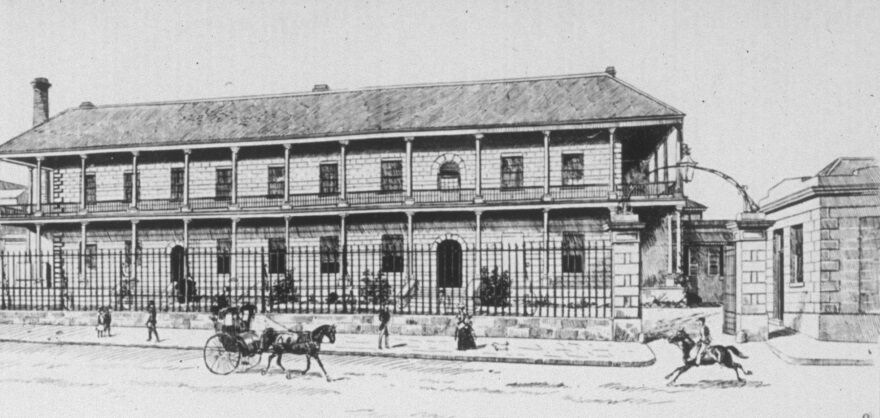
The Sydney Mint was established in a wing of the 'Rum Hospital' in Macquarie Street, Sydney. The mint began receiving gold on 14 May 1855 and issued its first gold sovereign soon after on June 23.
In their infancy the Sydney Mint sovereigns and half sovereigns were legal tender only in the colony of New South Wales.
In January 1856, the British tested the quality of the colonial gold coins and the results showed that they had a higher intrinsic value than their British counterparts, primarily due to their 8.33% silver content. Once these facts became known, profiteers began melting them down.
The colonial gold coins became legal tender in Tasmania and Western Australia in 1856. South Australia and Victoria were reticent to enshrine the Sydney Mint as Australia's official mint as each colony had independently requested their own and were miffed at missing out.
By 1857, the legal tender scope was widened to include all Australian colonies and Mauritius, Ceylon and Hong Kong. In 1868 the Sydney Mint Sovereigns and Half Sovereigns became legal tender throughout the British Empire.
The design of the Sydney Mint Sovereign lasted until 1870 and the Half Sovereign until 1866. It was the very last time the word Australia appeared on our gold sovereigns. From 1871, Australia's sovereigns and half sovereigns took on a traditional British design.
Shop Coinworks
© Copyright: Coinworks