Proof Gold Sovereigns and Half Sovereigns of the Sydney Mint (1853 - 1926)
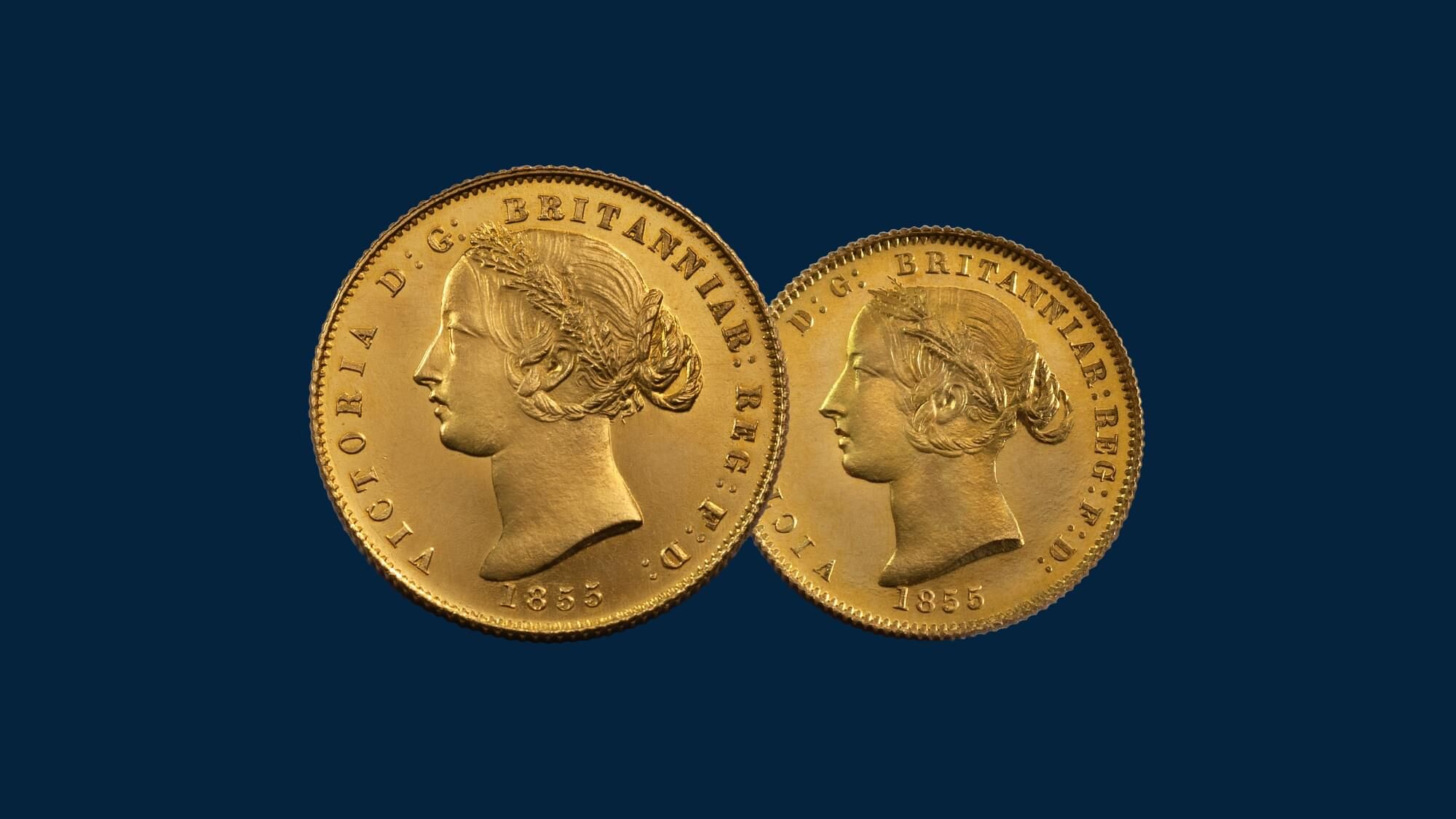
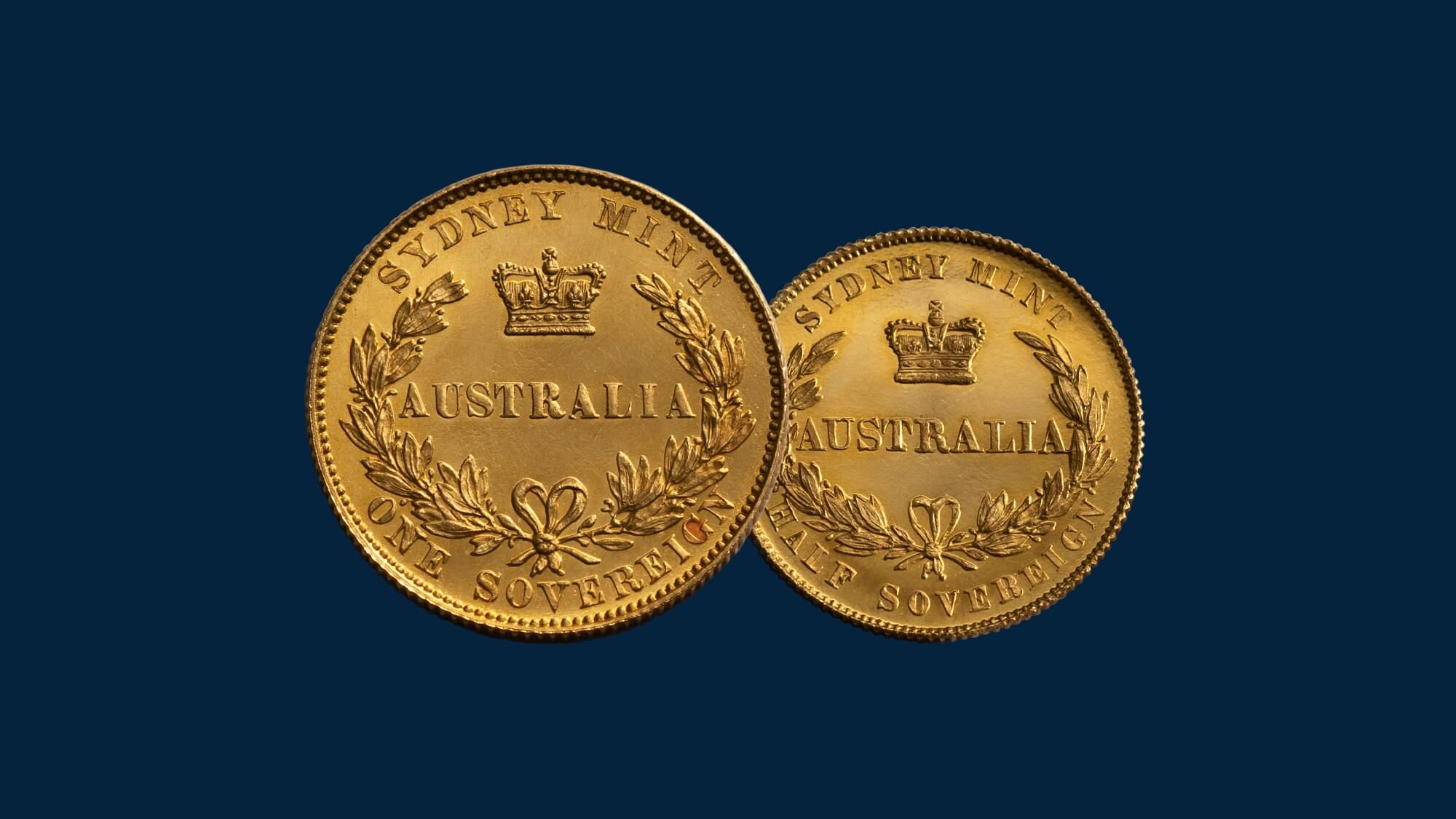
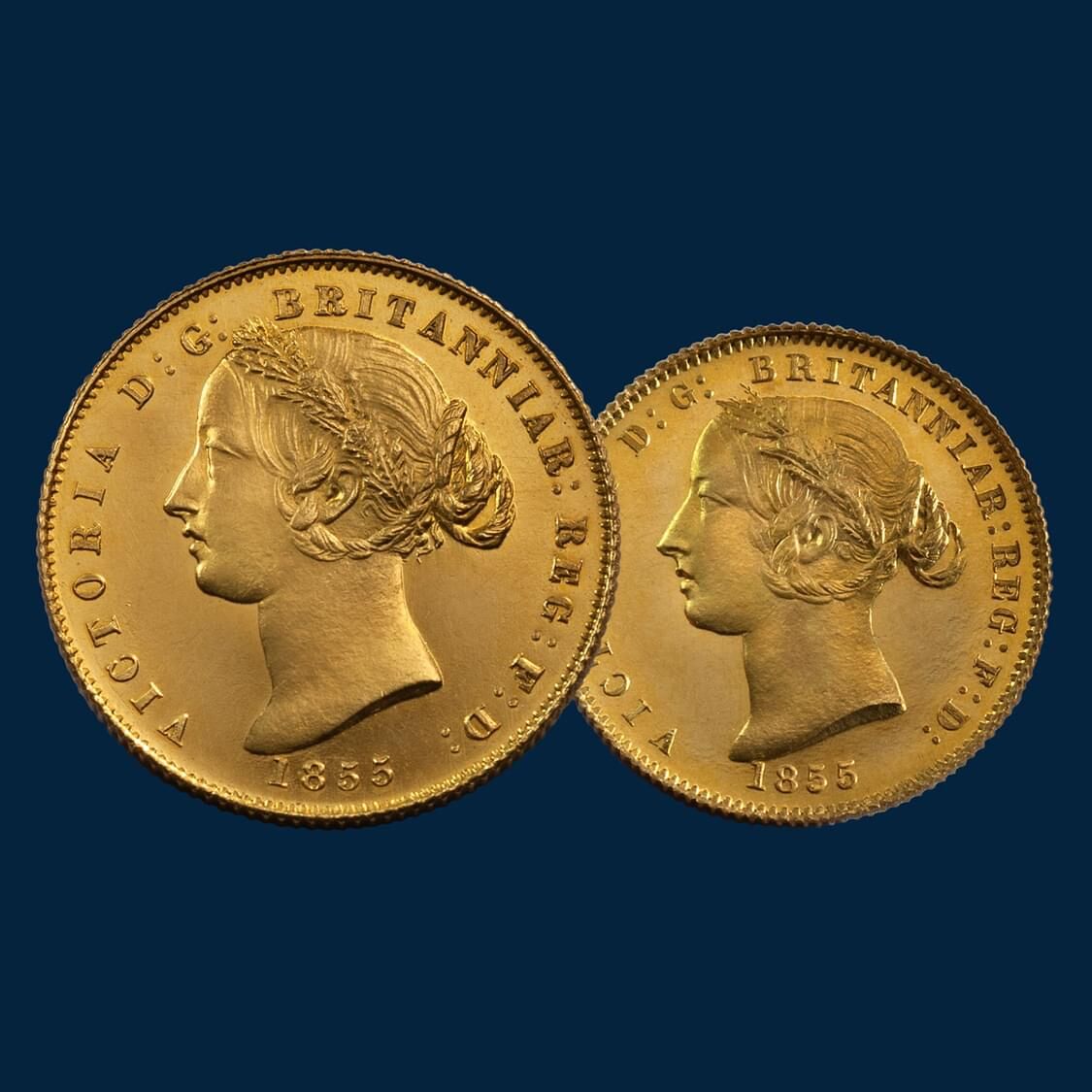
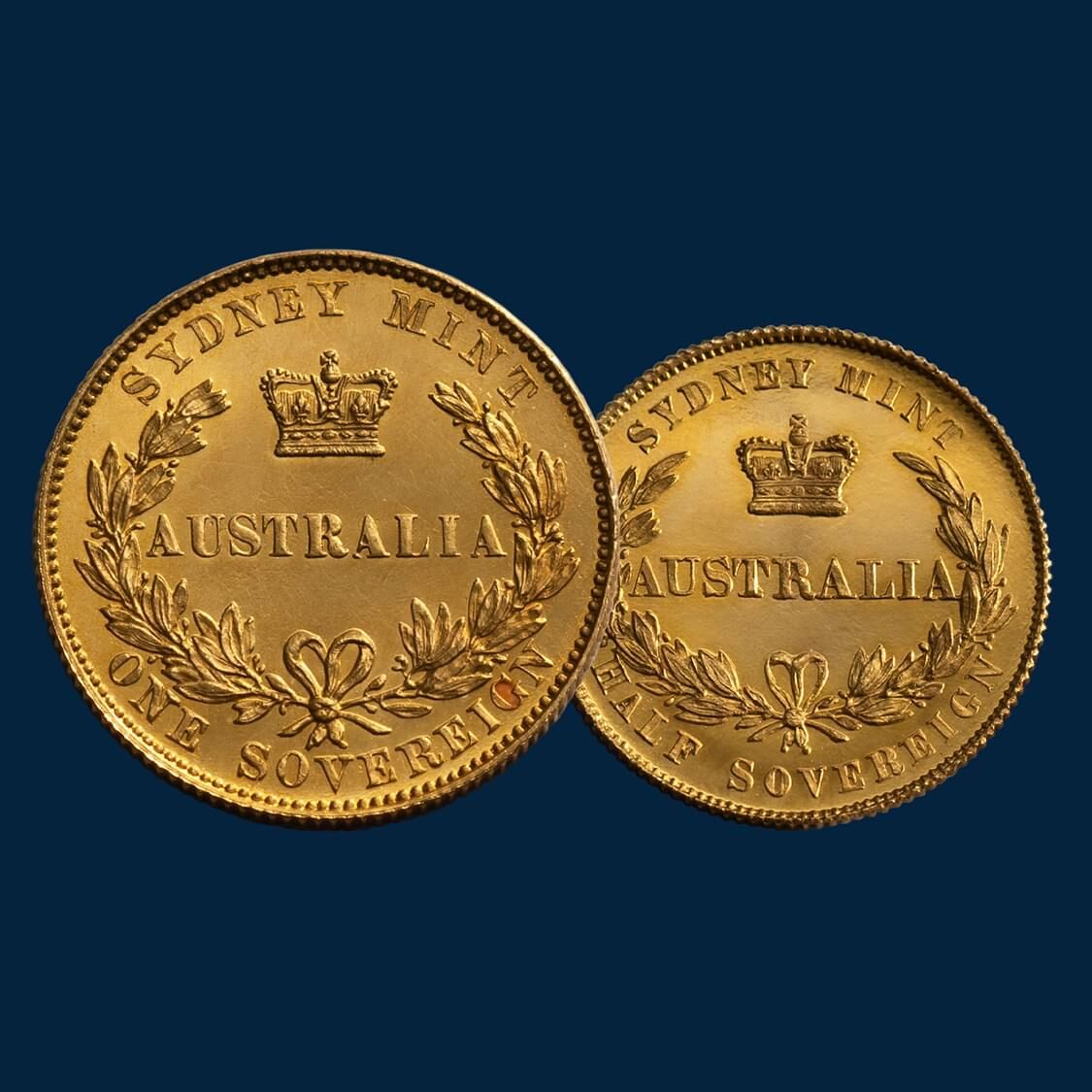
The Sydney Mint was the nation's first gold coin producer. During its lifetime, the mint processed more than 1200 tons of native gold, converting it into currency. In addition to producing circulating coins, the Sydney Mint was occasionally called upon to create special presentation pieces. The coins are technically referred to as 'Coins of Record' and were, in the main, struck to a proof finish.
A Coin of Record would be gifted to a monarch, a dignitary or sent to an influential collector. Or put on display at an international trade fair. And if the Royal Mint London requested a sovereign for its archives, it was yet another occasion when a Coin of Record would be minted. Situations where a circulation strike would simply not suffice.
A Coin of Record is an artistic interpretation of coinage, a strikingly beautiful coin beyond ordinary currency. Individually crafted to a proof finish using special coining techniques to standards far exceeding that required of a circulating coin. Occasionally, they were minted to a specimen finish.
Whereas production of circulating coinage was dictated by Government, Coins of Record were struck at the discretion of the mint master. The coins were not produced every year and, as they were individually created, the process was time consuming and the mintages minuscule. For Sydney Mint gold proofs, generally four pieces or less. There were years when only a single coin was struck.
Coins of Record of Australia's sovereigns and half sovereigns are visually stunning, distinguished by brilliant golden-mirror surfaces. And it is their beauty and their ultra-exclusivity that drives demand.
The coins are today a globally traded commodity, confirmed again at St James Auction in New York, January 2026.
They are the crown jewels of coinage, adding glamour and exceptionality to any collection!
Overview of the Sydney Mint proof gold market
The Sydney Mint opened in 1855 as a branch of the Royal Mint London, its function to produce gold sovereigns and half sovereigns. The mint was closed on 31st December 1926 striking its last gold sovereign in that year, the irony that a mint could produce coinage for Government and yet be unprofitable.
Three monarchs reigned between 1855 and 1926, Queen Victoria, King Edward VII and George V. The Queen Victoria era was represented by five portraits on Australia's gold sovereigns and half sovereigns, Sydney Mint Type 1 (1855 - 1856), Sydney Mint Type II (1857 - 1870), Young Head (1871 - 1887), Jubilee (1887 - 1893) and Veiled Head (1893 - 1901). Only one portrait of Edward VII and George V were used by the Sydney Mint.
The table below indicates the availability to collectors of Sydney Mint Coins of Record (1853 - 1926) in today's market. The information based on historical records, auction records and physical sightings. Unless otherwise stated, the coins were struck to proof quality.
Sydney Mint design, 1853 - 1870
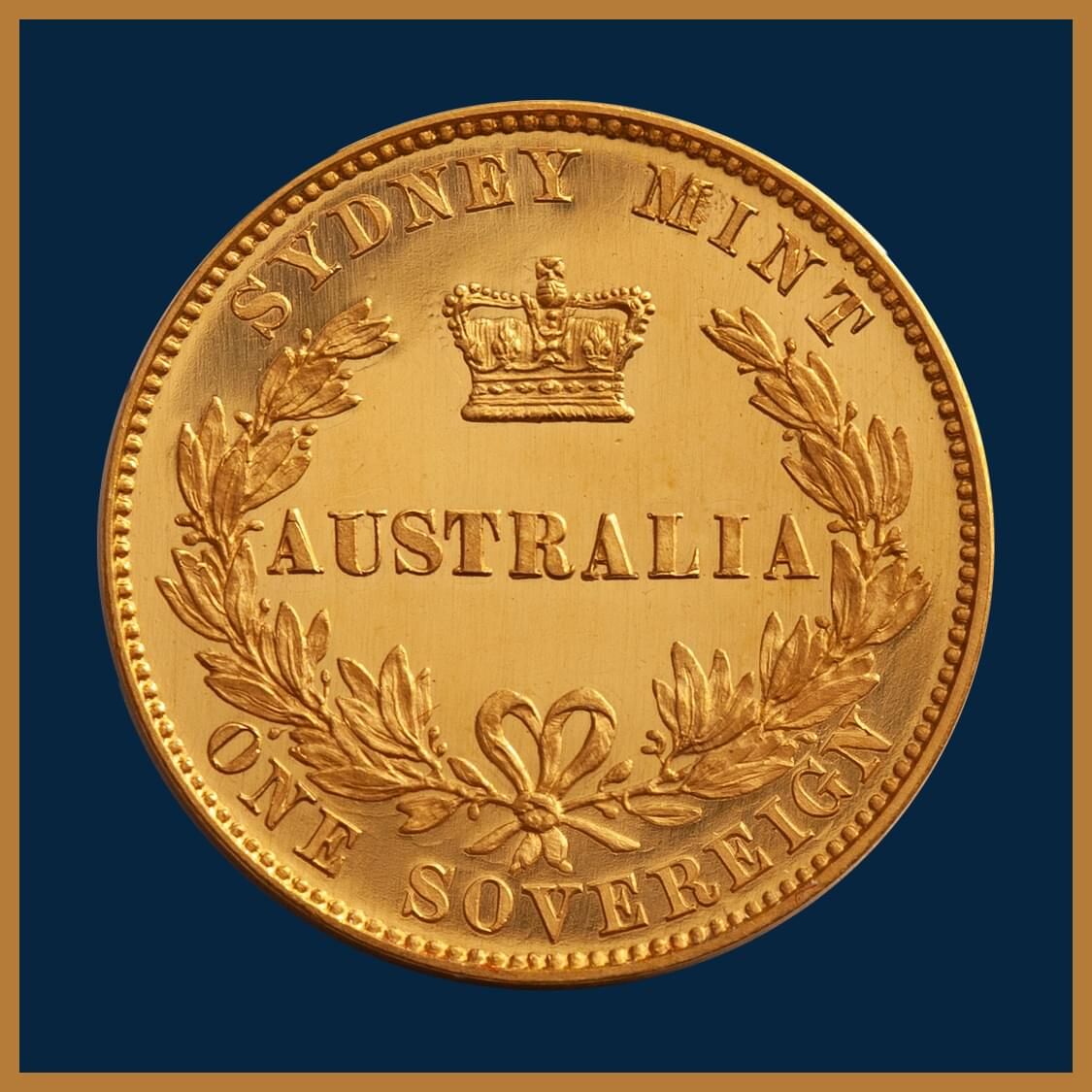
As a summary. The Sydney Mint design was the first to appear on Australia’s sovereigns. Proofs of the Sydney Mint coins were struck at the Royal Mint London dated 1853, 1855, 1856, 1857, 1866 and 1870, with one exception. In addition to the Royal Mint issues, a proof of the 1857 Sovereign was struck at the Sydney Mint, with a grained edge. The supreme highlights of the series are the 1855 Proof Sovereign and 1855 Proof Half Sovereign and the 1870 Proof Sovereign, the final year of the Sydney Mint design. And the grained edge 1857 Proof Sovereign, unique in private hands it is the only Sovereign featuring the Sydney Mint design that was actually struck at the Sydney Mint.
The Sydney Mint proofs are compelling, respected for the history they represent and sought after the world over. They are exclusive. The Proof Sovereigns are valued between $150,000 and $400,000 subject to date and quality. The Proof Half Sovereigns, $100,000 to $300,000 again, subject to date and quality.
Young Head, 1871 - 1887
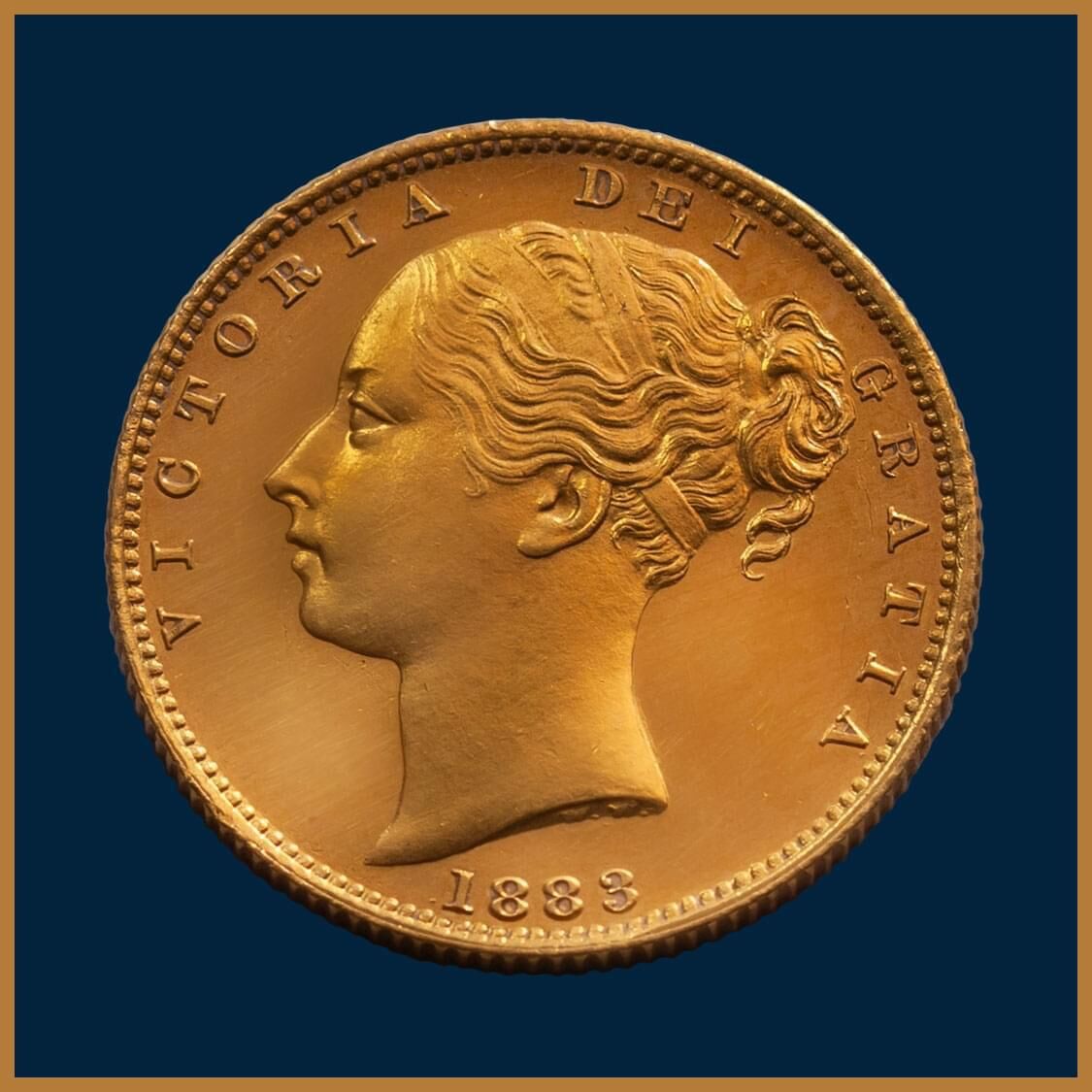
As a summary. During the Young Head era (1871 - 1887), the Sydney Mint struck proofs in only three years out of seventeen, 1871, 1880 and 1883. The 1871 pair is unique and is now in a long-term holding. The 1883 pair is also unique. The 1880 proofs are extremely rare, with three known of the sovereign (one of which is impaired) and two, perhaps three, of the half sovereign. A sovereign struck to a specimen finish in 1879 is noted.
As the first series of proofs struck in Australia, the Young Head Coins of Record are historically important. The proof sovereign and proof half sovereign range in value from $100,000 - $150,000 subject to date, quality and denomination. Impaired proofs fall below the lower dollar level.
Jubilee, 1887 - 1893
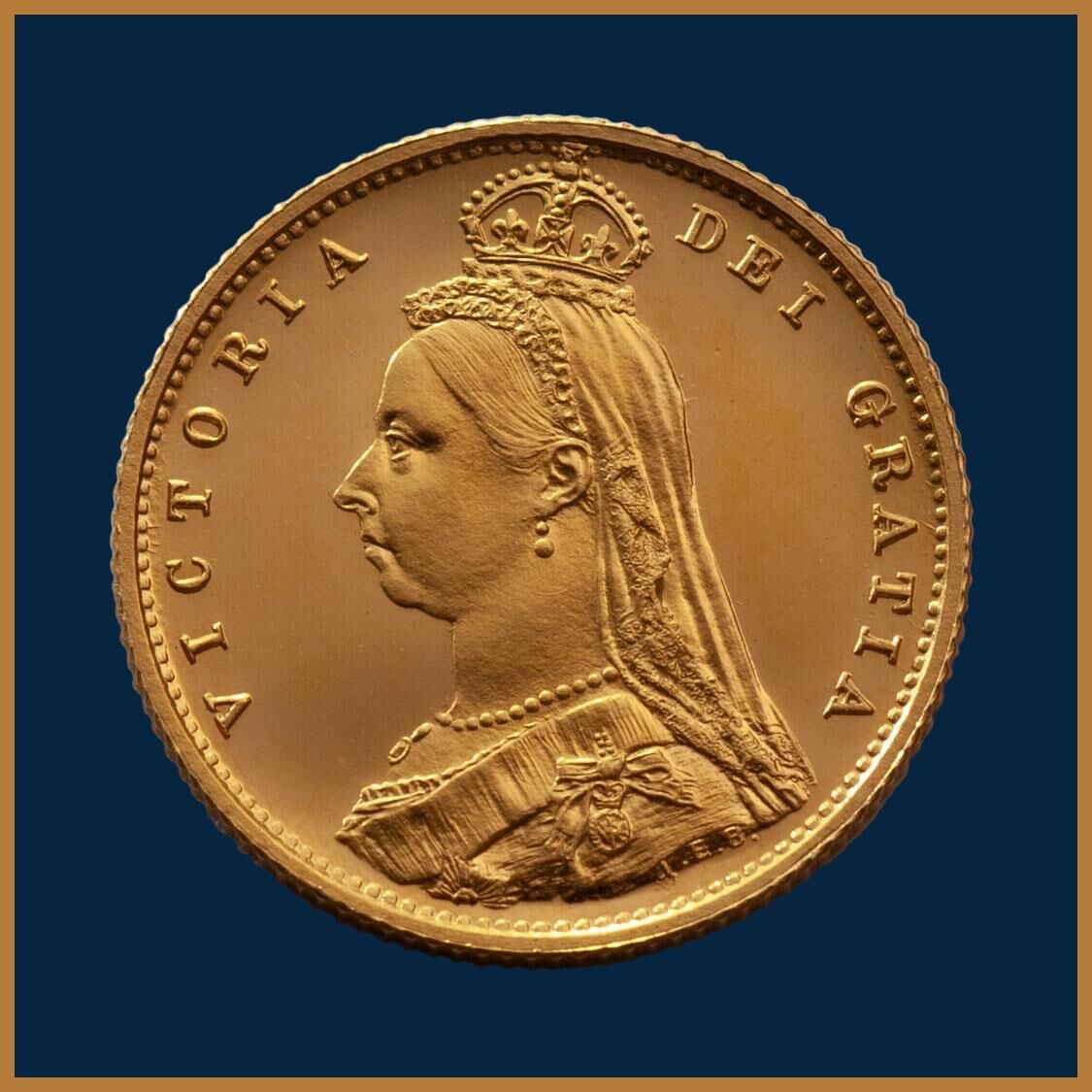
As a summary. The Jubilee era spans 1887 to 1893 and during those seven years the Sydney Mint struck proof sovereigns in two of them, 1887 and 1893. One complete four-coin 1887 Proof Set is held in Melbourne comprised of the Five Pounds, Two Pounds, Sovereign and Half Sovereign. One other 1887 Proof Sovereign and 1887 Proof Half Sovereign is known, each coin featuring a plain edge. Two of each of the grained edge 1893 Jubilee Proof Sovereign and 1893 Proof Half Sovereign are known. And one of each of the plain edge.
The Sydney Mint Jubilee Proof Sovereigns and Proof Half sovereigns range in value from $100,000 - $150,000 subject to date, quality and denomination. Mishandled proofs fall below the lower level, price-wise.
Veiled Head, 1893 - 1901
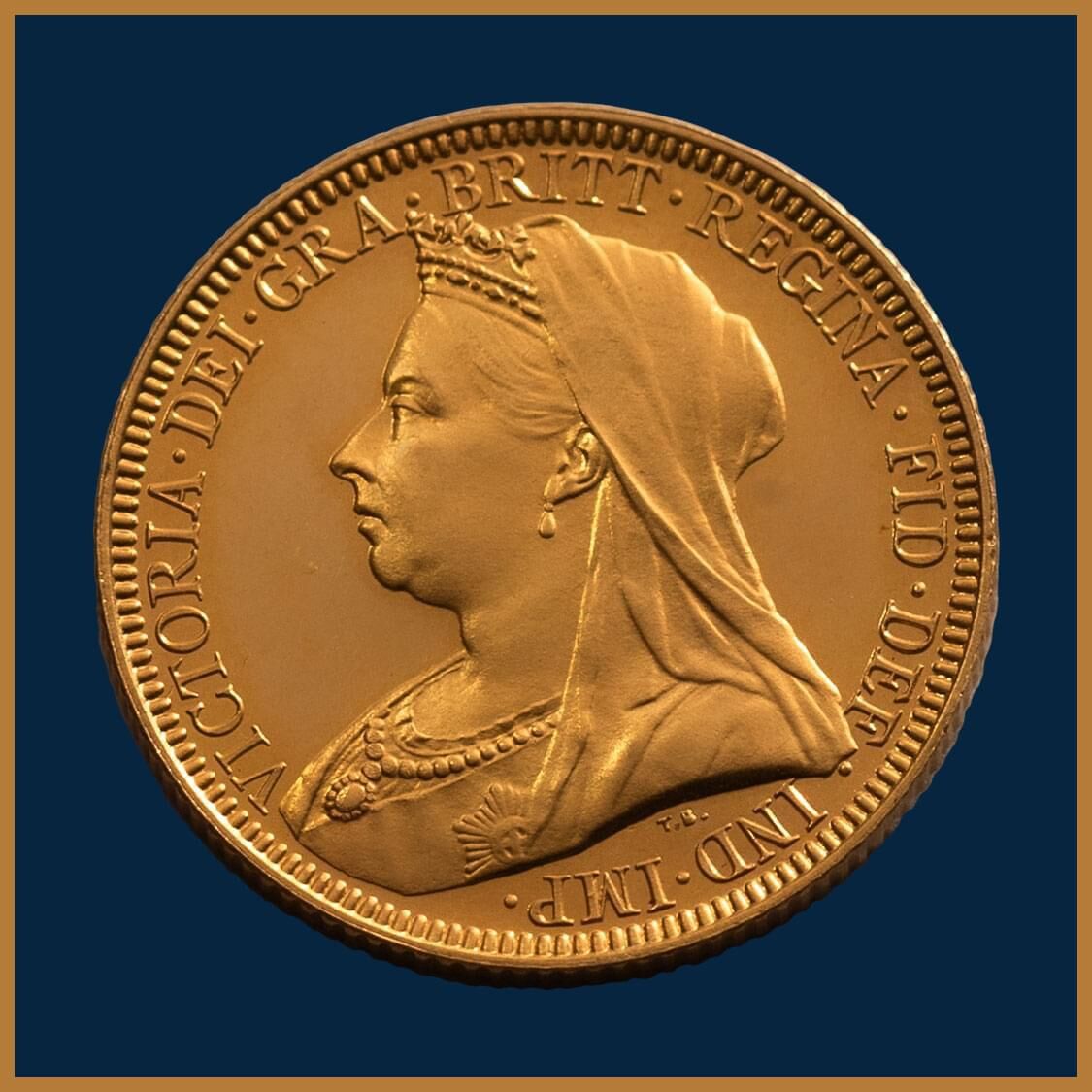
As a summary. The Sydney Mint struck proof sovereigns and half sovereigns in only 1893, the first year of the Veiled Head era (1893 - 1901). The coins were struck with grained and plain edges. Both styles are scarce with two grained edge pairs known. And one plain edge pair.
The proof sovereign and proof half sovereign range in value from $100,000 - $125,000 subject to date, quality, denomination and edge.
Edward VII, 1901 - 1910
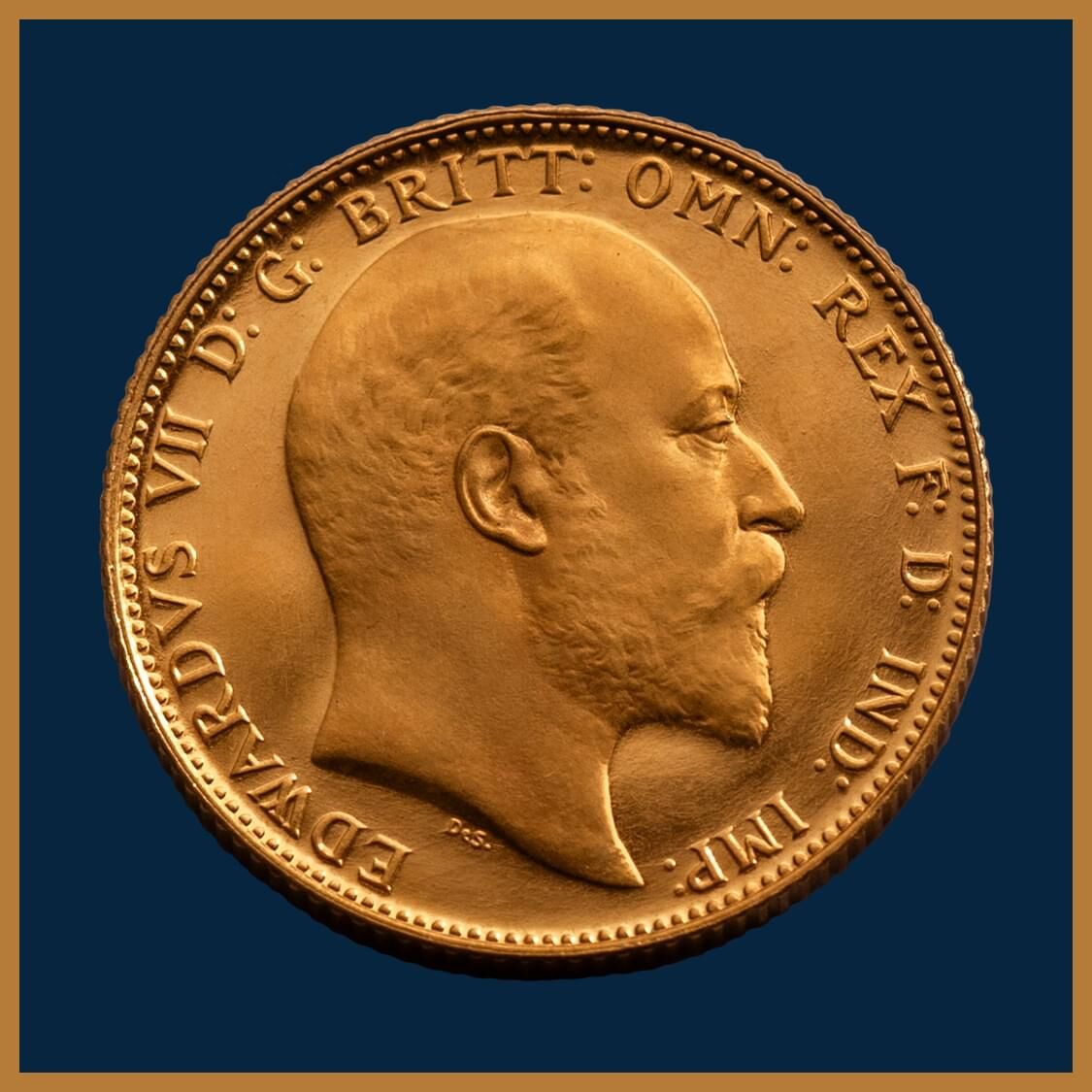
As a summary. During the Edward VII era (1901 - 1910) a matt proof sovereign and half sovereign were struck and included in a four-coin 1902 Proof Set. Two brilliant 1902 Proof Sovereigns were confirmed struck, whereabouts today unknown.
The 1902 Proof Sovereign and 1902 Proof Half Sovereign has an estimated value of $100,000 - $150,000 subject to quality and denomination.
George V, 1911 - 1926
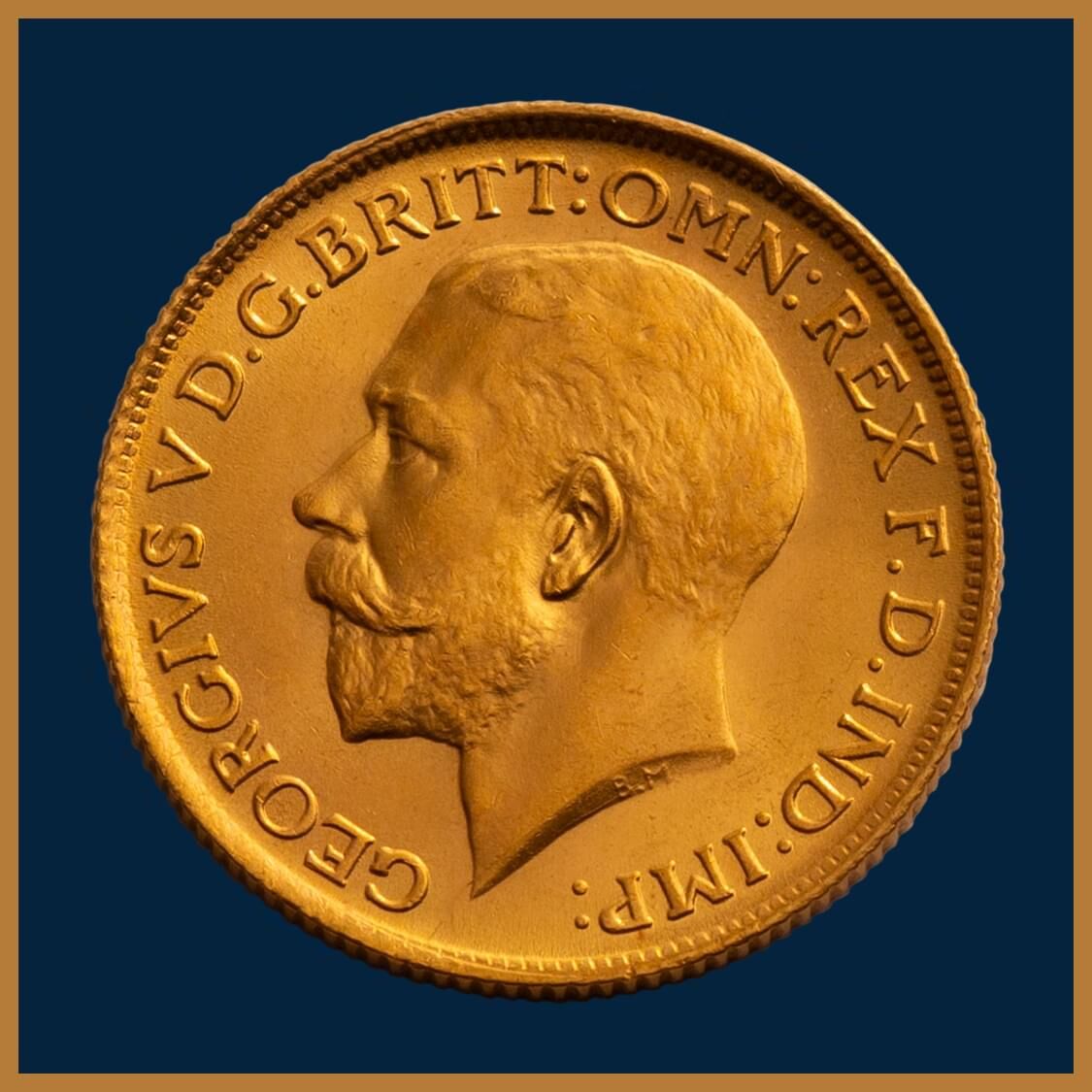
As a summary. The opening year of the George V era (1911 - 1926) is represented by a matt proof half sovereign valued at $100,000 to $150,000 (last sighted in November 1978). Coins of Record of the mint's twilight years were struck to specimen quality in the years 1920 (1), 1922 (2), 1923 and 1926.
The 1920 Sovereign is in a league of its own valued in excess of $800,000, the 1923 and 1922 $100,000 - $125,000 subject to quality. And the 1926 also $100,000 to $125,000.
Fundamentals of proof coining in the Sydney Mint era, 1853 - 1870
Royal approval was given in 1853 for the establishment of the Sydney Mint. Colonial coining operations officially began in 1855, the Royal Mint London producing the dies for Australia's first sovereign and first half sovereign.
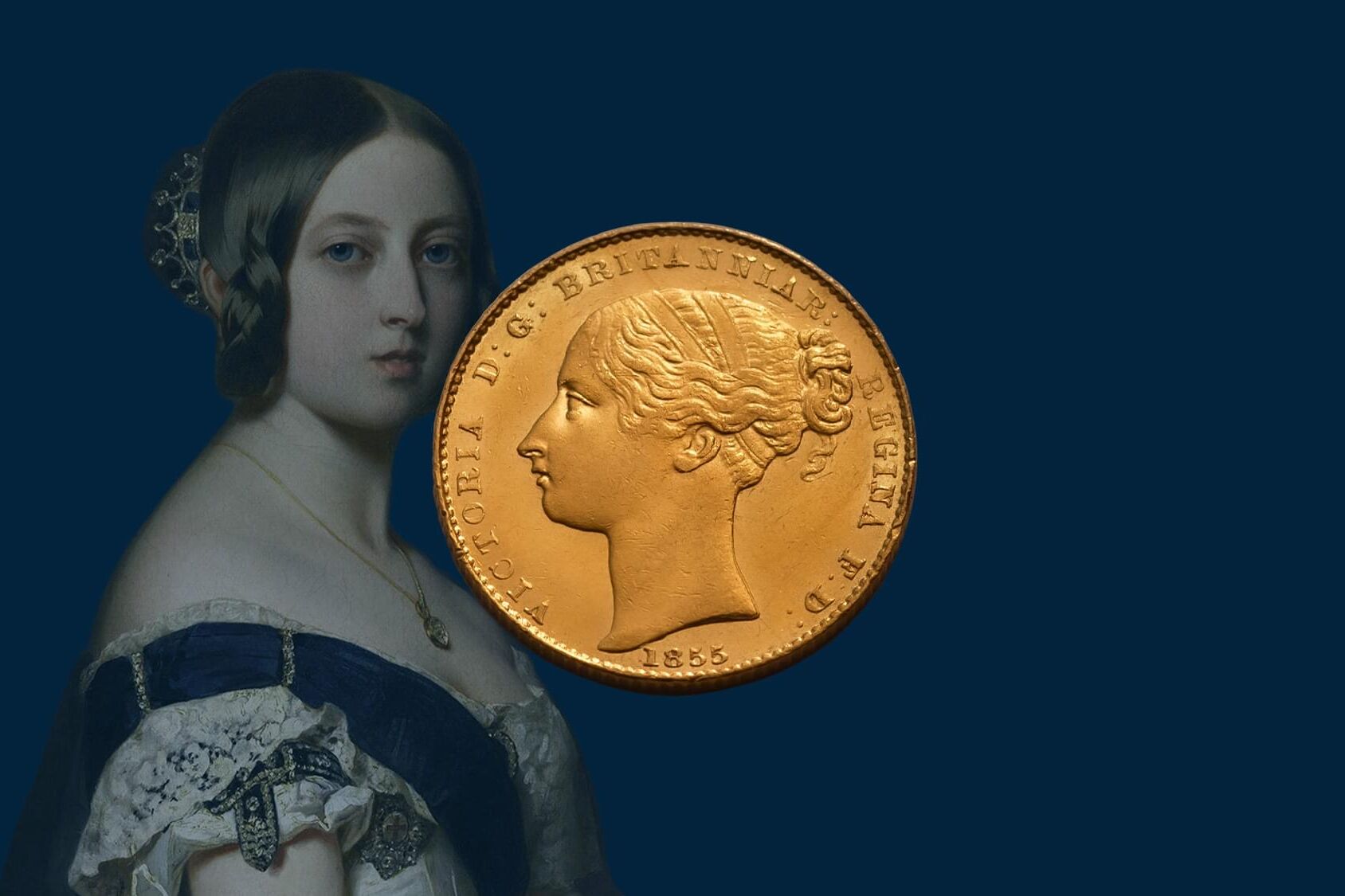
Australia's first sovereign was struck on 23 June 1855, the half sovereign a few months later. The coins were struck with a British styled portrait of Queen Victoria and a strikingly Australian reverse proclaiming the word 'Australia' and the issuing authority of the 'Sydney Mint'. The obverse and reverse designs were used again in 1856.
In 1857, the obverse of the Sydney Mint coins was amended by British engraver L. C. Wyon to incorporate a more Australian flavour into the design, Queen Victoria sporting a sprig of Australia’s native plant, the banksia, in her hair.
The first design used in 1855 and 1856 is referred to as the Type I design, the amended, second design the Type II. The styles, Type I and Type II, are collectively referred to as the ‘Sydney Mint’ design and lasted until 1870. Major revisions occurred in 1871 to both the obverse and the reverse to eliminate the Australian style from our gold coinage. The words Sydney Mint were removed, replaced by a discrete 'S' for Sydney mint mark. The word 'Australia' was also eliminated. And the portrait was replaced with a neo-classical style popular in Britain, the monarch featuring two bands of ribbons in her hair instead of the banksia.
In 1853, the Royal Mint London tested the dies, and recorded the designs for posterity, striking frosted proofs of the proposed sovereign and half sovereign coinage. They are 'Coins of Record' in the truest sense. We know that four pairs were produced. And they are all accounted for. (John Sharples reported the existence of a single 1853 Proof Sovereign in private hands in the 1990s.)
Of the four 1853 proof pairs, the Royal Mint Collection holds two. The British Museum holds another pair, acquired from the Royal Mint in 1854. The fourth pair was first offered in 1981 by Spink Auctions Australia, eventually finding its way into the Quartermaster Collection, in 1992. The last recorded sale of the 1853 proofs was in New York in January 2026, St James Auctions (Lot 110). The pair is currently held in the US, an estimate on value in excess of $750,000.
Proofs were also struck at the Royal Mint London in 1855, 1856, 1857, 1866 and 1870. The close connection between the mint in London and leading British collectors has meant that many, if not most of the proofs, made their way into private hands.
The 1855 Proof Sovereign is not held in any public institutions worldwide, including the Royal Mint Collection.
A pair of 1855 Proof Sovereign and 1855 Proof Half Sovereign appeared in the Murdoch Collection (Lot 615) and appears to have become part of the Nobleman Collection, sold by Sothebys in 1922 as Lot 699. At some point in time, post-Nobleman, the pair was broken up. We know that Max Stern Melbourne, handled the proof sovereign in 1969 (when it was offered privately to Barrie Winsor). The next public sighting was in July 1985, sold by Spink Auctions Australia (Lot 2171) for $32,000, the coin's first and only appearance at an Australian auction. The coin was acquired by Coinworks from Barrie Winsor in 2000 and is now held with a Coinworks client, alongside the proof half sovereign.
A second privately held 1855 Proof Sovereign surfaced in 1999 in the U.K. held by the Strauss family. Sold to Barrie Winsor by private treaty, it eventually became part of the Quartermaster Collection. Most recently, the coin was sold by Heritage Auctions U.S. on May 5, 2022 as Lot 30152 and is still held overseas.
A third 1855 Proof Sovereign was offered by Kunker Auctions Number 316 (Lot 869) in January 2019, the coin noted as coming from the archives of the Pretoria Mint. The coin is also held by an overseas collector.
Conclusion. The 1855 Proof Sovereign is known by three privately held examples, two of which are held by overseas collectors.
The Museum of Victoria holds one 1855 Proof Half Sovereign acquired from A H Baldwin, London in 1929. The British Museum also holds an example, acquired in 1935 as part of the Clarke-Thornhill bequest. The interesting point that the coins currently held in institutions were acquired commercially and not transferred (gratis) within the minting system. The Royal Mint London did not seek to retain any examples but made them available to collectors.
An 1855 Proof Half Sovereign was held in the John G. Murdoch Collection, sold Sothebys London 1903 (Lot 615). The next recorded owner was Virgil M. Brand (most likely acquired from the Nobleman collection but not cited) then to Captain Vivien Hewitt, John Ahbe and Spink Australia Sale 6, Noble Numismatics Sale 62 (Lot 983). The coin was acquired by Coinworks from Barrie Winsor in 2000 and is now held with a Coinworks client, alongside the proof sovereign.
A second privately held 1855 Proof Half Sovereign surfaced in 1999 in the U.K. held by the Strauss family. Sold to Barrie Winsor by private treaty, it eventually became part of the Quartermaster Collection. More recently, the coin was sold in the U.S. in January 2026 by St James Auctions (Lot 111), where it still resides.
A third 1855 Proof Half Sovereign was offered at auction in March 1985. The coin had been held as a pocket piece and was described as 'Good Fine', selling for $16,200 on an estimate of $20,000.
Conclusion. The 1855 Proof Half Sovereign is known by three privately held examples, one of which is held overseas. Two are held in Australia, of which one has circulated.
Only one pair of 1855 Sydney Mint Proof Sovereign and Proof Half Sovereign is held in Australia (shown below).
The 1856 Proof Sovereign and 1856 Proof Half Sovereign are not held in any public institutions, worldwide. The dies for the half sovereign are preserved in the Royal Mint Collection, Wales.
A pair of 1856 Proof Sovereign and 1856 Proof Half Sovereign appeared in the Murdoch Collection (Lot 616). The Nobleman Collection, sold by Sothebys in 1922, held only an 1856 Proof Half Sovereign, (Lot 700). Perhaps ex Murdoch?
The Murdoch 1856 Proof Sovereign eventually made its way into the Collection of King Farouk of Egypt sold by Sotheby's 1954 (Lots 846), thence to Spink Auctions Australia 1978 (Lot 541) and November 1981 (Lot 985). Its next auction appearance was at Morton & Eden London on 11 December 2003 (Lot 520) where it was acquired by Barrie Winsor and sold to the Quartermaster Collection. The coin most recently exchanged hands at Heritage Auctions (U.S.) on 5 May 2022 (Lot 30153). And where it currently resides.
The second 1856 Proof Sovereign was offered in Monaco in December 2016 by Editions V. Gadoury Auctions (Lot 164). Then sold by Heritage Auctions U.S on 5 November 2020 (Lot 33046).
Conclusion. The 1856 Proof Sovereign is known by two privately held examples, both of which are held by overseas collectors.
Three examples of the 1856 Proof Half Sovereign are known today. The Murdoch example (Lot 616) followed a similar path to the sovereign, King Farouk Egypt (Lot 846), Spink Auctions Australia November 1981 (Lot 985). Its final auction appearance was at Morton & Eden London on 11 December 2003 (Lot 521) where it was acquired by Barrie Winsor and sold to the Quartermaster Collection. The coin most recently exchanged hands in New York on 14 January 2026, the sale of the Regent Collection by St James Auctions (Lot 112).
A second example was offered at Spink Auctions in July 1987 (Lot 1879) and again in November 1999 (Lot 1420). A third example surfaced at Noble Numismatics Auction in 2005 (Lot 1229) ex Pretoria Mint South Africa.
Conclusion. The 1856 Proof Half Sovereign is known by three privately held examples, two of which are held in Australia.
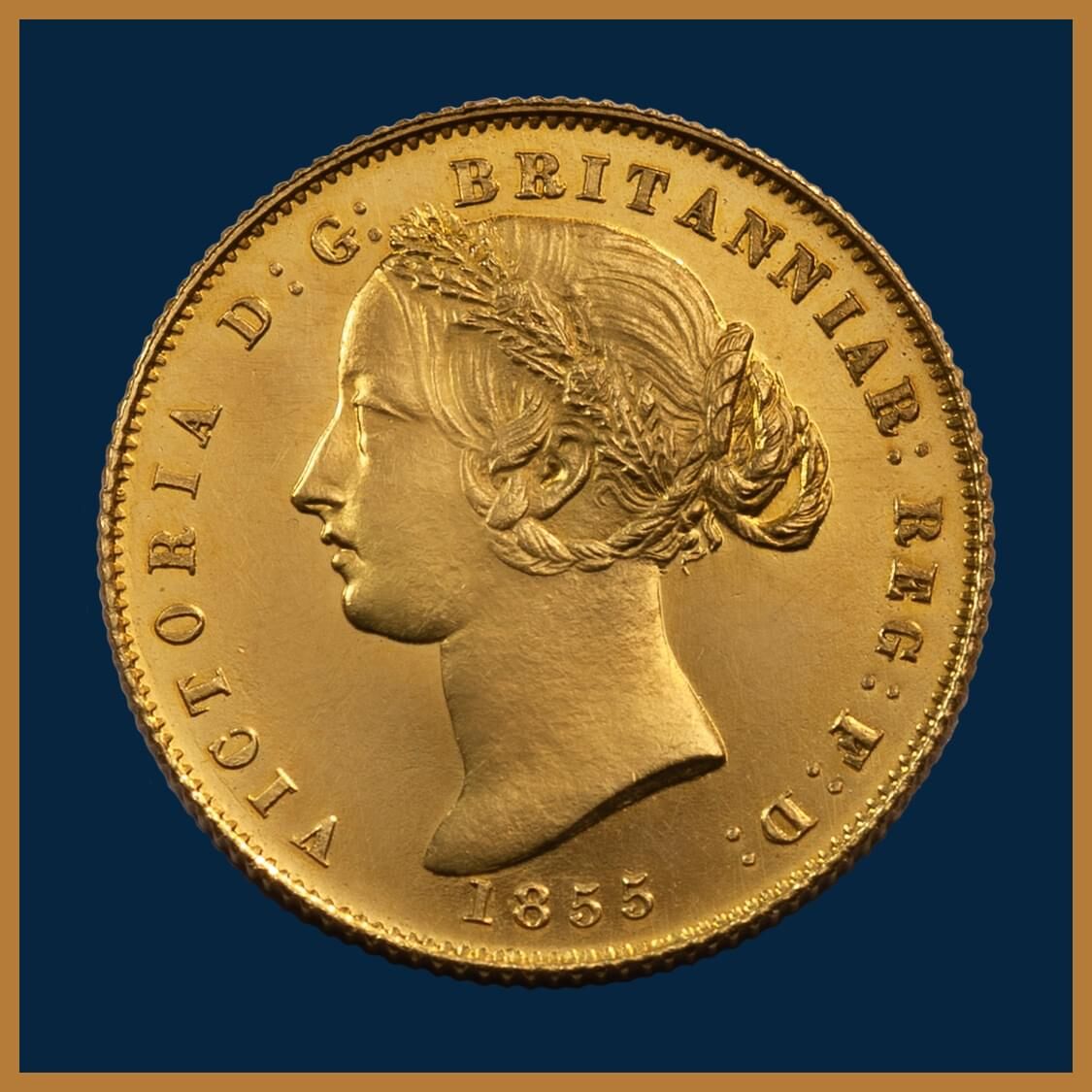
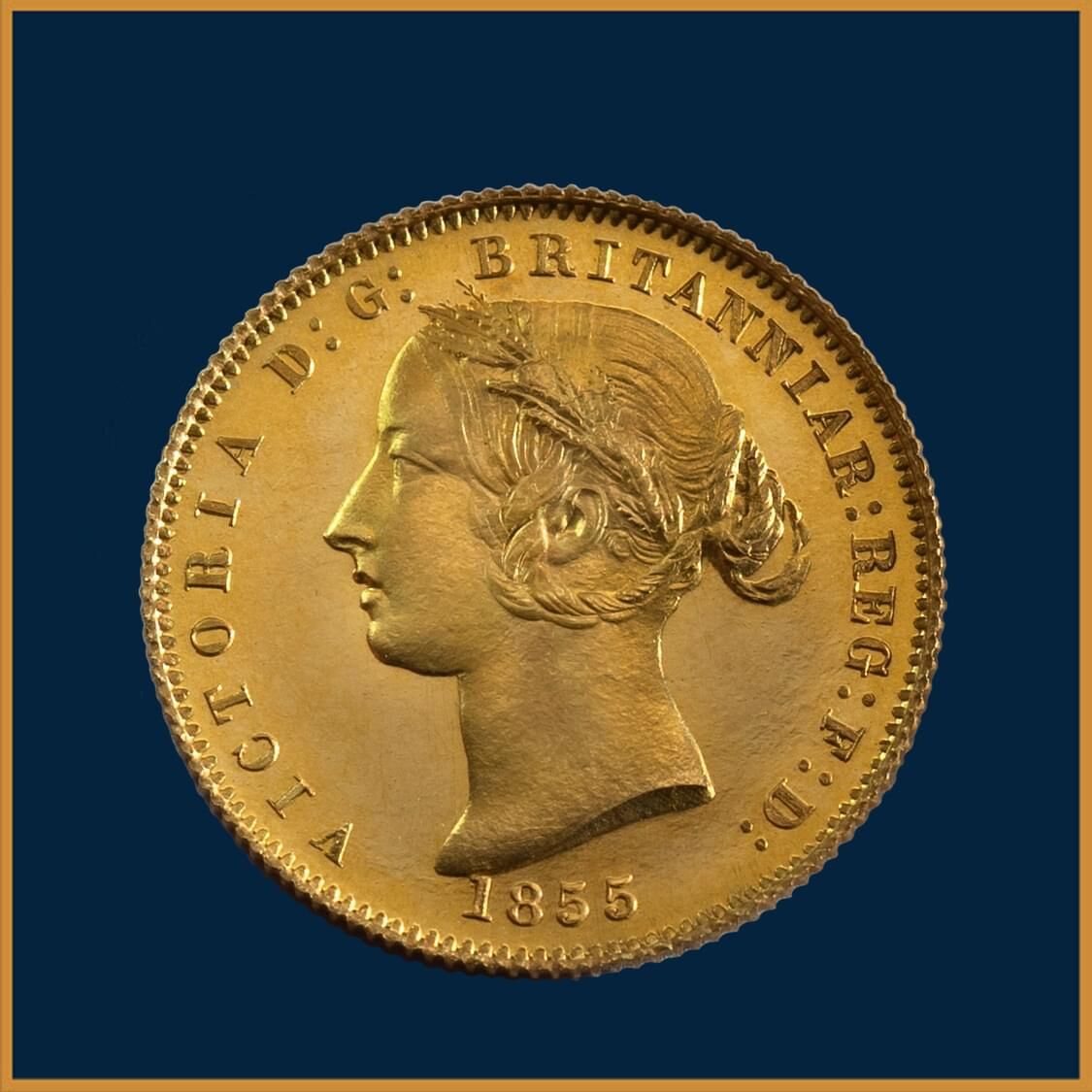
The Royal Mint holds an 1857 proof pair. The Murdoch Collection held two pairs of the 1857 proofs (Lot 617 and 618), the first pair purchased from the Brice Collection (Lot 308) thence to the Montagu Collection 1896 - 1897 (Lot 310). The second pair came from the L. C. Wyon Collection, Wyon a British engraver most notable for his work on the 1855 reverse and 1857 obverse portrait on Australia's Sydney Mint coinage.
An 1857 Proof Sovereign and 1857 Proof Half Sovereign have made several auction appearances in Australia, one of each coin linked to John G. Murdoch.
Conclusion. Three examples of each of the 1857 Proof Sovereign and 1857 Proof Half Sovereign are believed privately held.
The above 1857 proofs, Brice thence to Montagu, Wyon thence to Murdoch were struck at the Royal Mint London and feature a plain edge.
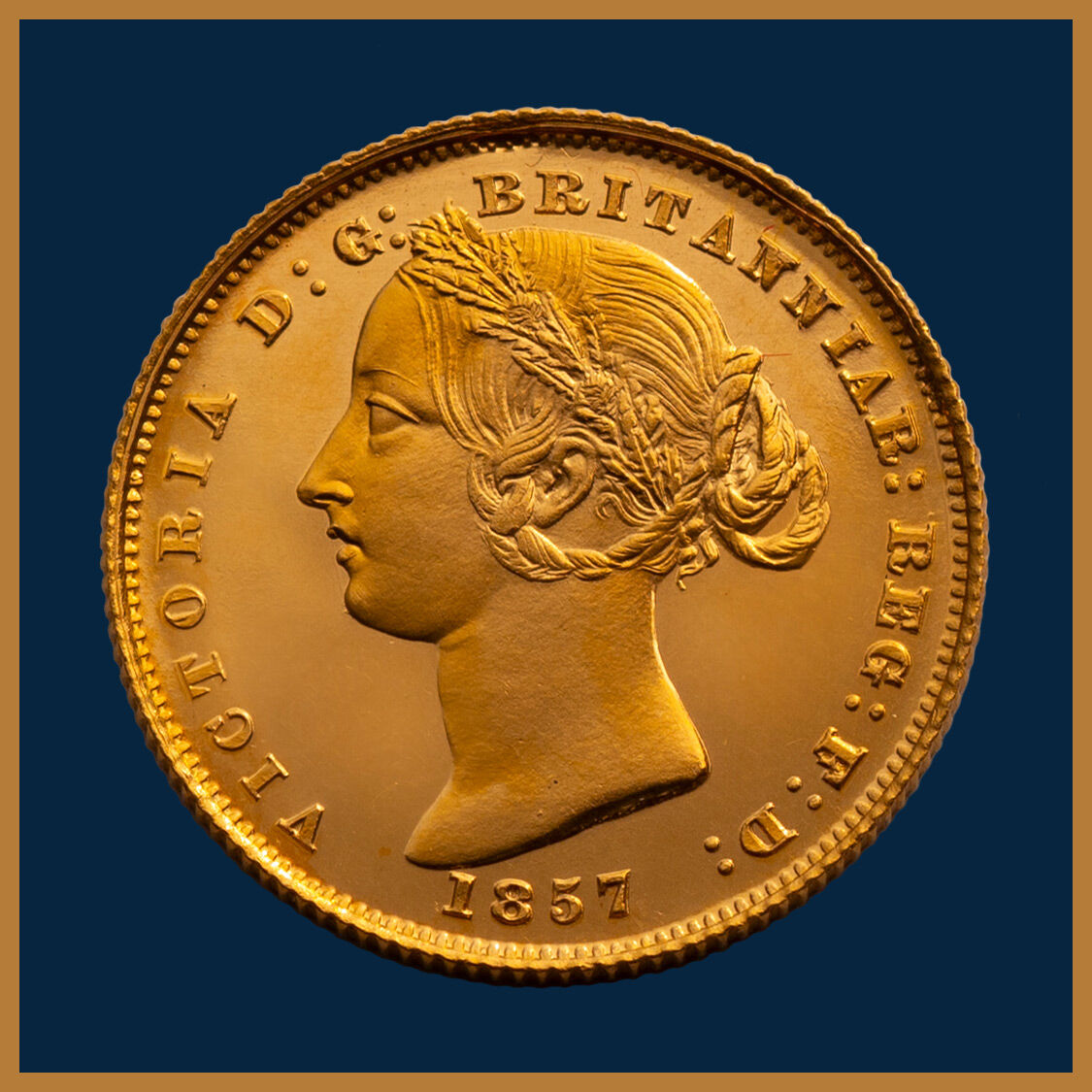
Grained edge examples of the 1857 Proof Sovereign also exist. Three are known, one of which is held in private hands. The remaining two coins are held in Government institutions, the Museum of Victoria (donated by Dr William Howatt in 1926, acquired from the Sydney Mint). And the Biblioteque Nationale de France in Paris.
The grained edge 1857 Proof Sovereign (shown below) has a richness and strength that the Royal Mint strikes simply do not possess. The grained edge '57 proofs were believed struck at the Sydney Mint, circa 1883, when the Sydney Mint received the dies from the Royal Mint. There is a suggestion that they could have been struck on closure of the Sydney Mint when a number of presentation strikes were executed. As Young Head proofs were struck at the Sydney Mint in 1883 after a two-year hiatus, we favour the former.
Two pairs of the 1866 proofs appeared in England in the early 1970s. It appears probable that both pairs were struck for the Paris International Exhibition in 1867 and may be the same coins recorded as being cleaned by the Royal Mint for the colonial office in 1879. No known examples are held in public collections. Only one pair has appeared at an Australian public auction in 1986 (Lots 507/508), 1988 (Lots 2452/2453) and most recently in 2003 (Lots 1295/1296). The other pair is said to be held in a New Zealand collection.
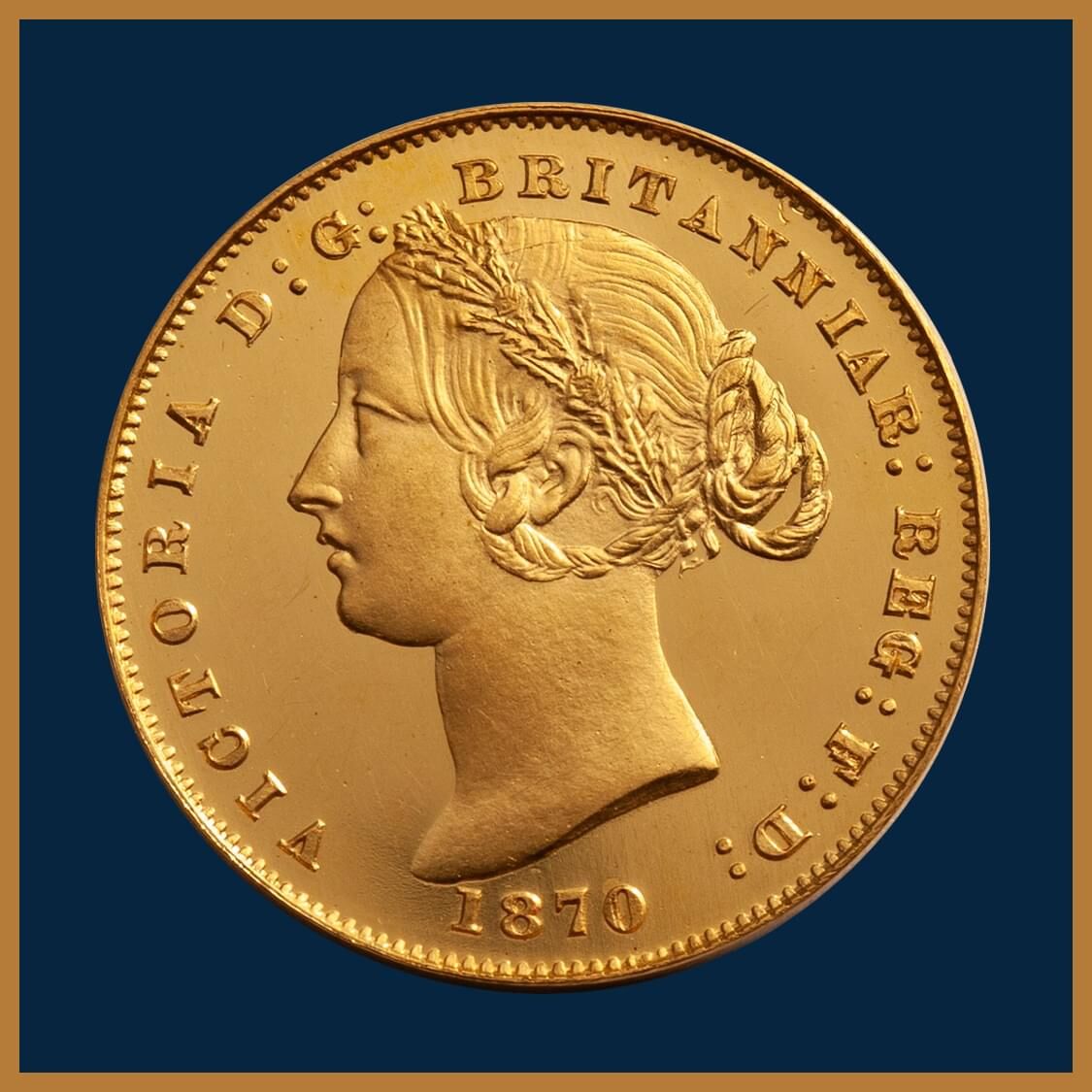
The year 1870 was the very last time the Sydney Mint design was used on Australia's gold coins.
Such an important year, and yet only one 1870 Proof Sovereign is known. There are no recorded examples in public institutions, museums and Government archives, both in Australia and overseas. And this includes the Museum of Victoria, the Royal Australian Mint in Canberra, the British Museum and the Royal Mint London, all of which have extensive holdings of Australia’s heritage coins. The Royal Mint still has the proof dies. And a pair of proofs in tin of the obverse and reverse bearing the legend MODEL/E. They are held at the Royal Mint, Wales.
During a posting in London in the 1970s Barrie Winsor established a provenance on the 1870 Proof Sovereign that dated back to its first public sighting in 1873. He also recalls being offered the coin in 1976 by Judith Spiers of Spink London for £4000. (Sadly, he recalls declining the offer.)
The 1870 Proof Sovereign was first offered by Sothebys London 26 May 1873 in the sale of the John Brodribb Bergne Collection. Sighted again at Sotheby, Wilkinson & Hodge 7 April 1881 in the sale of the J Haliburton Young Collection, thence to the Montagu Collection sold Sotheby Wilkinson & Hodge 1896 & 1897 (Lot 309). The chain continues to the John Gloag Murdoch Collection sold Sotheby 26 July 1903 (Lot 619), then to Captain Vivian Hewitt Spink 1967, Baldwin Collection, London, Spink Australia November 1978 (Lot 564), Spink Australia July 1981 (Lot 989) and Spink Australia July 1988 (Lot 2304). A truly remarkable coin, and quality-wise, quite possibly the finest example of proof coining of any date. With a provenance that is inspirational!
Collectors are driven by a desire to find rare items whether for personal appreciation, historical significance, or investment. And collectors often seek the 'first' of an item. Collectors are also attracted to high-quality pieces that offer a unique experience and pride of ownership.
Such comments may well have been written for the Sydney Mint proofs of 1853 to 1870.
The Sydney Mint design was the first to appear on Australia’s sovereigns. Proofs of the Sydney Mint coins were struck at the Royal Mint London dated 1853, 1855, 1856, 1857, 1866 and 1870. Aesthetically, the coins are compelling. Respected for the history they represent. And they are exclusive, sought after by collectors the world over.
The proximity to already established collector markets in the U.K. and Europe, meant that the Sydney Mint proofs were traded commercially soon after they were struck. Sold into the U.K. and Europe, the U.S. and Africa to collectors whose names still resonate strongly with today's numismatic community, Murdoch, Nobleman, Vivian Hewitt, Ahbe, King Farouk of Egypt, to name but five.
In tracking the Sydney Mint proofs we note that most of the coins came back to Australia in the 1970s when London firm, Spink, formed an affiliation with an Australian coin dealer and established Spink Auctions Australia, opening up our collector market by conducting regular auctions. With a direct pipeline into the great collections in the U.K and Europe, Spink had no difficulties sourcing and repatriating Australia's greatest Sydney Mint proof coin rarities. And energising a local collector market that was just in its infancy.
Early auction results provide the history, but the reality is today's collectors look to what has been happening in the past decade for guidance and inspiration. Since 2016, there has been a trend to sell our Sydney Mint proofs into overseas coin markets. Into the U.S. primarily but also Europe, the coins eagerly taken up, as affirmed by European and U.S. auction results in 2016, 2020, 2022 and 2026, remembering that Sydney Mint proofs are so scarce the coins will never make annual appearances.
Shipping Australia's great colonial coin rarities off overseas is, in our view, a tragedy. They have been sold into overseas markets and are unlikely to return. If there is an up-side to these movements, it is that those that remain in Australia, are now even more precious. And far more valuable.
The supreme highlights of the series are the 1855 Proof Sovereign and 1855 Proof Half Sovereign struck at the Royal Mint London. And the 1870 Proof Sovereign also a Royal Mint production. And the grained edge 1857 Proof Sovereign. Unique in private hands it is the only Sovereign featuring the Sydney Mint design that was actually struck at the Sydney Mint.
Fundamentals of Sydney Mint proof coining in the Young Head era, 1872 - 1887
The Sydney Mint took control of its proof issues in 1871, the first year of the Young Head design.
The coins produced at the Sydney Mint during the Young Head era featured new obverse and reverse designs. The sprig of banksia in the queen's hair was replaced with bands of ribbon presenting a more traditional regal style. And two new reverse designs were introduced, that of St. George and the Dragon by Benedetto Pistrucci and the Shield design of J. B. Merlen. The Shield reverse was the only design used on Australia's half sovereigns during the Young Head era.
The Sydney Mint struck its first Coin of Record in 1871. (Prior to this 'Sydney Mint' proofs were struck at the Royal Mint London.) The Royal Mint London produced the dies for the '1871' strike. That the Sydney Mint held the dies (as reflected in their records) and, the dearth of examples in official British Collections, indicates that the proofs of 1871 were the first set to be struck in Australia, and the first striking of imperial proof gold coins outside Britain. Important indeed. A keen numismatic eye will also acknowledge distinct style differences between Royal Mint and Sydney Mint strikes: the same differences evidenced in the plain edge and grained edge 1857 Proof Sovereigns.
The proofs of 1871 appeared at Sothebys auction, in London in 1888, in the sale of the Marsham Collection. An 1871 St George (grained edge) and an 1871 Shield (plain edge) Proof Sovereign were offered as lots 832 and 833 respectively. The 1871 Proof Half Sovereign (grained edge) was offered as lot 834. (Prices realised were £5 12s 6d, £9 10s and £4 10s respectively. Note the price of the plain edge shield example.)
The grained edge St. George example passed through the hands of Murdoch, sold 1903 Sotheby (Lot 620), Huth, sold Sotheby 1927, (Lot 627) and Whetmore, sold Glendinings 1943, (Lot 192). That the plain edge shield sovereign sold at the Marsham sale in 1888, but has never been sighted since, suggests that it was acquired by an institution. The 1871 Proof Half Sovereign was offered in the Whetmore Collection sold Glendinings 1943 (lot 201).
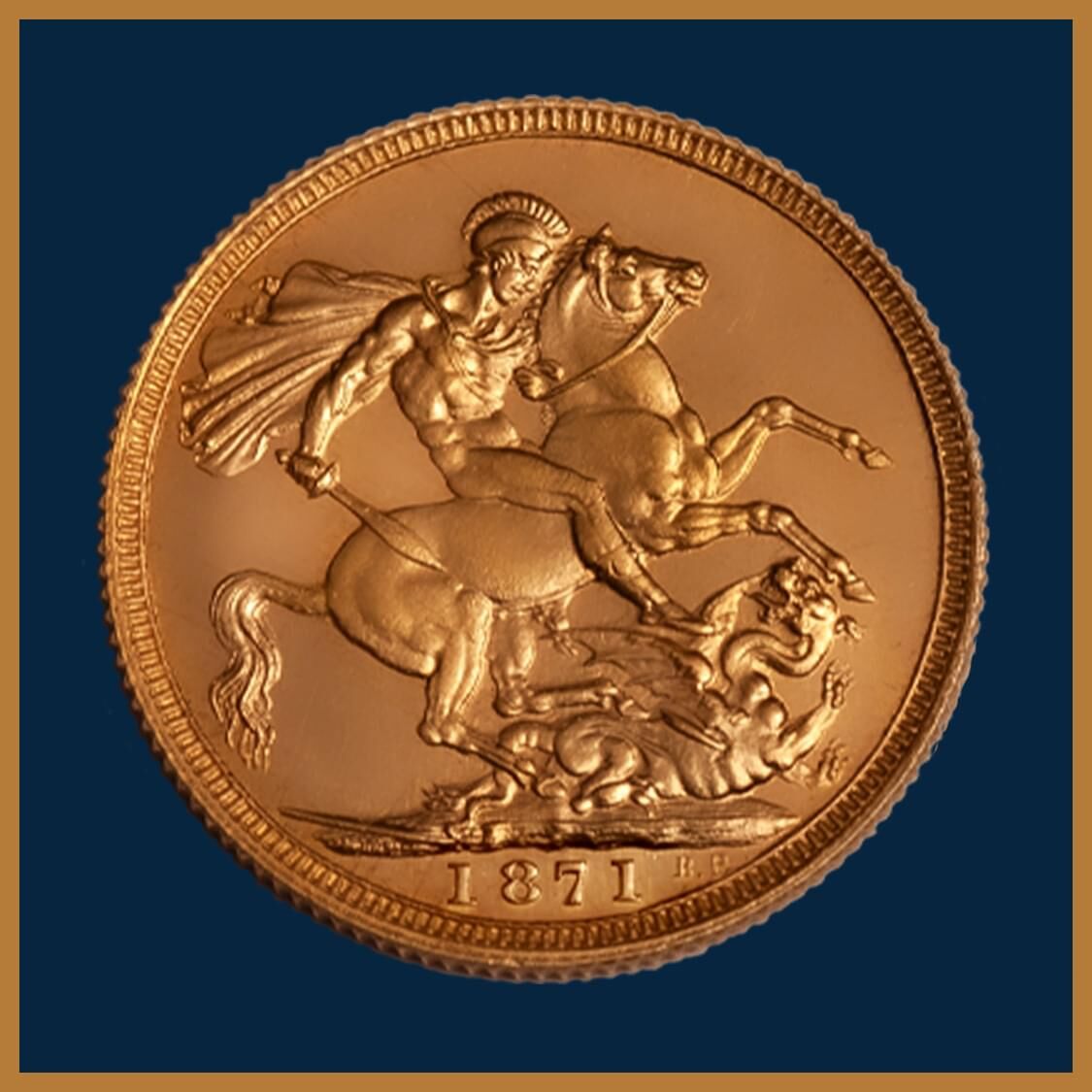
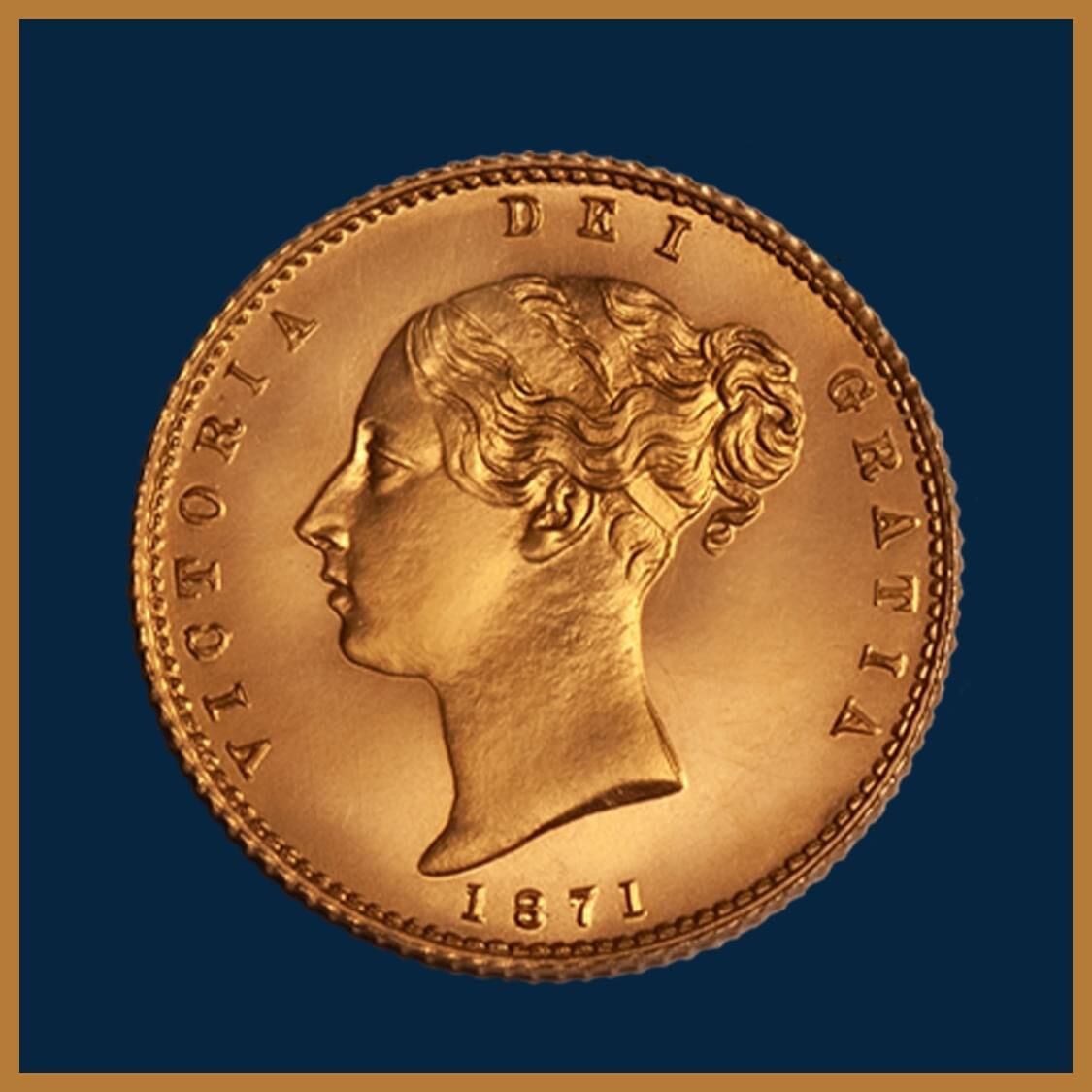
The 1871 St. George Proof Sovereign and 1871 Shield Half Sovereign are two of Australia's greatest coin rarities and returned to their country of origin in 1978. They were first offered at an Australian auction by Spink Auctions Australia in November 1978 (Lot 599 & Lot 650), again in November 1981 (Lot 991 & Lot 999), and later July 1988 (Lot 2305 & Lot 2306). They were sold by Coinworks in 2024 to a Canberra collector.
No other 1871 proofs have ever been sighted. Profoundly important as the very first proofs struck in Australia.
It is noted throughout the Sydney Mint's history that it experimented with both grained and plain edge. The Melbourne Mint's plain edge strikings were kept within minting circles. Both plain edge and grained edge examples of Sydney Mint proofs are noted in collector's hands.
Barrie Winsor records in his notes the production of a specimen sovereign in 1879. Unique. He also notes that it is impaired.
The next proof issue to be struck by the Sydney Mint occurred in 1880, no doubt for the Melbourne International Exhibition, a significant event in the history of colonial Australia. It was the first official World's Fair in the Southern Hemisphere and took place from October 1 to April 30, 1880.
The Dangar Collection sold by Glendinings London in 1954 offered an 1880 Shield Proof Sovereign (grained edge) as lot 221 and a St George Proof Sovereign (plain edge) as lot 222. One example of the 1880 Shield Proof Sovereign (grained) has been offered by Spink Auctions Australia in November 1978 (Lot 657), November 1981 (Lot 992) and again in July 1988 (Lot 2307). From the Dangar collection? Unconfirmed. Spink also offered a St George Proof Sovereign (grained), in November 1986 (Lot 717), the coin impaired and was passed in. Our estimate on the number of 1880 Proof Sovereigns available to collectors in today's market is three.
The Dangar Collection sold by Glendinings London in 1954 offered a milled edge 1880 Proof Half Sovereign as lot 225. An 1880 Proof Half Sovereign was offered in 1974 by Glendinings and fetched £520 (Lot 22). A Proof 1880 Half Sovereign was offered by Spink Auctions Australia in 1978 (Lot 657), again in 1981 (Lot 1000) and again in 1983 (Lot 525). A second example was offered in 1988 (Lot 2308). Notation linking coins offered in Spink Auctions to the 1954 and 1974 Glendinings auctions is lacking. Our estimate on the number of 1880 Proof Half Sovereigns available to collectors in today's market is two, perhaps three.
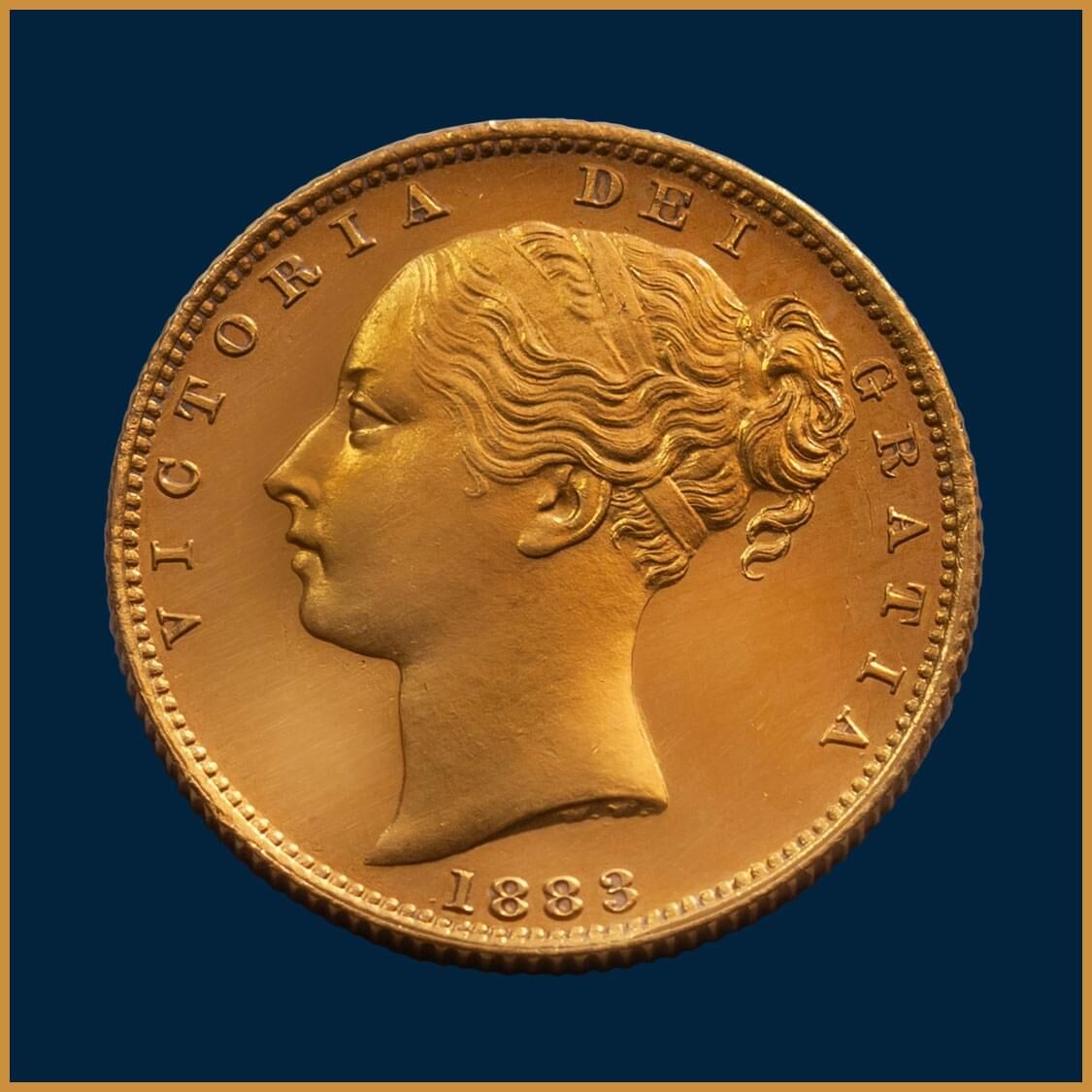
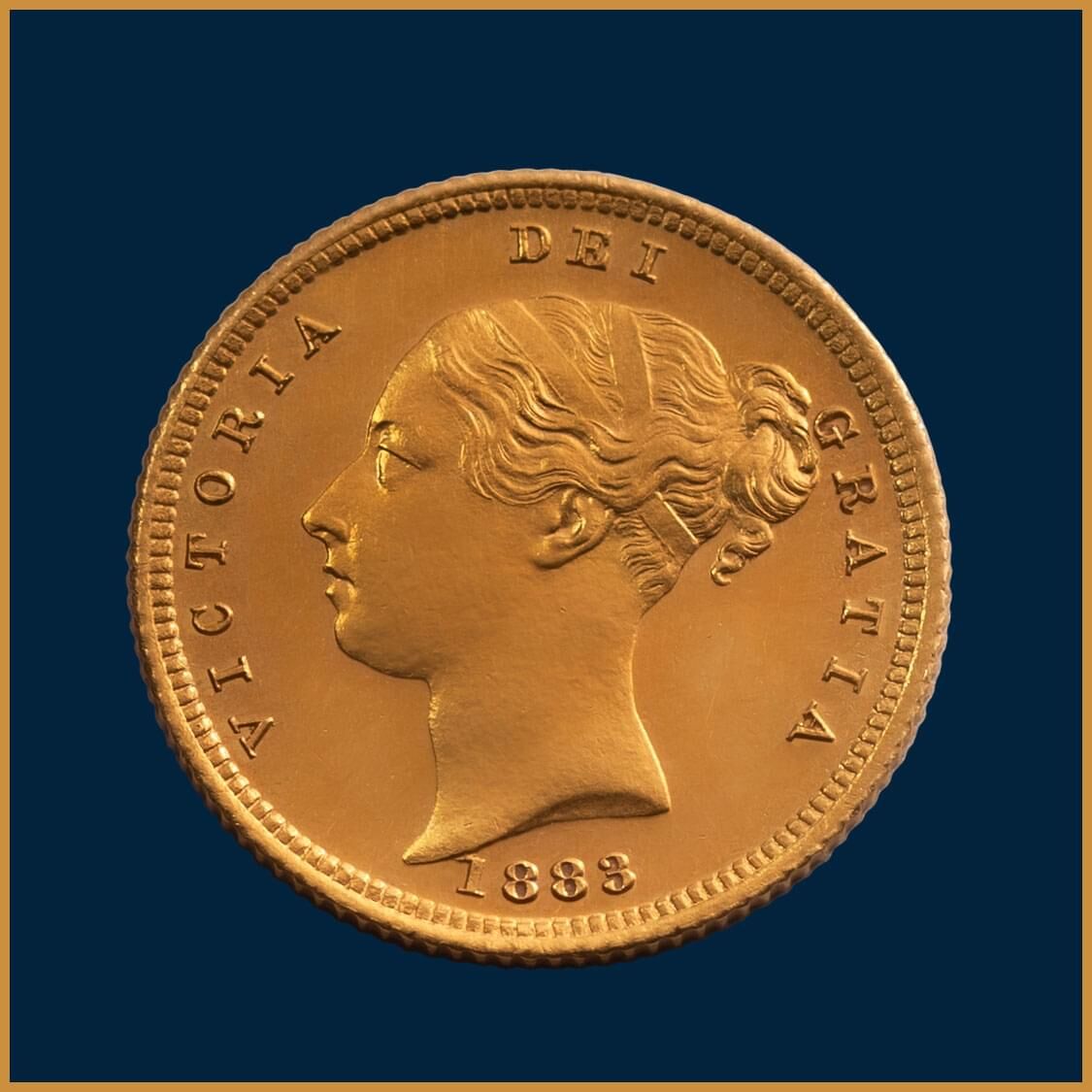
Proofs were again struck in 1883: a shield design proof sovereign and matching proof half sovereign. Official records show that the Sydney Mint received the dies for the 1857 sovereign in 1883. Already possessing the dies for the '1883' strike, it is not beyond the realms of possibility that the mint master decided to test both the '83 and the '57 dies by producing proofs. (The similarity in the styles, the richness and intensity of the two proofs, is unmistakable.)
An 1883 Proof Sovereign was offered at Spink Auctions in November 1981 (Lot 993). The 1883 Proof Half Sovereign was also first offered in November 1981 (Lot 1001) and again in July 1988 (Lot 2309). They were sold as a pair in 1989 by Barrie Winsor through M. R. Roberts and are the only known proofs of this year.
A Proof 1886 Sovereign is said to have been struck but has never been confirmed or sighted.
No Young Head proofs were struck in 1887.
During the Young Head era (1871 - 1887), the Sydney Mint struck proofs in only three years out of seventeen, 1871, 1880 and 1883. The 1871 pair is unique and is now in a long-term holding. The 1883 pair is also unique. The 1880 proofs are extremely rare, with three known of the sovereign (one of which is impaired) and two, perhaps three, of the half sovereign. A sovereign struck to a specimen finish in 1879 is noted.
As the first series of proofs struck in Australia, the coins are historically important. The proof sovereign and proof half sovereign range in value from $100,000 - $150,000 subject to date, quality and denomination. Impaired proofs fall below the lower dollar level.
Fundamentals of Sydney Mint proof coining in the Jubilee era, 1887 - 1893
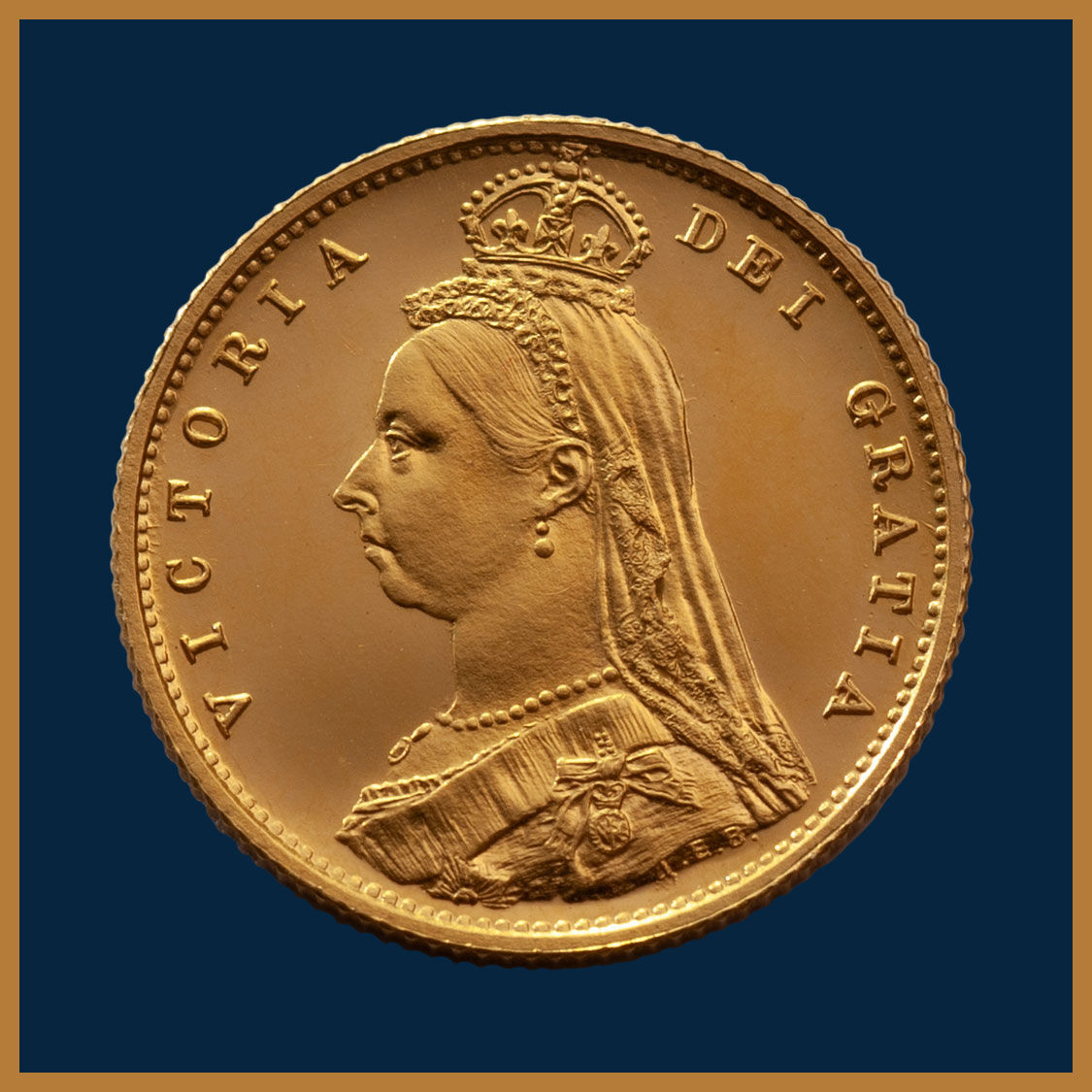
Victoria became Queen of the British Empire on 20 June 1837, and her golden jubilee celebrated fifty years to the day, on 20 June 1887. A new sovereign portrait was designed by (later Sir) Joseph Edgar Boehm to replace the Young Head portrait. The new design drew inordinate criticism for Victoria’s apparent scowling look and the precarious balancing of her crown. The design only lasted six years.
The year 1887 also saw the dropping of the Shield reverse on Australia's sovereigns. All Jubilee Head Proof Sovereigns were struck with only the St George and the Dragon reverse. The Shield reverse was however maintained on the half sovereign until the Veiled Head era commencing in 1893.
The Sydney Mint struck proofs in the first year of the Jubilee era, '1887' And the last, '1893'. And nothing in between.
To commemorate Queen Victoria's jubilee, the Royal Mint London produced gold coins for the U.K. in denominations of Five Pounds, Two Pounds, Sovereign and Half Sovereign, as both proof collector issues and circulating currency.
Emulating the Royal Mint, the Sydney Mint struck two four-coin Australian Proof Sets, one of which was obtained by John G Murdoch (Lots 613, 614 and 625). The other set was obtained by Sydney politician, Henry Dangar (Lots 226, 227 and 228). A further ten 1887 Two Pounds were struck and progressively sold at a twenty-five per cent premium. The Murdoch Collection also held an additional 1887 grained edge Proof Sovereign and Proof Half Sovereign pair (Lot 626). The Sydney Mint also produced a plain edge pair, its destination again, the Murdoch Collection (Lot 627). So, at this point we know that four 1887 Proof Sovereigns were struck, one with a plain edge. And four 1887 Proof Half Sovereigns, also one with a plain edge. Two grained edged pairs were held in the four-coin sets.
An 1887 Proof Sovereign was offered by Glendinings in 1939 in the sale of the Hamilton Smith-Briggs Collection (Lot 257). Most likely from the Murdoch Collection. Spink Auctions Australia has offered examples of the grained edge 1887 Proof Sovereign (in 1978, 1996 and 1998, the latter impaired) and one of the plain edge, in 1993 (also impaired). Most likely ex Murdoch, but unconfirmed. Spink Auctions has never offered an 1887 Jubilee Proof Half Sovereign. The Quartermaster Collection held a complete 1887 Proof Set Five Pounds, Two Pounds, Sovereign and Half Sovereign, the four pieces confirmed ex Murdoch Collection. The set is now held by a Melbourne collector.
While the Murdoch 1887 Set is today complete, the Dangar Set has been broken up into its individual components. Our assessment on numbers (and that of Barrie Winsor) is that two 1887 Proof Sovereigns and two 1887 Proof Half Sovereigns are available to collectors including those housed in the four-coin set.
Plain edge 1887 Proof Sovereign and Proof Half Sovereign are held in the Museum of Victoria, a bequest from Dr William Howat, who purchased them from the Sydney Mint in their closing-down sale for 30 shillings and fifteen shillings respectively and donated to the museum in 1926. The dies for the sovereign and half sovereign were transferred to the Melbourne Mint and on its closure to the Royal Australian Mint Canberra.
Two pairs of the grained edge Jubilee 1893 Proof Sovereign and Proof Half Sovereign were held by the Murdoch Collection and offered by Sotheby Wilkinson & Hodge as lot 632, 634 and 635, one of the pairs split into two lots. An 1893 Jubilee Sovereign (grained edge) was offered at Spink Auction November 1985 (Lot 1045), most likely ex Murdoch.
An 1893 Proof Half Sovereign was offered by Sothebys in 1927 in the sale of the Huth Collection (lot 630), again most likely ex Murdoch. The 1893 Jubilee Proof Half Sovereign has never been sighted at an Australian auction.
The plain edge examples in the Museum of Victoria are from the Sydney Mint, the coin purchased by Dr William Howatt for 30s and 15s respectively and donated to the Victorian Collection in 1926.
As a summary, the Jubilee era spans 1887 to 1893 and during those seven years the Sydney Mint struck proof sovereigns in two of them, 1887 and 1893. While guides have, over the years, referred to a Sydney Mint 1892 Pattern Proof Sovereign, the coin has never been sighted. One complete four-coin 1887 Proof Set is held in Melbourne comprised of the Five Pounds, Two Pounds, Sovereign and Half Sovereign. One other 1887 Proof Sovereign and 1887 Proof Half Sovereign is known, each with a plain edge. Two of each of the grained edge 1893 Jubilee Proof Sovereign and 1893 Proof Half Sovereign are known. And one of each of the plain edge.
The Sydney Mint Jubilee Proof Sovereigns and Proof Half Sovereigns range in value from $100,000 - $150,000 subject to date, quality and denomination. Mishandled proofs fall below the lower level, price-wise.
Fundamentals of Sydney Mint proof coining in the Veiled Head era, 1893 - 1901
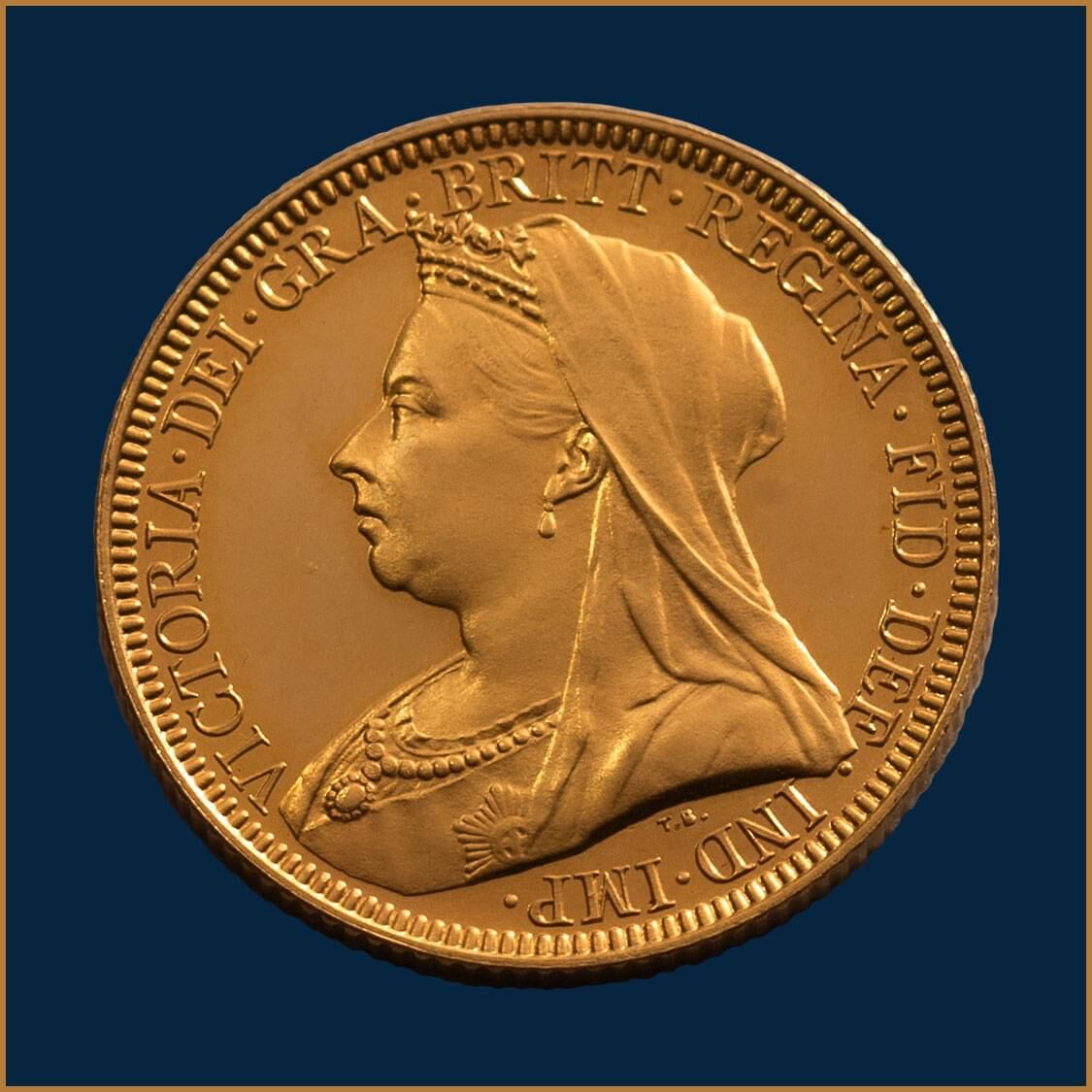
The Veiled Head era of Queen Victoria, depicting the monarch in her twilight years commenced on Australia's sovereigns and half sovereigns in 1893 and continued until her death in 1901.
The Sydney Mint struck proofs only in the first year of the Veiled Head era.
The Dangar Collection sold Glendinings April 15, 1953 held two 1893 Veiled Head Proof Sovereigns (lot 229), the coins struck with a milled edge. One of the Proof Sovereigns re-appeared at Spink Auctions Australia October 1977 (lot 500) and again in November 1980 (Lot 577) and most recently in November 1989 (Lot 1321).
The Dangar Collection also held two milled edge 1893 Veiled Head Proof Half Sovereigns (lot 231). One of the 1893 Proof Half Sovereigns appeared with the proof sovereign in October 1977 (lot 500) at Spink Auctions Australia. And appeared again solo in November 1980 (Lot 673) and more recently in November 1989 (Lot 1393).
Coinworks has sold an 1893 proof pair of Sovereign and Half Sovereign (milled edge) ex Dangar, Spink Auctions 1980 and 1989. And a unique 1893 Proof Sovereign and Half Sovereign pair with the plain edge.
The Museum of Victoria plain edge proof pair formed part of the Howatt donation n 1926, acquired from the Sydney Mint on closure.
As a summary, the Sydney Mint struck proof sovereigns and half sovereigns in only 1893, the first year of the Veiled Head era (1893 - 1901). The coins were struck with grained and plain edges. Both styles are scarce with two grained edge pairs known. And one plain edge pair.
The proof sovereign and proof half sovereign range in value from $100,000 - $125,000 subject to date, quality, denomination and edge.
Fundamentals of Sydney Mint proof coining in the Edward VII era (1902 - 1910)
King Edward VII reigned between 1902 and 1910. In 1902, the Sydney Mint struck a Five Pounds, Two Pounds, Sovereign and Half Sovereign to a matt proof finish, each coin featuring a milled edge. The coins were struck from sand blasted dies to give the coins a matt finish and contained in one set.
The 1902 four-coin Proof Set (£5, £2. sovereign and half sovereign) was offered at Glendinings in 1953 in the sale of the Henry Dangar Collection (Lot 233). It was acquired by Spink & Son Ltd London and sold to Adelaide collector, Sydney Hagley. The set was eventually offered by Spink Auctions Australia November 1989 (Lots 1329, 1330, 1331, 1332) acquired by Barrie Winsor and sold into the Quartermaster Collection. The set is currently held by a Melbourne collector.
The Sydney mint also produced the 1902 Proof Sovereign to a brilliant finish. Two examples were held by Henry Dangar and offered at Glendinings in 1953 as lots 234 & 235. Their whereabouts are unknown. They have never appeared at an Australian auction.
There is a gilt base metal striking of the reverse of the 1906 Sydney Sovereign. The obverse bears the word 'MODEL'. The coin was struck at the Royal Mint for display purposes, part of a set that included the Melbourne and Perth Mint 1906 Sovereigns. John Sharples indicates in his studies the existence of a 1910 Proof Sovereign, but it has never been confirmed. Barrie Winsor indicates in his notes that the year exists as a proof.
As a summary, during the Edward VII era (1901 - 1910) a matt proof sovereign and half sovereign were struck and included in a four-coin 1902 Proof Set. Two brilliant 1902 Proof Sovereigns were confirmed struck, whereabouts today unknown, although Barrie Winsor confirms the sighting of one example.
The 1902 Proof Sovereign and 1902 Proof Half Sovereign has an estimated value of $100,000 - $150,000 subject to quality and decnomination.
Fundamentals of Sydney Mint proof coining in the George V era (1911 - 1926)
The portrait of George V appeared on Australia’s Proof Sovereigns and Proof Half Sovereigns struck at the Sydney Mint between 1911 and 1926, its year of closing. It's an era that boasts Australia's rarest sovereign, the enigmatic 1920 Sydney Sovereign.
Specimen dies of the 1911 sovereign and 1911 half sovereign were preserved at the Sydney Mint until 1926. They are now believed to be at the Royal Australian Mint, Canberra.
A 1911 Proof Half Sovereign is recorded in the Dangar sale, sold Glendinings April 1953 (Lot 240). A 1911 Proof Half Sovereign, described as a semi-matt proof was also offered by Spink Auctions Australia in November 1978 (Lot 686) and is its first and last recorded sighting, the coin realising $900 against a pre-sale estimate of $750. Perhaps the Dangar example.
There is a suggestion that a proof may have been struck in 1914, but both Barrie Winsor and John Sharples indicate that it has never been sighted.
In the twilight years of the Sydney Mint, Coins of Record were struck to specimen quality of coins dated 1920 (1), 1922(2), 1923 (1) and 1926 (3), the number in brackets indicating the known examples.
A 1920, 1922 and 1923 Specimen Sovereign appeared in the Quartermaster Auction on 4 June 2009 as lots 196, 202 and 205, noted having come from Robert Jaggard, Paul Terry and then private treaty Barrie Winsor to the Quartermaster Collection. A second 1922 Specimen Sovereign surfaced in 2007 offered at an auction in Sydney.
As a summary. The opening year of the George V era (1911 - 1926) is represented by a matt proof half sovereign valued at $100,000 to $150,000 (last sighted in November 1978). Coins of Record of the mint's twilight years were struck to specimen quality in the years 1920 (1), 1922 (2), 1923 and 1926. The 1920 Sovereign is in a league of its own valued in excess of $800,000, the 1923 and 1922 $100,000 - $125,000 subject to quality. And the 1926 also $100,000 to $125,000.
Why pairs are the 'go-to' item for proof gold collectors
Australia’s Proof Sovereigns and Proof Half Sovereigns are coins that were quite literally, fit for royalty. They are powerfully irresistible. And they are respected for the history they represent. They are sought after, the world over, for their exclusivity.
You don't buy a piece of proof gold and then put it aside. You savour the moment and you take in its glory, and you show it around to family and friends for they are exclusive and they are beautiful. And they are part of a tradition of proof coining that goes back centuries.
Today's collectors are showing a marked preference for pairs if, and when, they are available. So not one coin, but two, the Proof Sovereign and the Proof Half Sovereign together. The current sentiment is that a pair is the mint's complete story, the total narrative.
And this principle is being consistently taken up and reflected in Coinworks sales. The 1901 Perth Mint Proofs sold as a pair for $525,000, the purchaser commenting that he would not have bought an individual coin because it was not the complete story. The same views were expressed by the purchaser of the 1871 Sydney Mint Proof Sovereign and Half Sovereign. And in March 2026, a Proof 1896 Sovereign was acquired by a collector that already held the 1896 Proof Half Sovereign.
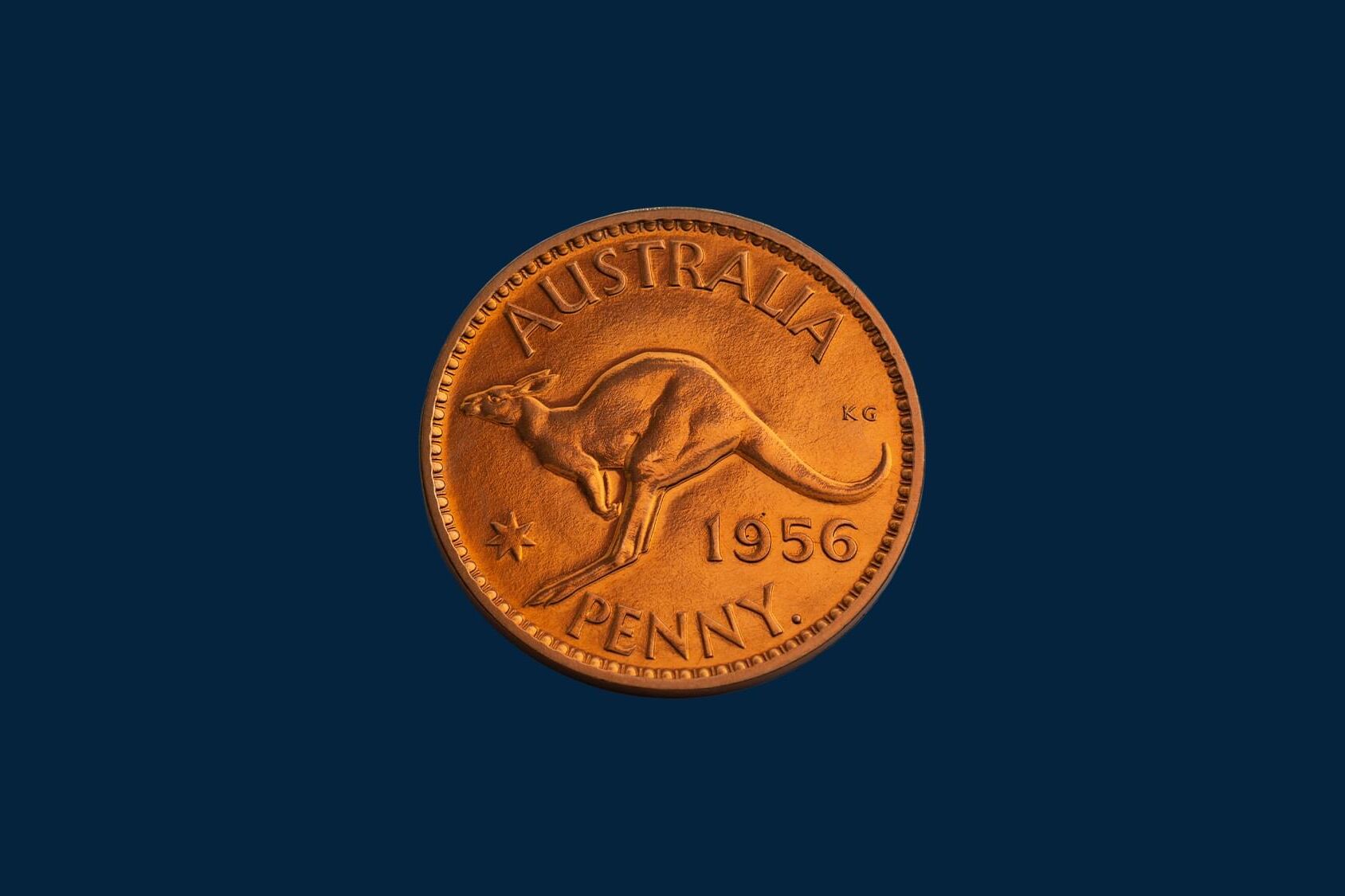
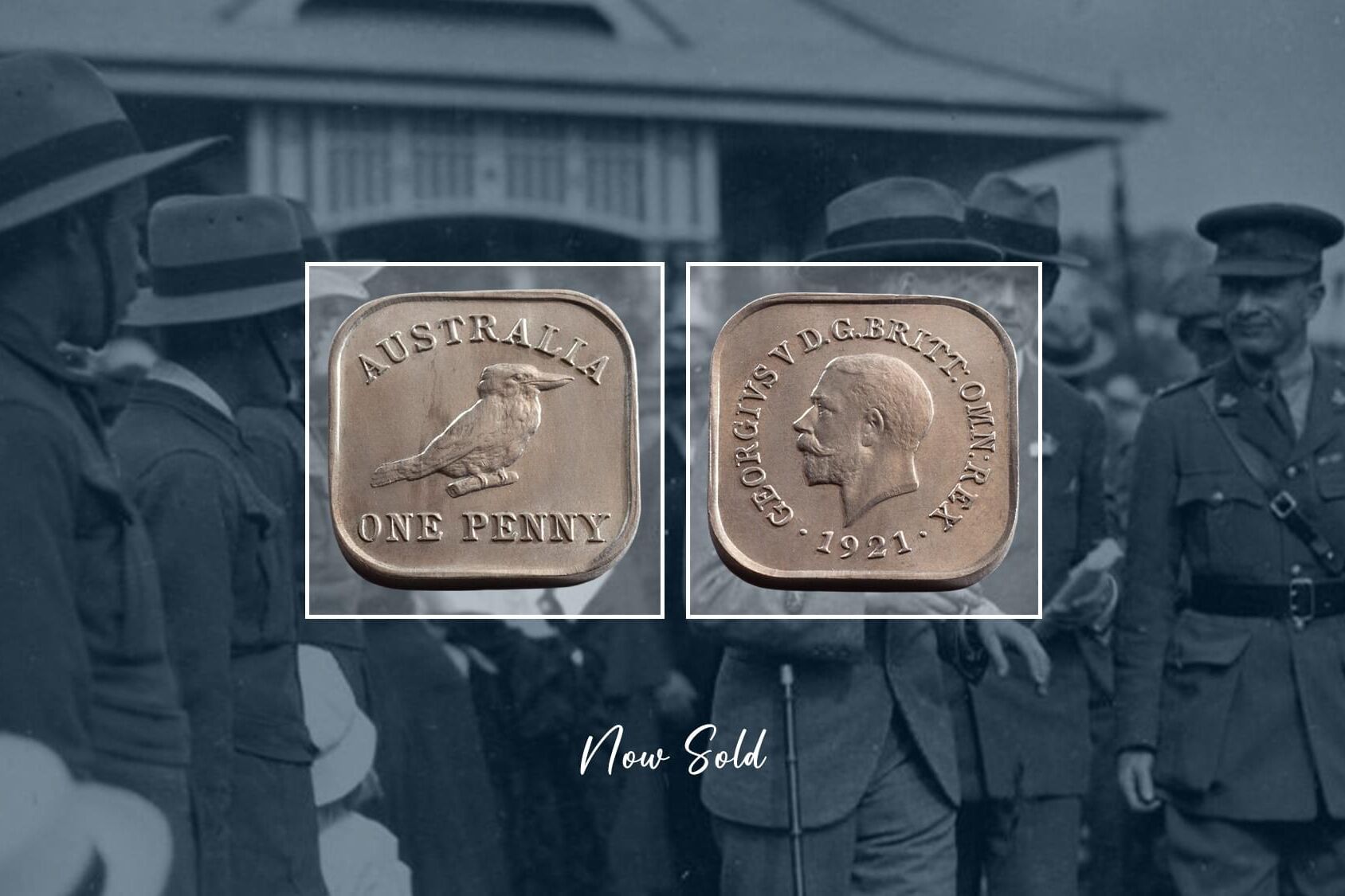
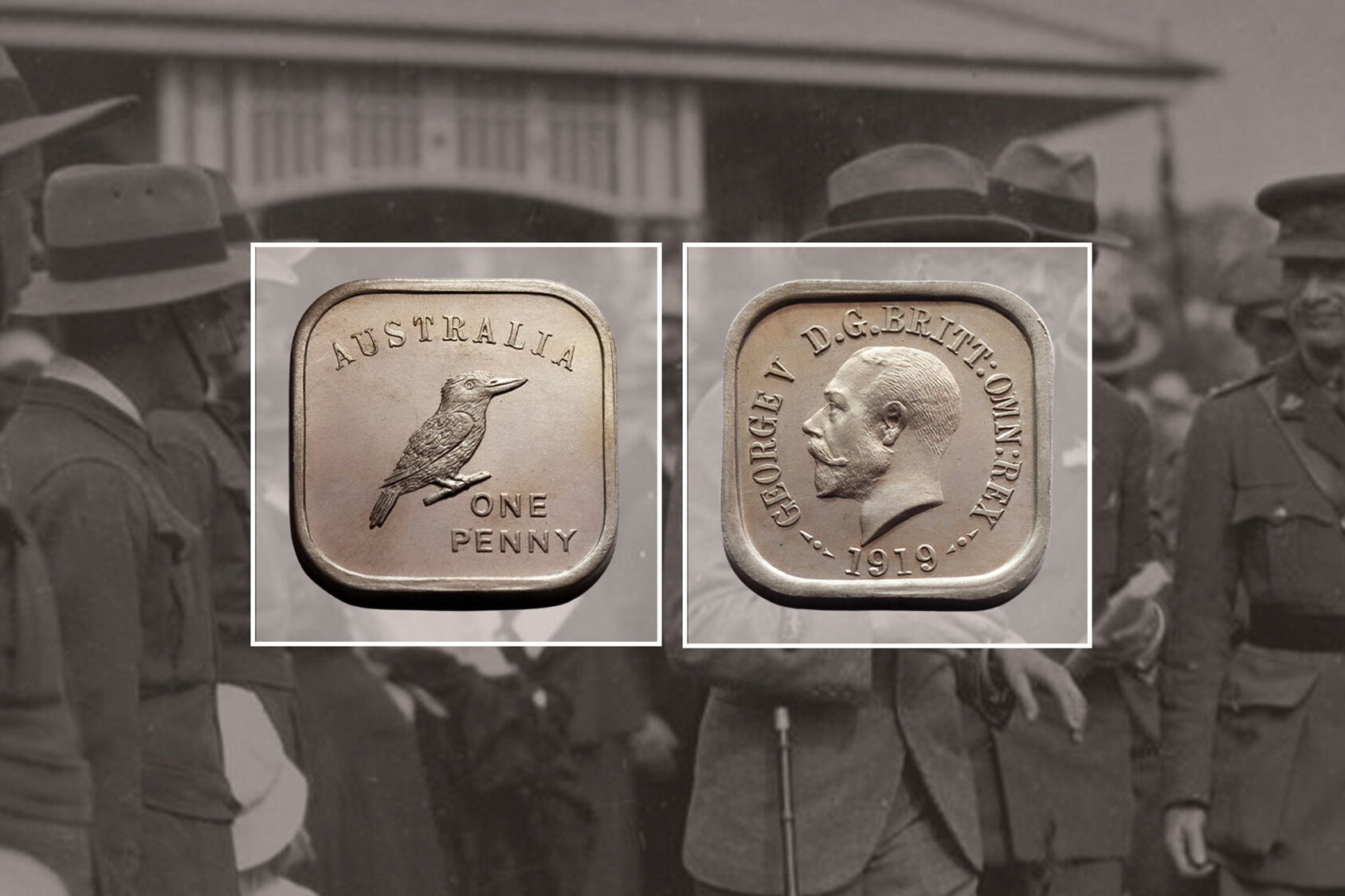
The pursuit of completion is also being shown in other areas of the market. The Complete Kookaburra Collection sold within a few hours of its release, the key here is that it was complete. A date set of kookaburra pennies, complete for each of the dates in which the coins were struck, is also today a strong collector favourite. In February 2026, a Coinworks client completed a 'mint' set of Holey Dollars: four Holey Dollars representing the mints Madrid, Lima, Potosi and Mexico.
Complete sets are naturally heirloom-worthy. They’re easier to pass down, easier to explain, and more likely to retain their identity over generations. Families understand the concept of the full set instantly.
Let's also be clear. There is a significant amount of collector/investment dollars available globally. And buyers with significant financial resources are looking to spend their money on an item that has substance. And pairs or sets have more substance than an individual coin.
Coinworks is also making this offer to clients who are considering a pair of proofs. Take the first coin and we will guarantee to hold the second coin, and hold the price, for six months to facilitate a purchase of the pair.
Four reasons why proof gold is worth owning
Nothing compares to the allure of gold.
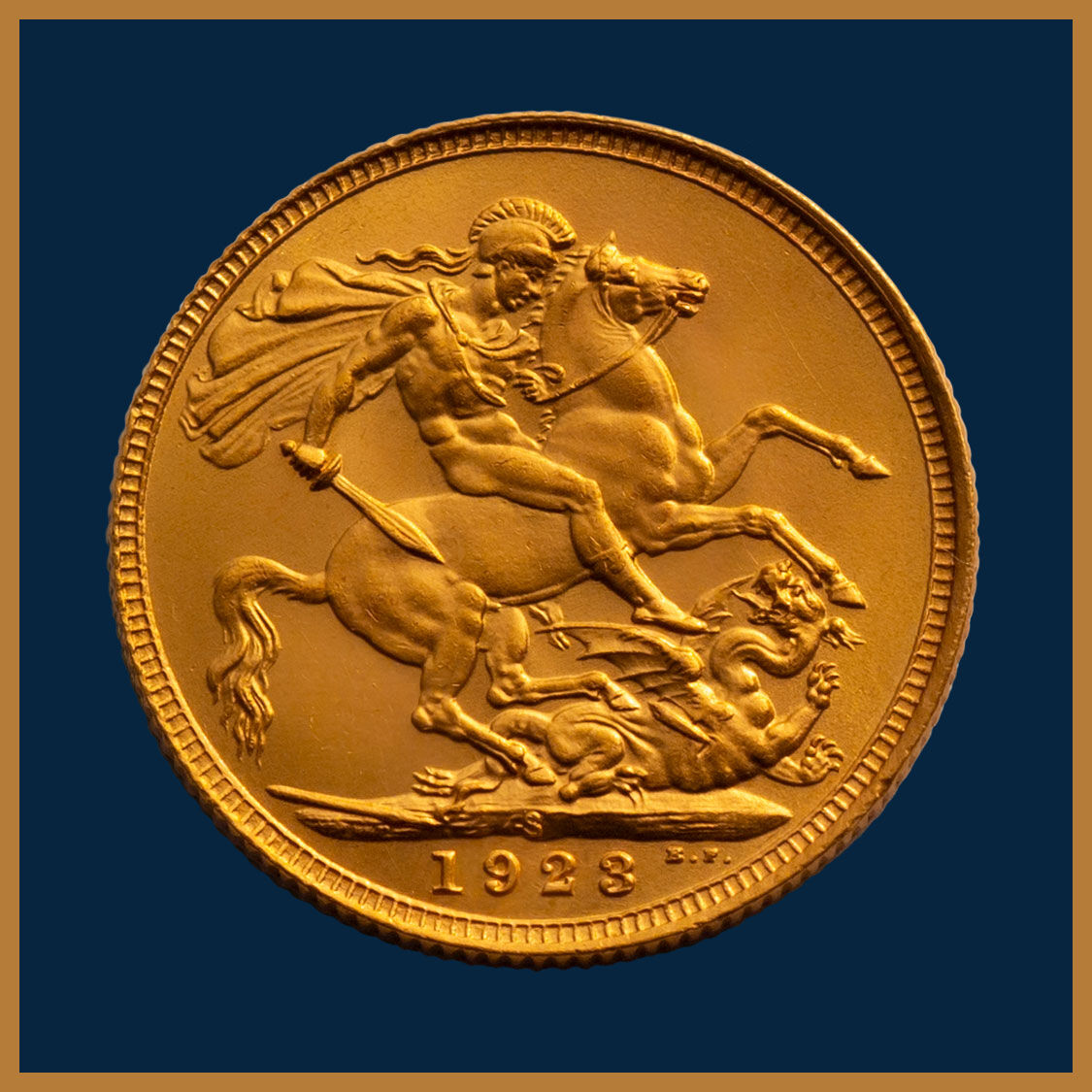
Particularly when it comes in the form of an Australian sovereign or half sovereign struck to PROOF quality. The coins are visually stunning, distinguished by the sharpest of detail and brilliant golden-mirror surfaces. When you look at the proofs shown above, you can only but agree. Perfection in gold.
The coins have a wonderful connection to the past.
Proof sovereigns and proof half sovereigns are the story tellers, defining an era, or a year, like no other coin. The coins can also define an occasion. And a monarch. And they tend to have a connection to a prominent person, either a dignitary, a Mint Master or an influential collector.
The coins are genuinely rare.
Irrespective of the year in which they were struck, and the mint at which they were produced, Australia's proof sovereigns and proof half sovereigns are 'extremely rare'. We would be lucky to sight one piece at auction annually. And the reason for their incredible scarcity is that proofs were not struck every year. And of those dates that were struck as proofs, only one, perhaps two up to a maximum of three filtered their way out into the collector market.
It is estimated that there are perhaps thirty-eight Melbourne Mint proof sovereigns available to collectors, covering the complete spectrum of dates from 1872 to 1931, a span of sixty-years. The estimate on proof half sovereigns (1872 to 1915) is twenty-nine coins.
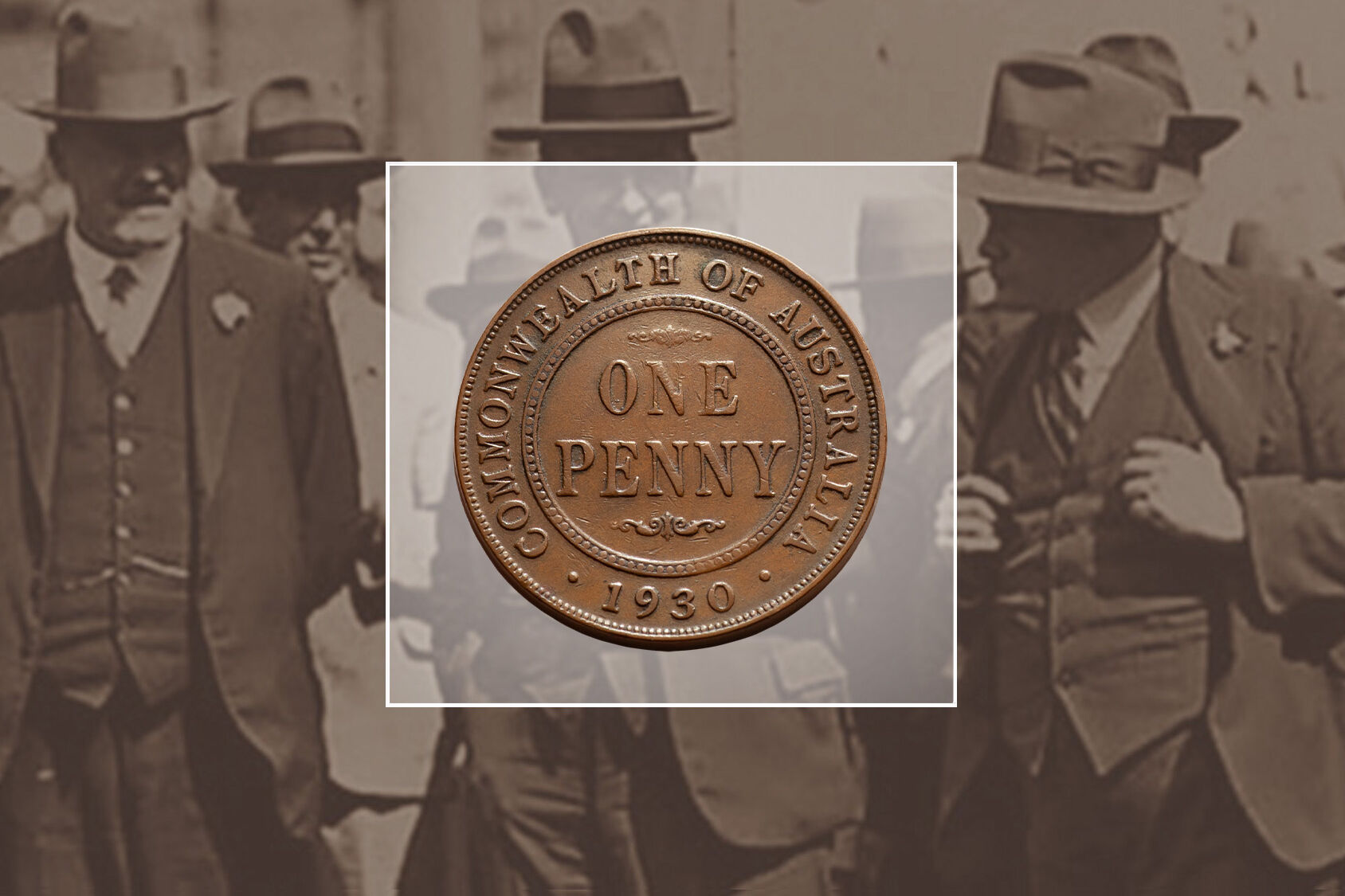
Compare their availability to our industry yardstick the 1930 Penny, where 1500 to 2000 examples are believed to exist. Or even a comparison to the Kookaburra Square Penny, struck between 1919 and 1921, where one hundred and fifty examples are believed available to collectors.
There are two other considerations that further limit their availability. As proof sovereigns and proof half sovereigns shared the same design as those coins struck for commercial usage, some of the proofs have tragically filtered their way into circulation and have been grossly mishandled, thereby marring their quality. And reducing the pool of "as struck" proof gold coins. The 1855 Sydney Mint Proof Half Sovereign, an acknowledged proof that has accidentally circulated.
The second consideration is that great coins tend to be held for the long term. The owner of "The Madrid Collection of Australian Rare Coins" held onto his proof gold coins for more than twenty years. The Spalding family for even longer. So too Tom Hadley, of Quartermaster Collection fame.
The coins have strong collector/investor appeal.
Collectors that buy in this area are all but guaranteed that the market will never be flooded with examples. So, it is a sector that offers financial stability and has been the hunting ground of investors for decades. The sector also has strength because it has widespread support amongst the Australian market. And overseas coin markets.
Shop Coinworks
© Copyright: Coinworks