1813 Dump, struck with the extremely rare C/4 dies, one of the finest known.

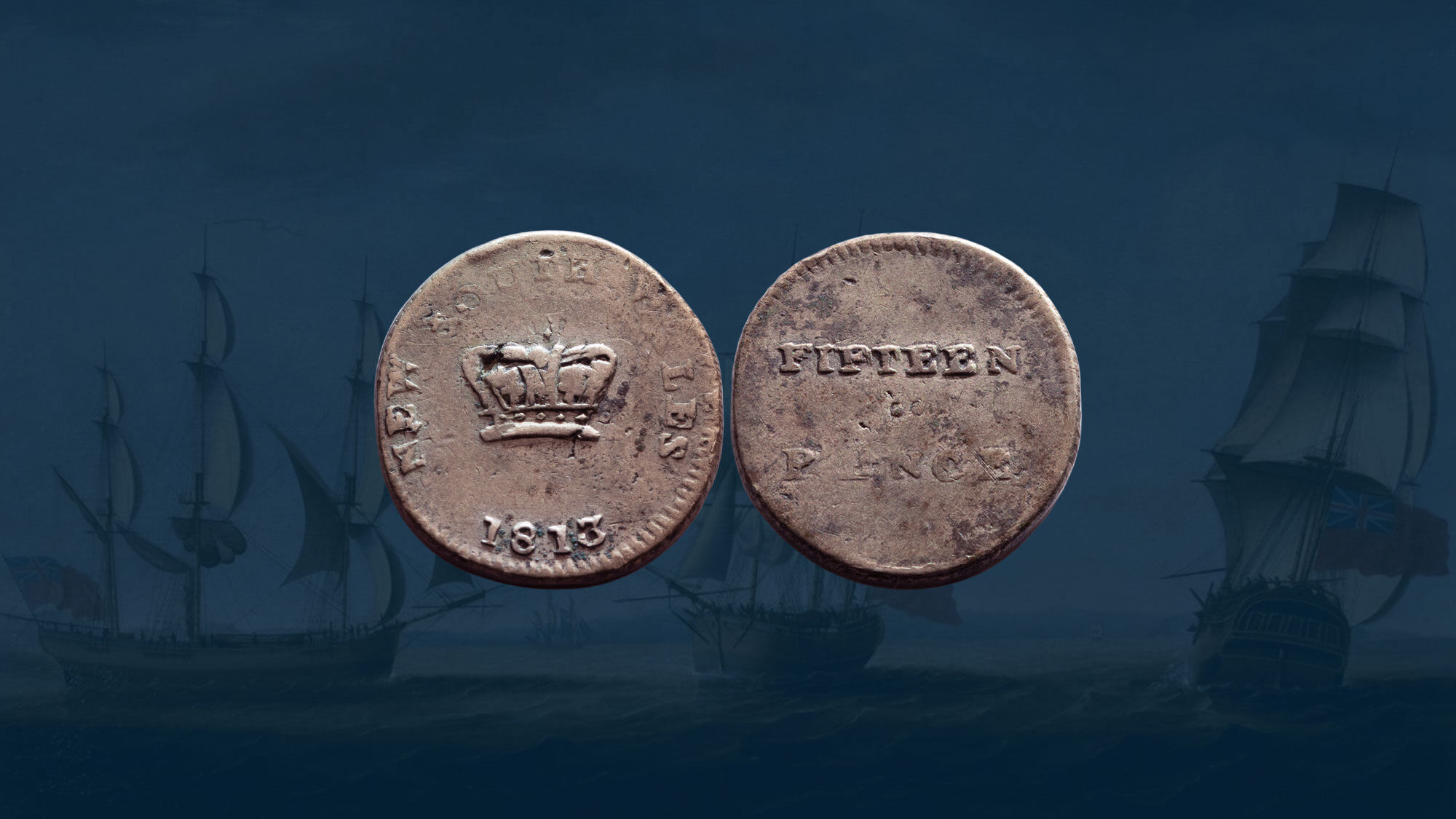
Macquarie had high hopes for the Holey Dollar and Dump, and in particular the Dump. He stated that the Dump would fill the role of small change and would remove much of the need for promissory notes of low denominations.
This 1813 Dump is an inordinately rare example of the nation’s first fifteen pence. Struck from a die combination that historians refer to as obverse die ‘C’ and reverse die ‘4’, eight examples are known. Historians suggest that due to the crude nature of the C/4 Dumps, they may have been trials presented to Governor Lachlan Macquarie before production officially commenced.
Over and above the rarity of the C/4 Dumps, the quality of this coin is superior. It is one of the finest of the C/4s. And interestingly (coincidentally) the coin has been held with your finest known E/3 in the same collection from 1988 on wards. And if you take up this offer, the tradition continues.
The Holey Dollar, and the Dump, are the nation’s first coins, minted in 1813 by order of Governor Lachlan Macquarie.
The issuing of Australia’s first coinage symbolised the changing dynamics of the penal colony of New South Wales. The colony had started out in 1788 as a jail, a repository for convicts, under the governorship of Captain Arthur Phillip. It had emerged some twenty-five years later as a thriving economy requiring a formal medium of exchange to support a burgeoning commercial hub.
As Macquarie had no access to metal blanks to create his currency, he improvised and acquired 40,000 Spanish Silver Dollars as a substitute.
To make his new coinage unique to the colony, and to inhibit their export, he employed emancipated convict William Henshall to cut a hole in each silver dollar.
Each holed silver dollar was then counterstamped on both sides, around the edge of the hole. On one side, the date 1813 and the issuing authority of New South Wales. And on the other side, the value 'Five Shillings' with some decorative embellishments. It became the Holey Dollar.
The silver disc that fell out of the hole was also overstamped with a crown, the issuing authority of New South Wales. And on the other side the value of Fifteen Pence. It became the Dump.
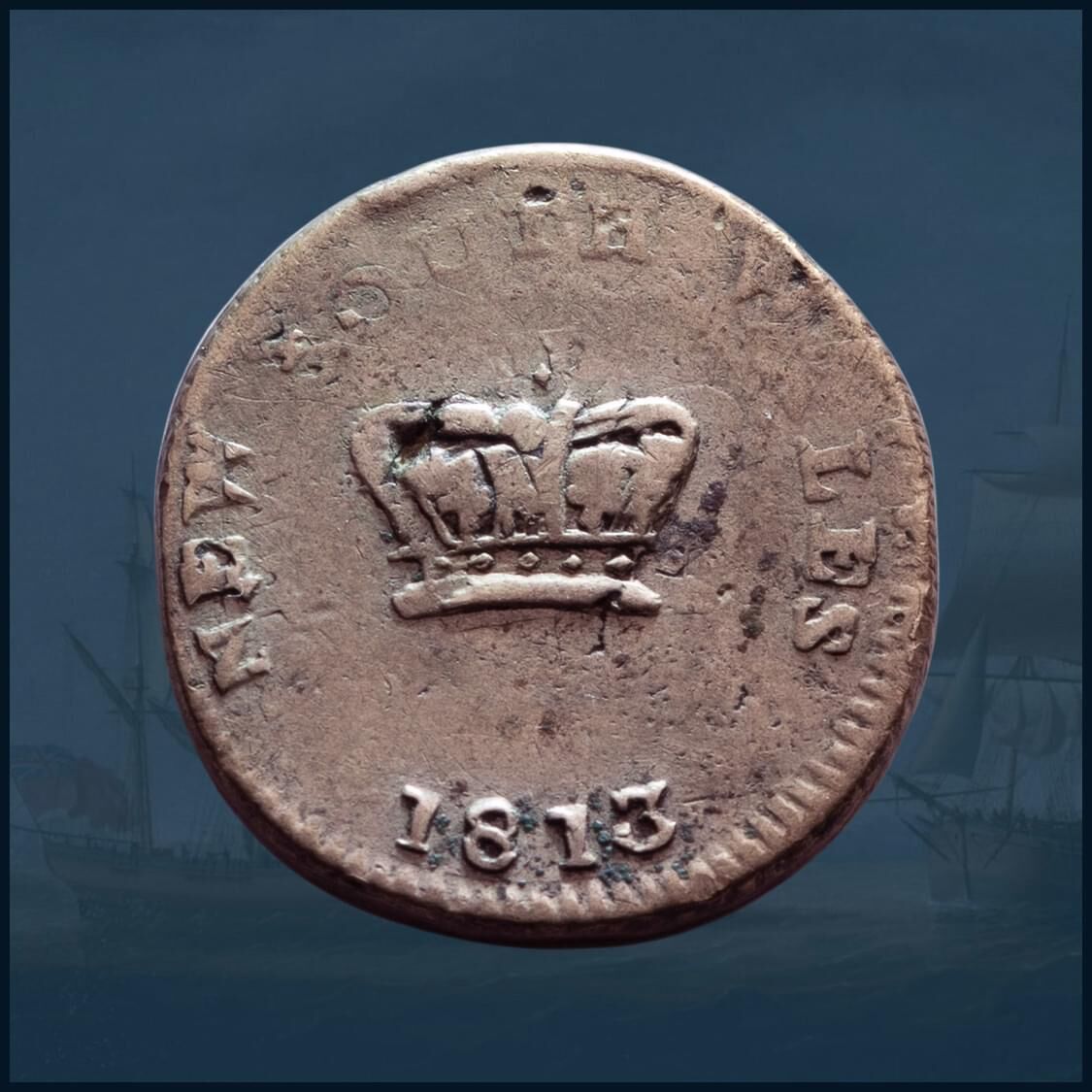
1813 Dump Type C4
Good Fine and one of the finest known
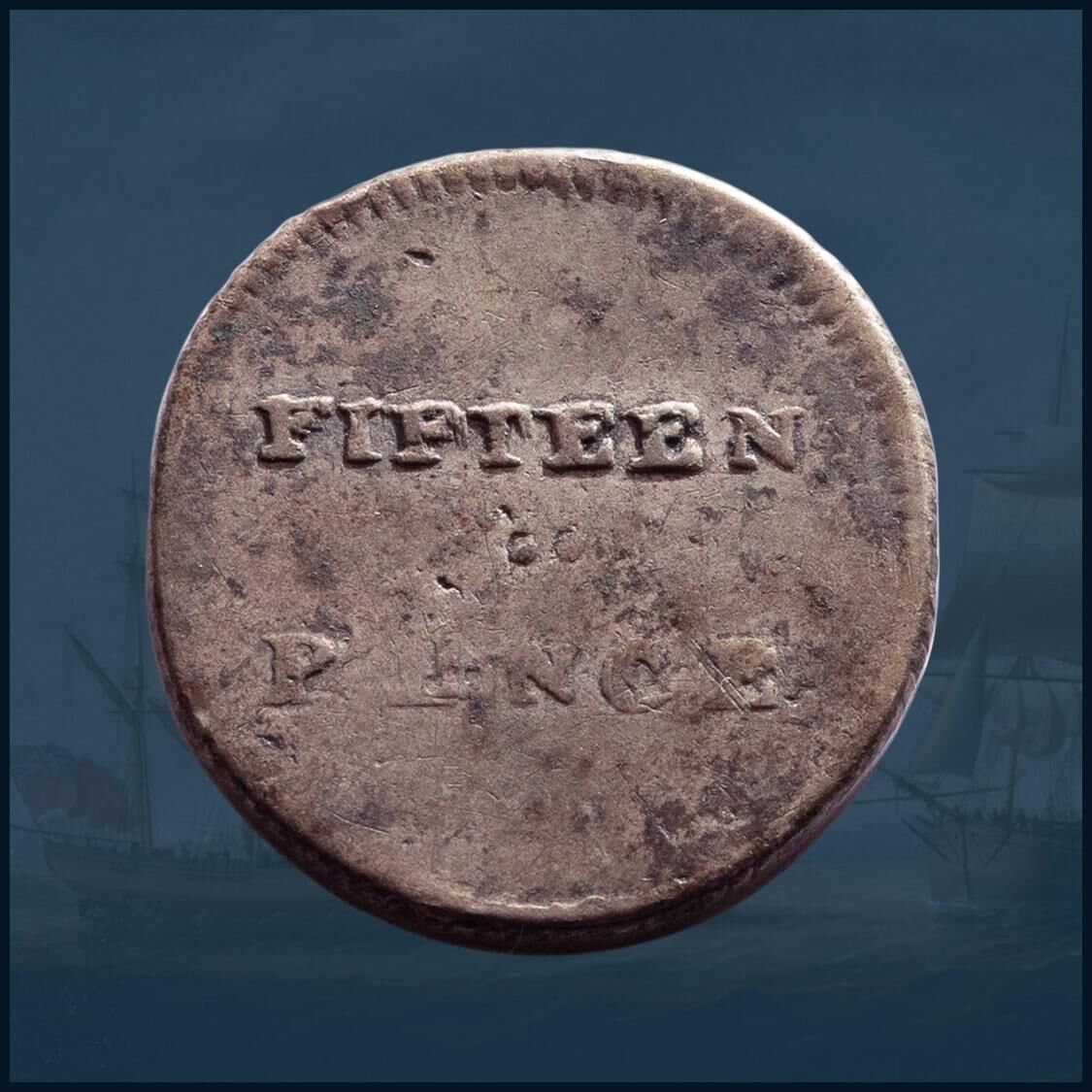
1813 Dump Type C4
Good Fine and one of the finest known
The industry acknowledges that there are about one thousand surviving examples of the 1813 Dump, with eight hundred available to collectors, the balance held in museums and public institutions.
Within that collector pool, the Dump appears in four distinctly different die combinations or styles. The four combinations have been classified by respected collector and author Bill Mira as the type A/1, D/2, E/3 and C/4, the letter referring to the obverse die, the numeral representing the reverse die.
No examples have been identified that differ from the four styles.
On the obverse, the different styles are reflected in the shape of the cross on the crown, the position of this cross in relation to the letters in the legend above it. And in the shapes and positioning of the row of five jewels in the band of the crown.
On the reverse, differences are found in the distances between the words 'FIFTEEN' and 'PENCE' and in the position of the 'T' in 'FIFTEEN' in relation to the 'N' in 'PENCE'.
The E/3 and C/4 dies produced coins that were very crude and esoteric and tend to be enjoyed by collectors seeking to acquire one of each style. There is a suggestion that they may have been test pieces presented to Governor Macquarie before production began. Or the work of another engraver that was discarded due to the poor result.
Many of the C/4 Dumps, in particular, have surface cracks and splits supporting the theory that they were produced to establish the correct striking pressure and planchet temperatures. That they may have been contemporary forgeries struck in silver, has also been muted.
Obverse die C:
An imaginary line drawn along the base of the Crown passes above the 'N' of 'NEW' and above the top of the 'S' of 'WALES'.
The cross points between the 'T' and the 'H' of 'SOUTH'.
The '3' in 1813 is upright.
The five jewels are diamond-shaped and are central in the band.
Reverse die 4:
The upright stroke of 'F' in 'FIFTEEN' is to the right of the upright stroke of 'P' in 'PENCE.
The vertical stroke of 'T' is well left of the centre of the 'N'.
'FIFTEEN' and 'PENCE' are 4mm apart.
There is a round punch mark in the centre of the reverse.
© Copyright: Coinworks