The finest 1813 Dump, struck with the rare D/2 dies, ex J. J. Ford

This J. J. Ford 1813 Dump is a remarkable piece of colonial history. At About Uncirculated, it is extraordinary and is the only known D/2 Dump at this quality level. There are none of a higher quality. Quite remarkable when you consider that the Dump was the workhorse of the colony.
This Dump was offered in 2004, at Stacks, New York, opening auction of the year. Viewed as the passive partner to the higher denomination Holey Dollar, the coin, forced a market-rethink about the status and the price at which top quality Dumps can - and should – command. The coin cemented its position as the finest known and put top quality 1813 Dumps 'on the map' on a worldwide scale breaking the $100,000 barrier for the first time ever.
Ranked number one!
A pecking order exists amongst top echelon Colonial Dumps. This particular example, with a quality level of About Uncirculated, ranks as Number 1 of the surviving D/2 examples. The Dump with a value of fifteen pence circulated widely in the colony, the extreme wear on most Dumps evidence that they saw considerable use. Not so with this Dump. In the hand the coin is stunning, its state of preservation simply miraculous. The fields are highly reflective with grey/blue toning, the coin mint fresh for quality.
Under the eye glass, the coin continues to shine. We note the horizontal line that makes up the cross on the orb at the top of the crown. And the smudging of the vertical line. Most collectors would not even be aware that, as with the 1852 Adelaide Pound, the Dump design includes a cross on the orb at the top of the crown.
And there is a 'stop' in the legend 'NEW SOUTH WALES' after 'NEW' and after 'SOUTH'. The dies would have had shallow depressions to create the stops and must have quickly filled with debris for they can be difficult - or impossible - to discern on even the best of D/2 examples.
There is no doubt that heat was involved in the creation of the Dump. When the disc fell out of the centre of the Spanish Dollar, it still bore the original dollar design of a four quadrant shield, depicting a lion and castle in each quadrant. High temperatures obliterated the original Spanish Dollar design from most Dumps.
This Dump has extensive evidence of the original Spanish Dollar design on the reverse. That evidence includes the base of the crown, the cross-bars of the four quadrants in the shield and the remnants of the castle and lion in each quadrant. Its sizeable and its impressive.
While the method of manufacture of the nation's first coins is unknown, history records that convicted forger and emancipist, William Henshall, was hired to create the nation's first currency. Effectively our first Mint Master. Henshall declared his involvement in the creation of the Dump by inserting his initial, an 'H' for Henshall, on some - but not all - of the reverse dies of the Dump. The 'H' for Henshall is rarely seen in D/2 examples. And even when it is sighted it can only be described as a 'blob'. The 'H' for Henshall is present on this coin and is shaped. Quite amazing!
An 1813 Dump to be savoured
The buyer of this 1813 Dump will take pride in knowing that the coin was formerly held as part of the legendary J. J. Ford Collection.
High profile collectors are noted for holding only the very best. John J. Ford was a major force in numismatics in the USA for 68 years both as a professional numismatist and a consummate collector. That this coin was part of the J. J. Ford Collection speaks volumes to its calibre.
The buyer will also take pride in knowing that this Dump has been exhibited twice, in 2013 at the Macquarie Bank exhibition. And in 2019, at the Royal Australian Mint Canberra, in the 'All That Is Holey' Exhibition.
The coin was a natural contender for inclusion in the exhibitions. It was struck from the very rare D/2 dies. And with a quality grading of About Uncirculated is clearly the best.
Historians have determined that four individual dies were used in the striking of the 1813 Dump. The A/1 Dump is the most frequently sighted (75% of cases). Next in line for availability is the D/2 dies (20%). Then comes the C/4 and E/3 dies that while incredibly rare, produced coins that were extremely crude.
This coin is an exceptional piece for it has design detail and shows a finesse in the striking that is not normally seen in the D/2 type. Historians argue that the D/2 design types were most likely the first coins produced, since the majority of specimens reflect one major design characteristic. The legend and the date tend to be partially struck because the dies were too big for the blank. And the denticles (introduced as a security measure) are almost always absent. On this Dump, however, the legend and the date are well contained in the coin and the partial denticles are crisp and clear.
1813 Dump Type D/2, About Uncirculated, ex J. J. Ford Collection, $165,000.
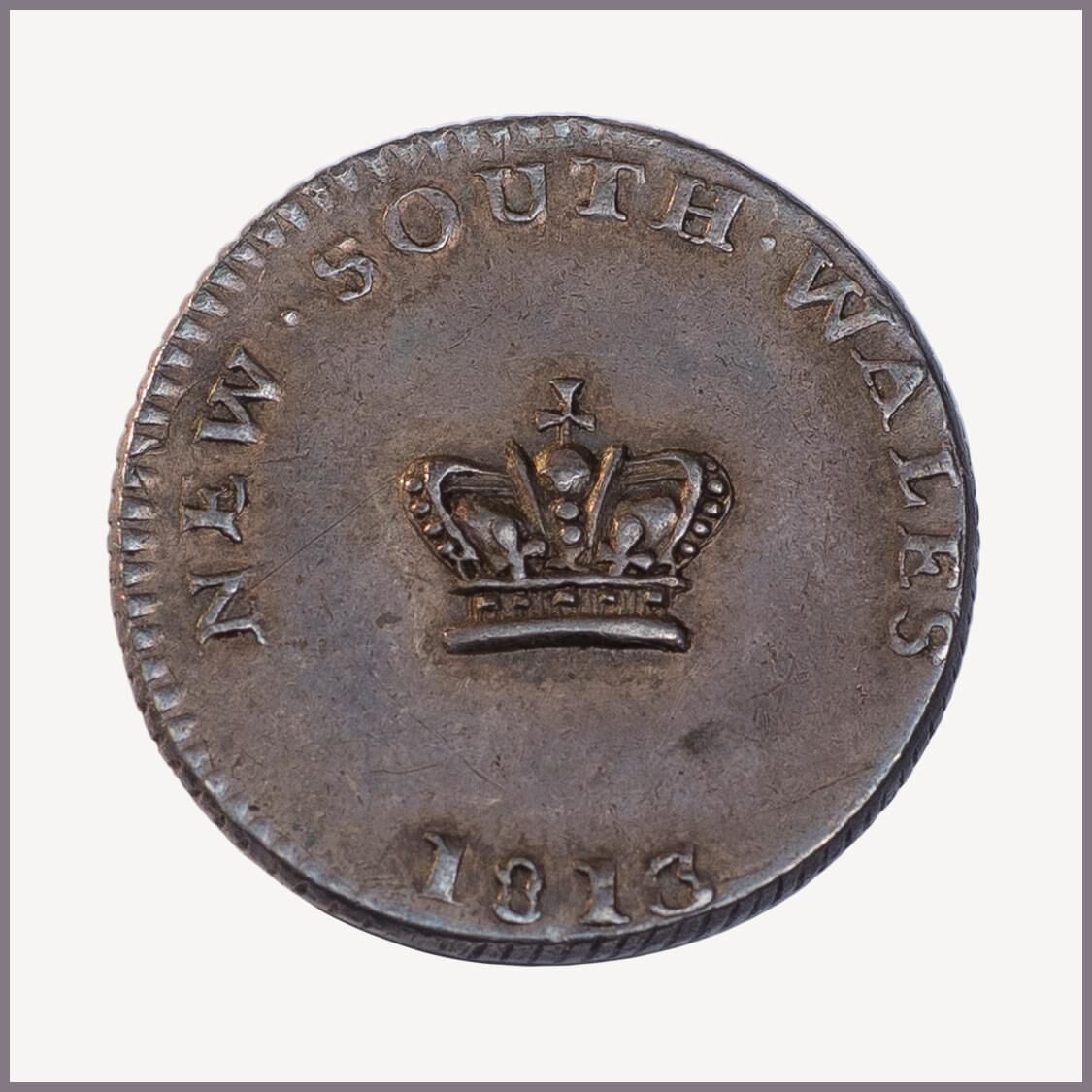
About Uncirculated 1813 Dump ex J. J. Ford Collection
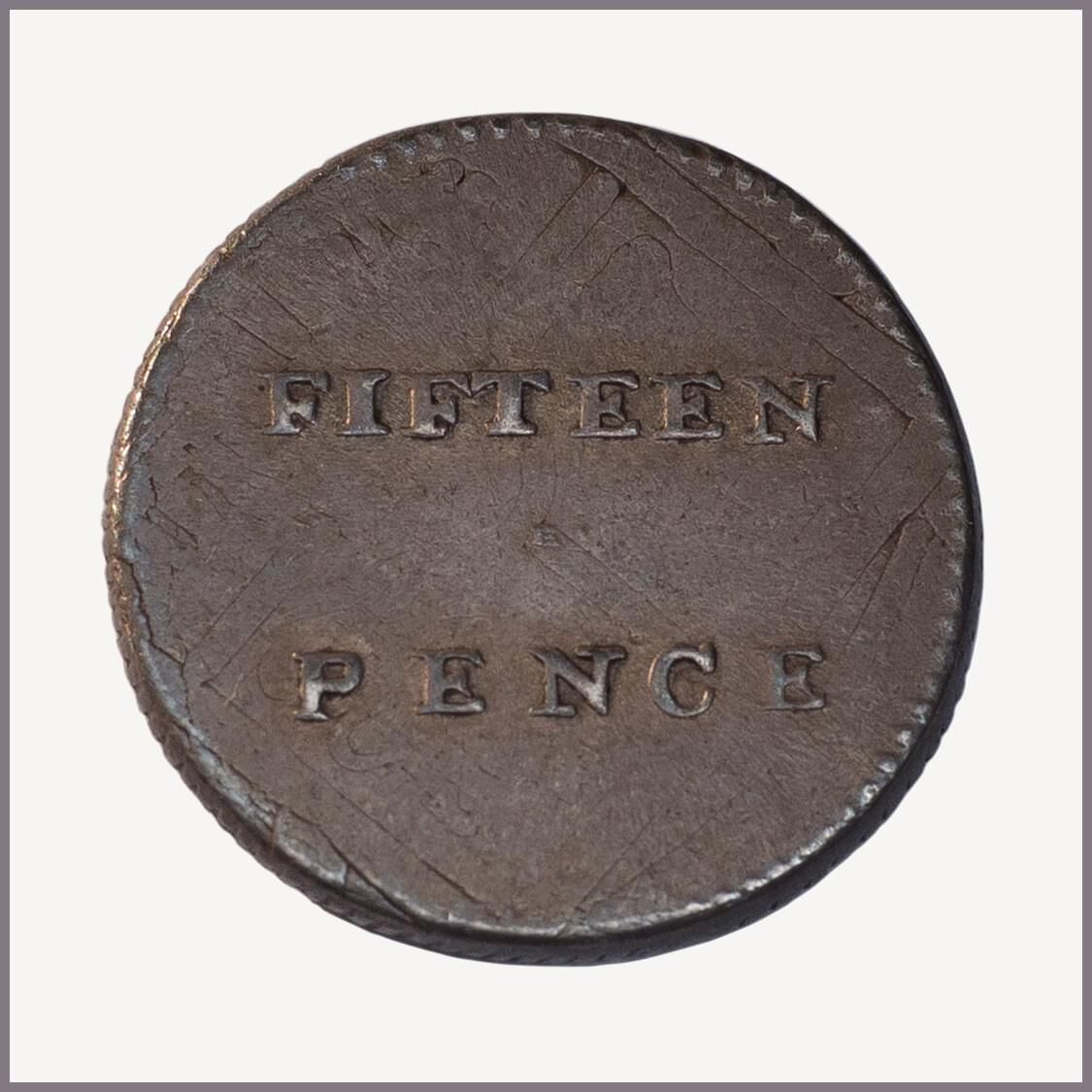
About Uncirculated 1813 Dump ex J. J. Ford Collection
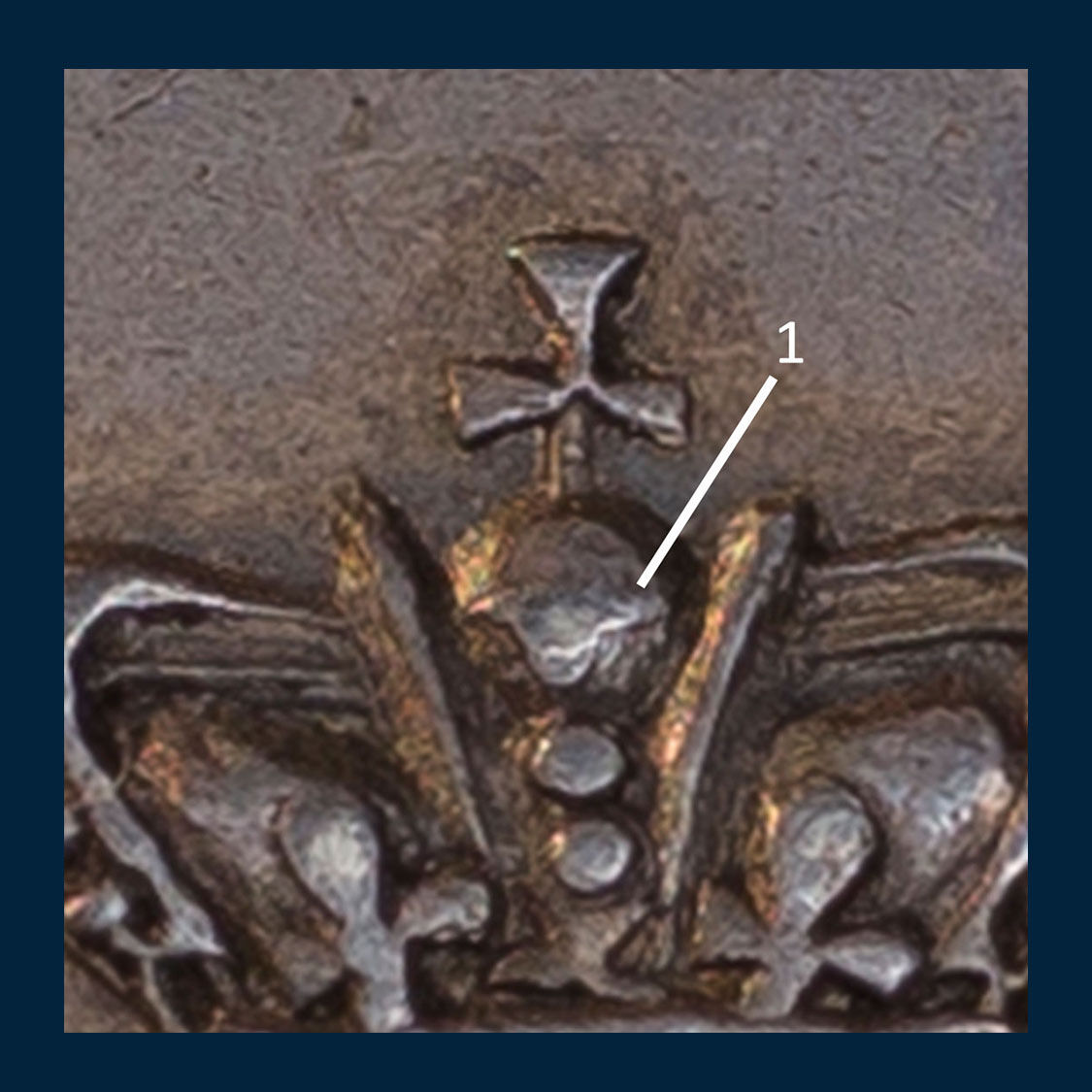
The horizontal line that makes up the cross on the orb at the top of the crown is present. Amazing!
This coin shines under an eye glass. We note the horizontal line that makes up the cross on the orb at the top of the crown. And the smudging of the vertical line. Most collectors would not even be aware that, as with the 1852 Adelaide Pound, the Dump design includes a cross on the orb at the top of the crown. (See close-up above.)
Henshall declared his involvement in the creation of the Dump by inserting his initial, an 'H' for Henshall, on some - but not all - of the reverse dies of the Dump. The 'H' for Henshall is rarely seen in D/2 examples. And even when it is sighted it can only be described as a 'blob'. The 'H' for Henshall is present on this coin and is formed. Quite amazing! (See close up below.)
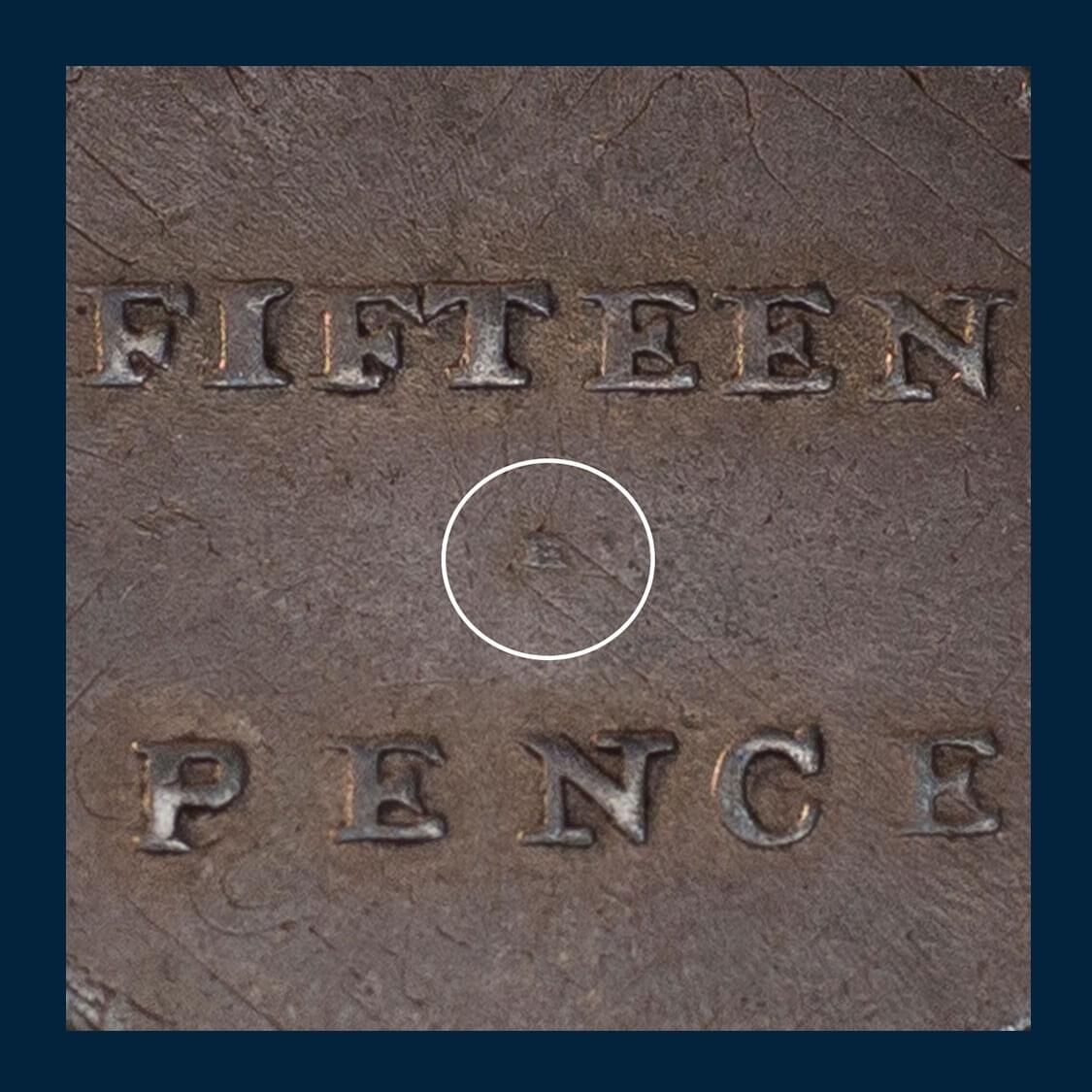
The 'H' for Henshall is present on this coin and is formed. Again, quite amazing!
© Copyright: Coinworks