The 1852 Government Assay Office Adelaide Gold One Pound Type 1B, struck with the beaded inner circle reverse die, edge with wide milling

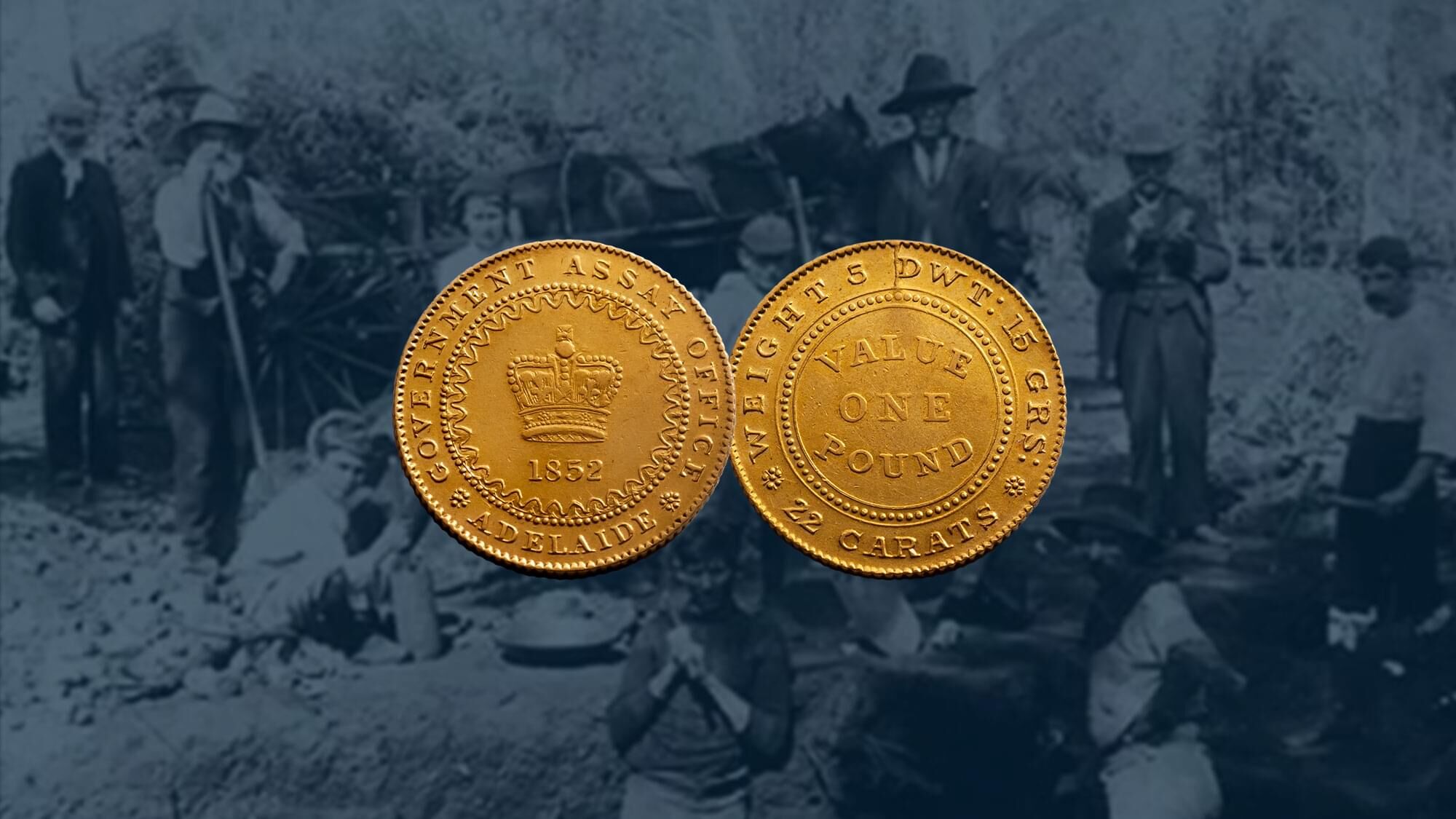
Because the reverse design of the Type I and the Type II are different, it is a natural consequence for collectors to strive for both coins, one of each type. In saying this, most collectors try to achieve some synergy between the two coins, so that the combined effect is impressive. And this Type I Adelaide Pound will sit very nicely alongside your Type II. It is visually very attractive. Because the edges on both this coin and your Type II are strong, and the fields lustrous, a novice looking at the crown-side will most likely see no differences between the two coins. The Type I reverse is also lustrous. Your Type II probably more so. (Most Type II reverses are highly lustrous). The differences in the reverse between the Type I and the Type II will be those that should be noted: the style of lettering, the inner circle (beaded or scalloped), the tell-tale crack in the legend and and the softness in the strike in the central area of the design, an inherent trait of the Type I Adelaide Pound due to the focus of pressure in the first run being exerted on the edges. Overwhelmingly this Type I and your Type II will complement each other. They are well matched as a pair.
Just because this Adelaide Pound has circulated, it is very much worth considering. For it is the degree of circulation that has brought the coin to a price point that makes it affordable, and thus very appealing, to a large number of collectors.
That is the essence of this offering.
The 1813 Holey Dollar and the 1852 Type I Adelaide Pound are two of Australia’s leading coin rarities. Historically critical as our very first silver coin. And our very first gold coin. Instantly recognisable. And keenly sought after.
And importantly, both coins are sought after at all quality levels the reason simply that different quality levels present different price opportunities for collectors.
And not every collector has the means to acquire a top-shelf coin. Most collectors simply want a 'nice' example.
It is a fact that the strongest market for the Holey Dollar and the Type I Adelaide Pound are the circulated examples, those coins priced below $125,000.
The term 'circulated' needs to be qualified here for while wear is totally acceptable, harsh treatment that has resulted in strong gouges tends to be avoided. As are those coins that have been mounted in jewellery.
The above statement is intended to reinforce the investment value of well circulated examples of the Holey Dollar and Type I Adelaide Pound.
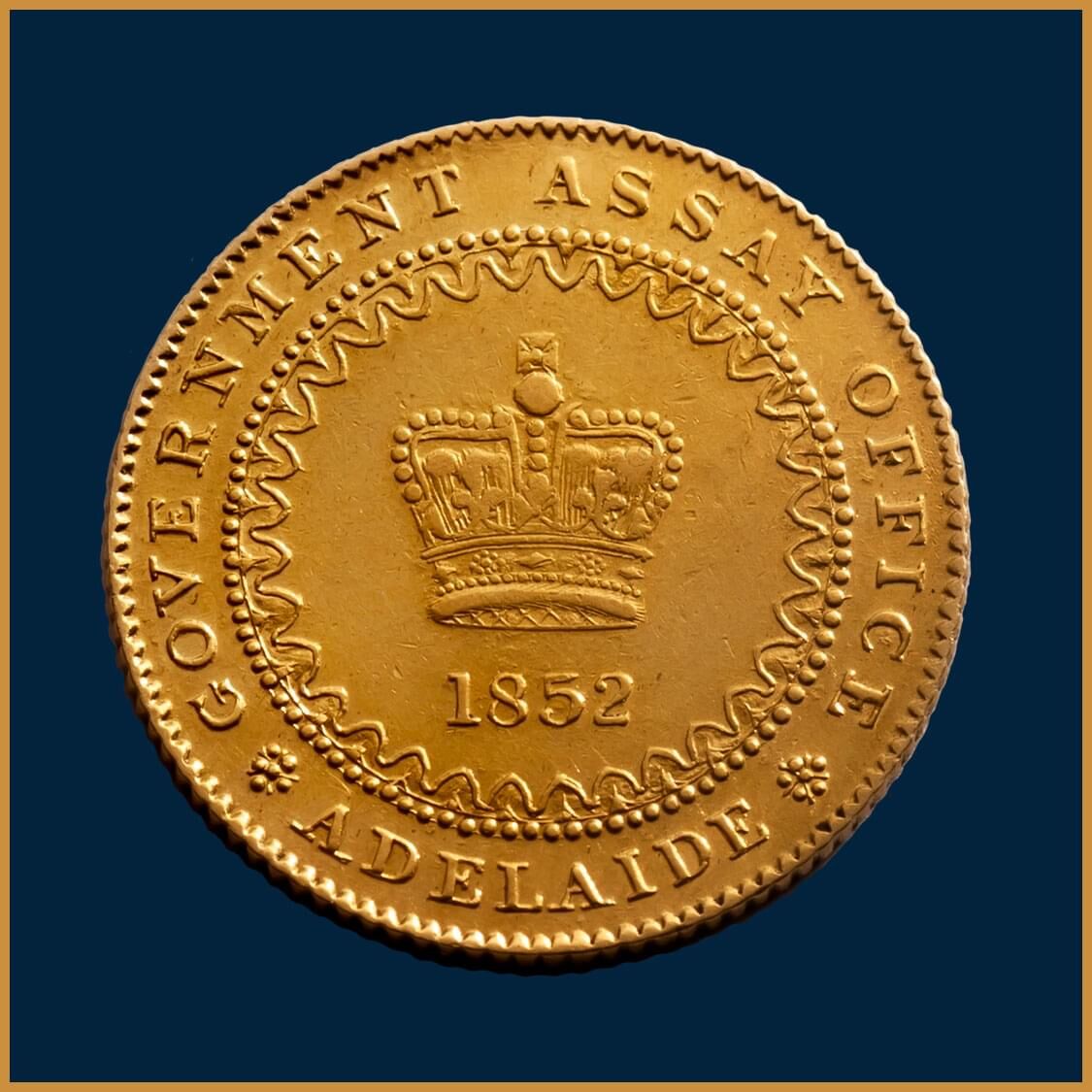
1852 Adelaide Pound Type I
Obverse
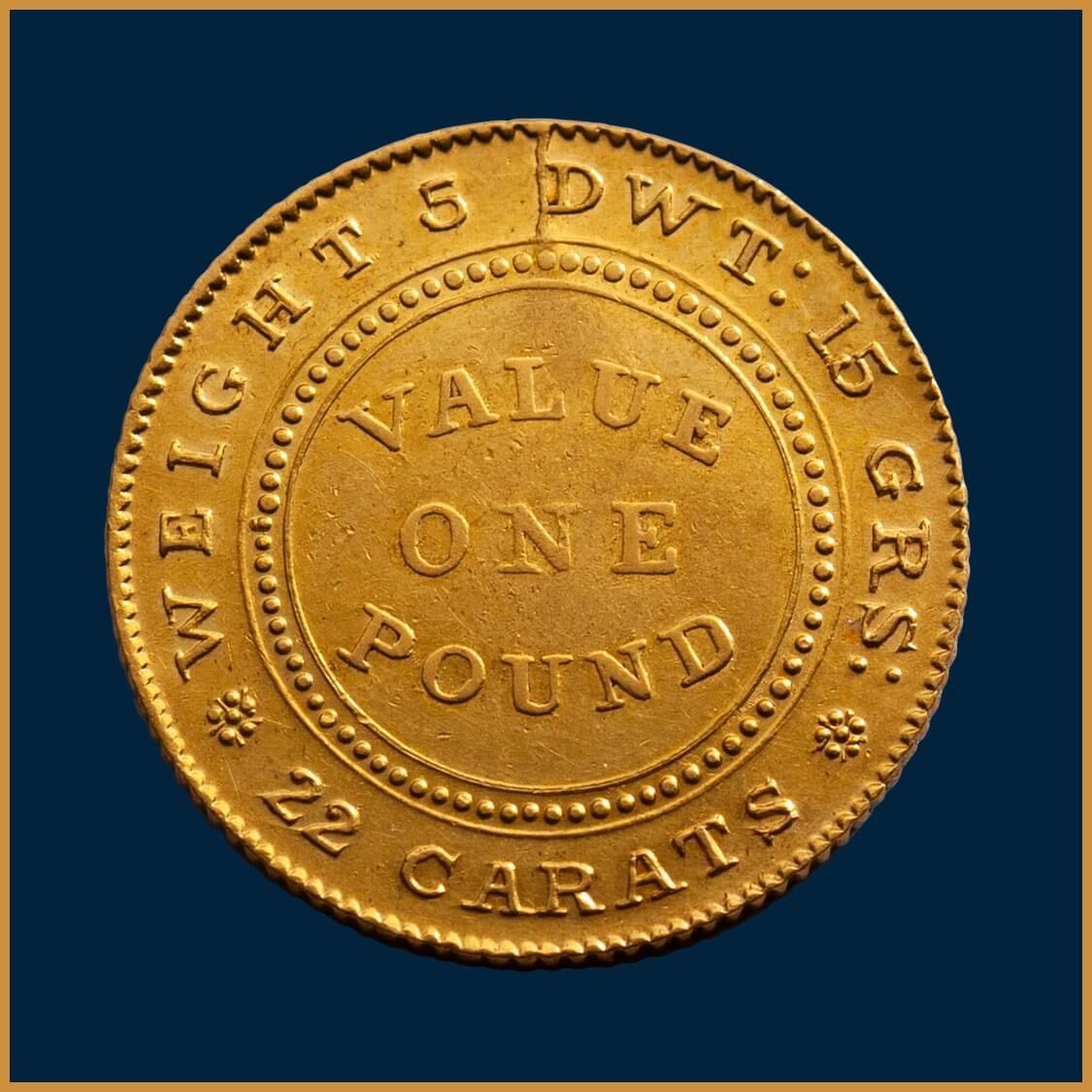
1852 Adelaide Pound Type I
Reverse
The first gold coin for the nation was struck at the Adelaide Assay Office on 23 September 1852. We know it today as the 1852 Adelaide Pound.
It is our most popular gold coin, and sought after at all quality levels.
Collectors have a choice when it comes to acquiring an 1852 Adelaide Pound. An example from the first production run. Or the second run.
The nation’s first gold coin was produced over two production runs. The same obverse design was used throughout, featuring the legend 'Government Assay Office Adelaide', a crown and the date '1852'.
But each production run used different reverse dies, the first using a die with stylish lettering and an elegant beaded inner circle. (Coins struck from the first die are known as Type I Adelaide Pounds.)
The second die had plain lettering and a scalloped inner circle. (Coins struck from the second die are known as Type II Adelaide Pounds
Irrespective of the production run, the Adelaide Pound is a scarce coin.
Forty examples survive today of the Type I, with perhaps two hundred and fifty of the Type II.
The 1852 Government Assay Office Adelaide Gold One Pound Type 1B, struck with the beaded inner circle reverse die, edge with wide milling, quality About Extremely Fine.
$95,000
Because the reverse design of the Type I and the Type II are different, it is a natural consequence for collectors to strive for both coins, one of each type. In saying this, most collectors try to achieve some synergy between the two coins, so that the combined effect is impressive. And this Type I Adelaide Pound will sit very nicely alongside your Type II. It is visually very attractive. Because the edges on both this coin and your Type II are strong, and the fields lustrous, a novice looking at the crown-side will most likely see no differences between the two coins.
The Type I reverse is also lustrous. Your Type II probably more so. (Most Type II reverses are highly lustrous). The differences in the reverse between the Type I and the Type II will be those that should be noted: the style of lettering, the inner circle (scalloped or beaded), the tell-tale crack in the legend and and the softness in the strike in the central area of the design, an inherent trait of the Type I Adelaide Pound due to the focus of pressure in the first run being exerted on the edges.
Overwhelmingly this Type I and your Type II will complement each other. They are well matched as a pair.
© Copyright: Coinworks