The 1852 Government Assay Office Adelaide Gold One Pound Type II, struck with the scalloped inner circle reverse die, edge with wide milling

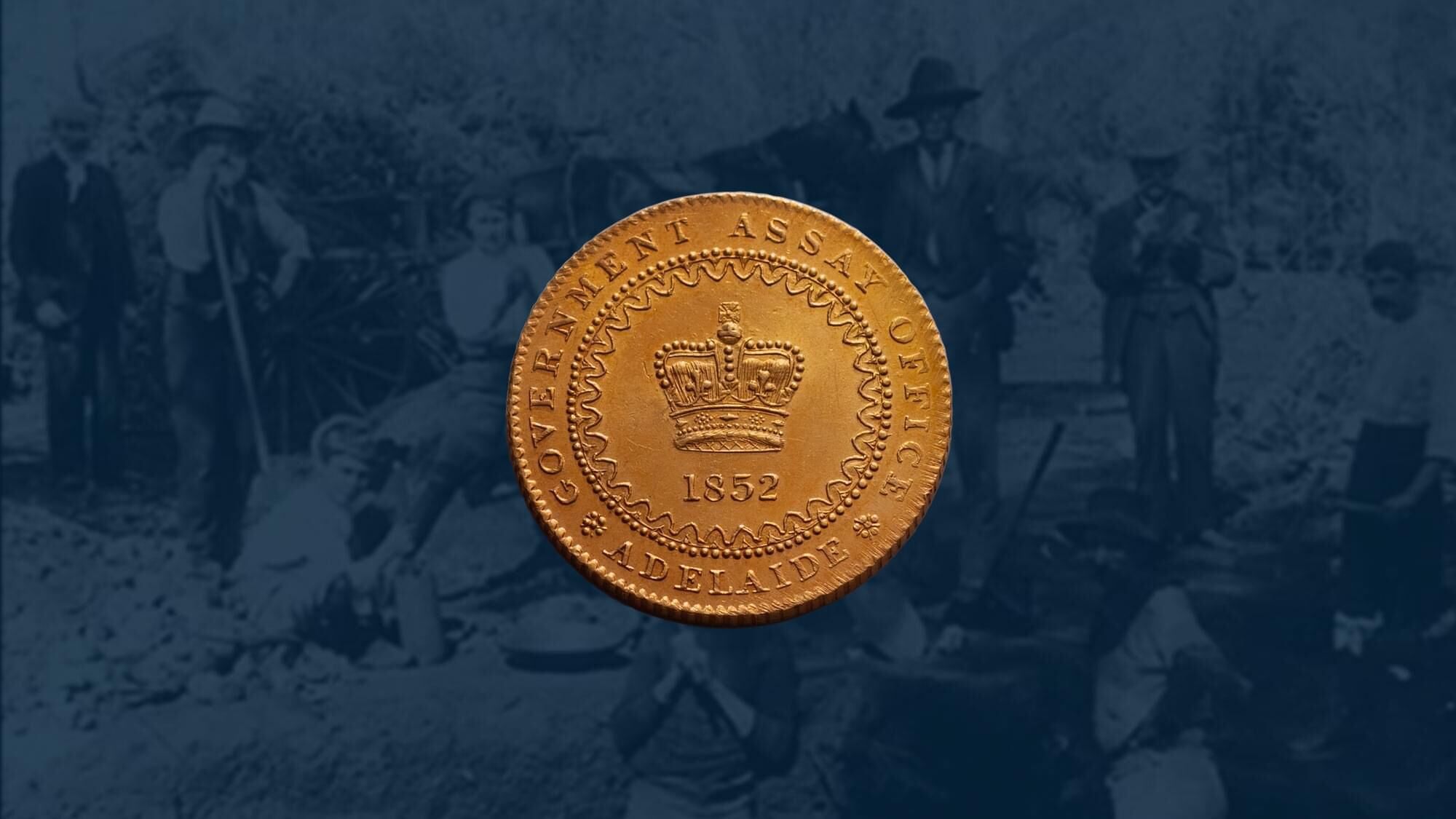
This 1852 Adelaide Pound has a quality level of Uncirculated. We checked our records. It’s been years since we last offered one at this quality level. We have offered lesser examples at $30,000 to $35,000. And a handful that were better, and obviously priced higher at $70,000 to $75,000.
Strict Uncirculated Adelaide Gold One Pounds are hard to find. And they have a seriously good price advantage, available under $50,000.
There is everything to like, and nothing to dislike, about this 1852 Adelaide Pound. Including the price. The coin is highly lustrous on both obverse and reverse and the prime design details of the crown and the legend, Government Assay Office Adelaide, are well defined. So too is the date '1852'.
This Adelaide Pound is presented in a miracle state. Uncirculated and available now.
The Adelaide One Pound is the nation’s first gold coin, struck in 1852 at the South Australian Government Assay Office, Adelaide.
Local jeweler and engraver Joshua Payne created the dies for the nation's first gold coins. The obverse declared the issuing authority, Government Assay Office Adelaide, encircling a crown and the date, 1852, the design used continuously throughout production. The reverse declared the fineness and weight encircling it's value.
With its fine design detail, the Adelaide Pound is compelling and a piece of significance, its status as the nation's first gold coin ensuring that it will never be forgotten.
And it is extremely rare with less than forty examples surviving from the first production run and perhaps two hundred and fifty from the second. Either first or second run, the Adelaide Pound is a prized possession, an iconic gold coin revered by local and international buyers.
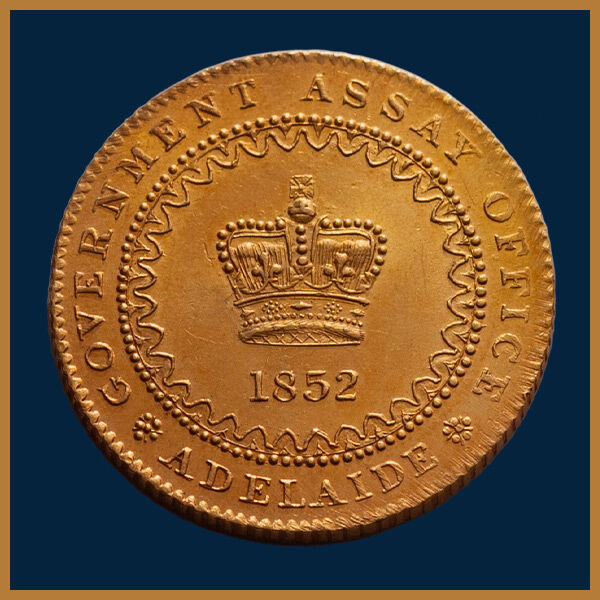
Uncirculated
1852 Adelaide One Pound
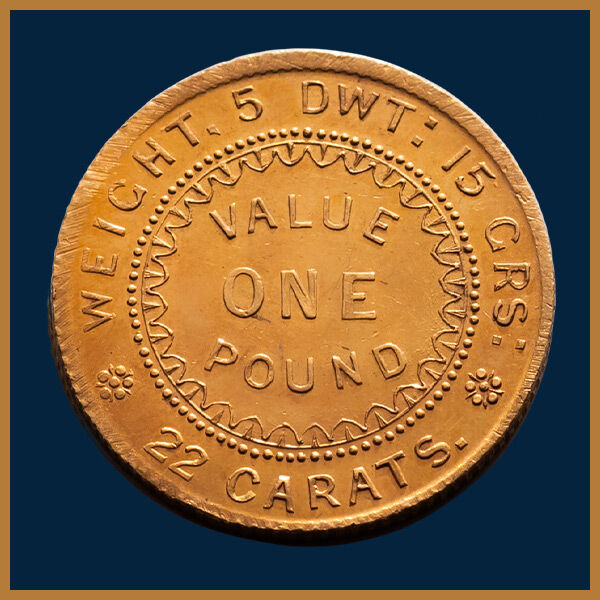
Uncirculated
1852 Adelaide One Pound
Dummy text
Dummy text
The first production run of Adelaide Pounds was short and eventful. A cracking of the reverse die during the striking of the first fifty coins halted production.
The impaired die, featuring a beaded inner circle, was replaced and production resumed, staff electing to use a die with a different design to that used in the first run. The second die featured a scalloped inner border. The move to use differently designed dies was profound for it clearly differentiates those coins struck in the first and second run.
In the second production run, pressure was relaxed on the edges to lengthen the die usage and re-focused on the central area of the design. The reduction in pressure on the edges meant that the edge perfection achieved in the first run of coins was simply not achievable. Most Adelaide Pounds from the second run therefore show some form of weakness in the edges, particularly in the Government Assay Office area. Occasionally the weakness is exhibited all the way round. Due to the re-focus of pressure away from the edges and to the centre of the coin, the crown design is almost always well executed with flattened areas simply due to wear.
The official recorded mintage of the nation’s first gold coin is 24,648, a relatively small number given the amount of gold deposited at the Assay Office. Very few out of the mintage actually circulated, with many of them ending up in the melting pot. Assaying of the one pound samples sent to London determined that the intrinsic value of the gold contained in each piece exceeded its nominal value. The coin therefore became the target of profiteers and were exported to London and melted down.
The Adelaide Gold One Pound, struck in the first production run, is known as the Type I Adelaide Pound and fewer than forty examples survive from the first production run in varying degrees of quality.
The Adelaide Gold One Pound, struck in the second production run, is known as the Type II Adelaide Pound. It is an iconic gold coin with perhaps two hundred and fifty available to collectors.
The clear advantage of the Type II over the Type I is its affordability.
The discovery of significant gold deposits in Australia in 1851 created sudden wealth and stimulated immigration on a vast scale. The Gold Rush transformed the nation, economically and socially, and marked the beginnings of a modern multi-cultural Australia.
No colony was immune from the dramatic effects of the discovery of gold. Those that were rich in gold. And those, such as the colony of South Australia, that was devoid of the precious metal, its economy collapsing due to the mass exit of manpower and currency lured to the Victorian gold fields.
While enormous potential wealth was being dug out of the ground, there was no local mechanism to transform the gold into currency. Money was scarce and the colonial governments had no authority to strike coinage.
That meant gold had to be shipped to London to convert into sovereigns, involving substantial shipping costs and a round-trip time of about six to eight months. The banks monopolised gold buying on the fields, forcing artificially low prices on the diggers who were powerless to achieve the higher London price. Transport from the fields was dangerous and expensive.
There was unanimous agreement amongst the five colonies, Victoria, Western Australia, Tasmania, South Australia and New South Wales, that a gold coinage had to be locally produced, that the six month turnaround of shipping gold off to London and receiving sovereigns in exchange was unworkable. As each colony was under different pressures however, they failed to agree on the form a currency should take. And to its urgency.
The New South Wales legislature debated the establishment of an Assay Office to resolve the currency crisis. The notion was rejected, the legislators opting instead to follow protocols and petition London for the establishment of a colonial Mint. The decision was heavily influenced by the banks. While both options would present an impediment to their business, a mint was the lesser of two evils.
In the knowledge that an 'official' solution might take years, the colonial Governments of South Australia and Victoria sought a more immediate resolve, that of an Assay Office. Victoria's rumblings went nowhere. South Australia however pursued the idea with vigour, circumventing currency laws and established the Adelaide Government Assay Office.
The opening of the Adelaide Assay office required local legislation. It came in the form of the Bullion Act, enacted on 23 January 1852. The Act authorised the opening of a Government Assay Office that would produce gold ingots. While not legal tender, they could be exchanged for banknotes at the rate of £3 11/- per ounce.
Production of ingots began on 4 March 1852.
Fielding numerous complaints about the ingots and their efficacy in solving South Australia's financial crisis, the Act was amended in November of the same year and the striking of ingots repealed.
Instead the Government Assayer was instructed to strike gold pieces with a value of Ten Shillings (10/-), One Pound (£1), Two Pounds (£2) and Five Pounds (£5).
Local jeweler and engraver Joshua Payne created the dies for the nation's first gold coins. The obverse declared the issuing authority, Government Assay Office Adelaide, encircling a crown and the date, 1852, the design used continuously throughout production. The reverse declared the fineness and weight encircling it's value.
Two designs were prepared for the reverse one pound dies, the first with stylish lettering and a simple, elegant beaded inner circle. It was used in the very first production run. The second was prepared with plain lettering and a scalloped inner circle (similar to that used on the obverse) and was used throughout the second production run.
Only the One Pound coin was struck in 1852, the final mintage recorded as 24,648. No Five Pound pieces were struck in that year. The dies are however currently held in the National Collection of South Australia. Dies of the Ten Shillings and Two Pounds have never been found.
The Bullion Act was intended only as a short-term solution, its operation limited to twelve months, expiring in January 1853. No attempt was made to extend it or continue the coinage after the period originally fixed.
© Copyright: Coinworks