1919 Kookaburra Penny, Type 3, featuring a unique kookaburra design and one of fifteen to twenty known

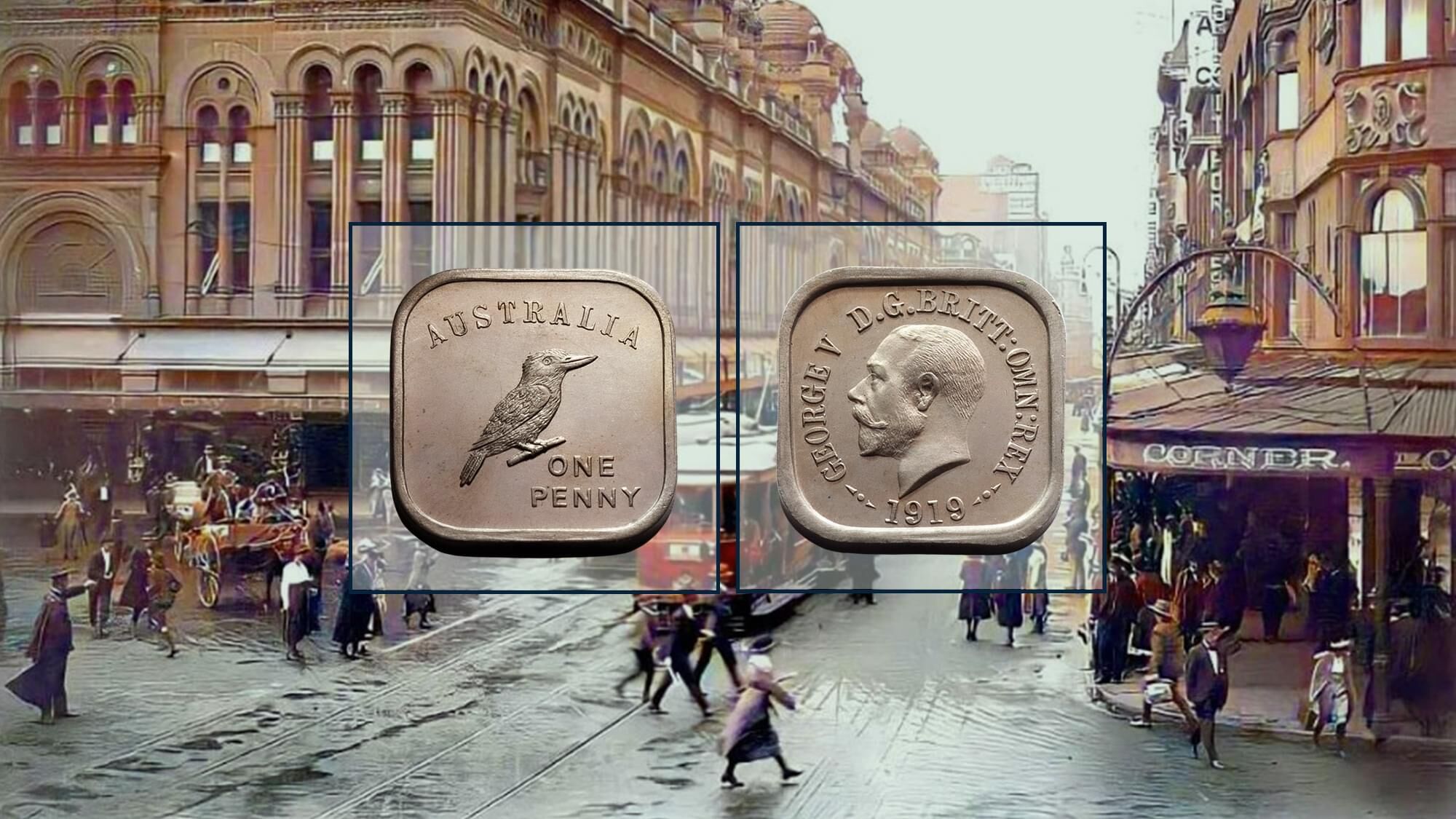
The Kookaburra coins are historical treasures: the nation's first attempt to break away from British designs and put something uniquely Australian on our coinage. They are an important part of our heritage. And they are extremely rare.
Collectors have options when it comes to acquiring a Kookaburra Penny. Our simple checklist will assist you in working through the options and involves the date, design type, quality and price.
This 1919 Type 3 Kookaburra Penny is graded Choice Uncirculated and receives a ten out of ten for each point in our check list. Read more for further information.
We have a simple four-point checklist for evaluating a Kookaburra Penny that involves the date, design type, quality and price.
1. What is the date?
The Kookaburra Pennies were struck in 1919, 1920 and 1921.
Our comments:
Each year offers opportunities for purchase involving varying degrees of rarity and price. The year 1919 is popular because it represents the start of the series, and collectors favour dates that reflect the 'beginnings'. It is also an emotional year, the signing of the World War I peace settlement at the Paris Peace Conference formalised the end of World War I.
2. What is the design type?
While all Square Pennies are rare, some designs are far rarer than others. And some designs are also unique. As you would expect, with uniqueness and rarity, can come a higher price tag. So, it's about finding a balance to your budget; the right design type to suit your budget.
Our comments:
The Type 3 is extremely rare with an estimated fifteen to twenty examples available to collectors. We might see a Type 3 on the market every one to two years. It is noted that the Type 3 has a reverse design that is unique to the type. No other kookaburra coins sports this design.
3. What is the quality?
The Square Pennies were test pieces and were not struck to the heady controls of a proof striking. As the coins were passed to the public for opinions and comments, some have been mishandled.
Our comments:
Some Kookaburra coins are so rare, that quality almost becomes irrelevant. But in cases such as the Type 3 which would become available a few times in a decade, quality can be considered. This coin is superb for quality. Take it through the light and you would be forgiven for thinking that it was minted to proof quality, the fields are like mirrors. And it is well struck, the details in the legend, portrait and the kookaburra are strongly three-dimensional. Could you improve upon the quality of this coin? We doubt it!
4. What is the price?
Given its quality assignation of Choice Uncirculated and its rarity, the 1919 Type 3 Kookaburra Penny is priced to market at $45,000.
Our comments: This 1919 Kookaburra Penny is priced at the same level as a high quality Nearly Very Fine 1930 Penny and yet is far, far scarcer.
Dummy text
Dummy text
In 1919, the Government put forward a proposal to replace the round 'British-styled' penny and halfpenny in use at the time with completely new Australian coins. Proudly nationalistic, crafted on one side, with a kookaburra sitting on a branch, underneath the word 'AUSTRALIA' and on the other side, a portrait of George V.
It was Australia's first attempt at independent design in our coinage. A currency that was Australian in imagery, concept and form. Coins with simple design elegance, produced for Australians, by Australians, in 1919, 1920 and 1921. Eleven variations of the penny and two of the halfpenny were produced over three years, each a variation on the one kookaburra theme and each variation assigned a numeric design type, Type 1 to Type 13, to make it easy for collectors.
The only denomination produced in 1919 was the square penny, crafted on one side with a kookaburra sitting on a branch. And on the other side, an uncrowned portrait of George V. Four variations on the one theme were produced in 1919 and they are designated the Type 3, Type 4, Type 5 and Type 6 Kookaburra Pennies.
The Type 3 Kookaburra Penny is the most available relative to the other 1919 designs and that is not a criticism. Simply a statement of fact. For the Type 3 is still extremely scarce with one example coming up for sale every eighteen months to two years. The remaining 1919 pennies, the Type 4, Type 5 and Type 6, are so scarce that a waiting time might range from four to ten years which would exasperate even the most patient of buyers and stifle market interest. A market is created when buyers and sellers interact, driven by a mutual interest in exchanging goods. This interaction establishes a price based on supply and demand. The reality is that you can't have a market without supply and it is the Type 3 that creates the market for the 1919 Kookaburra coins and sustains and excites buyer interest in the series.
Rarity - One of fifteen to twenty known examples. We estimate a Type 3 Kookaburra Penny would be offered every eighteen months to two years.
Composition - Nickel 75% Copper 25%
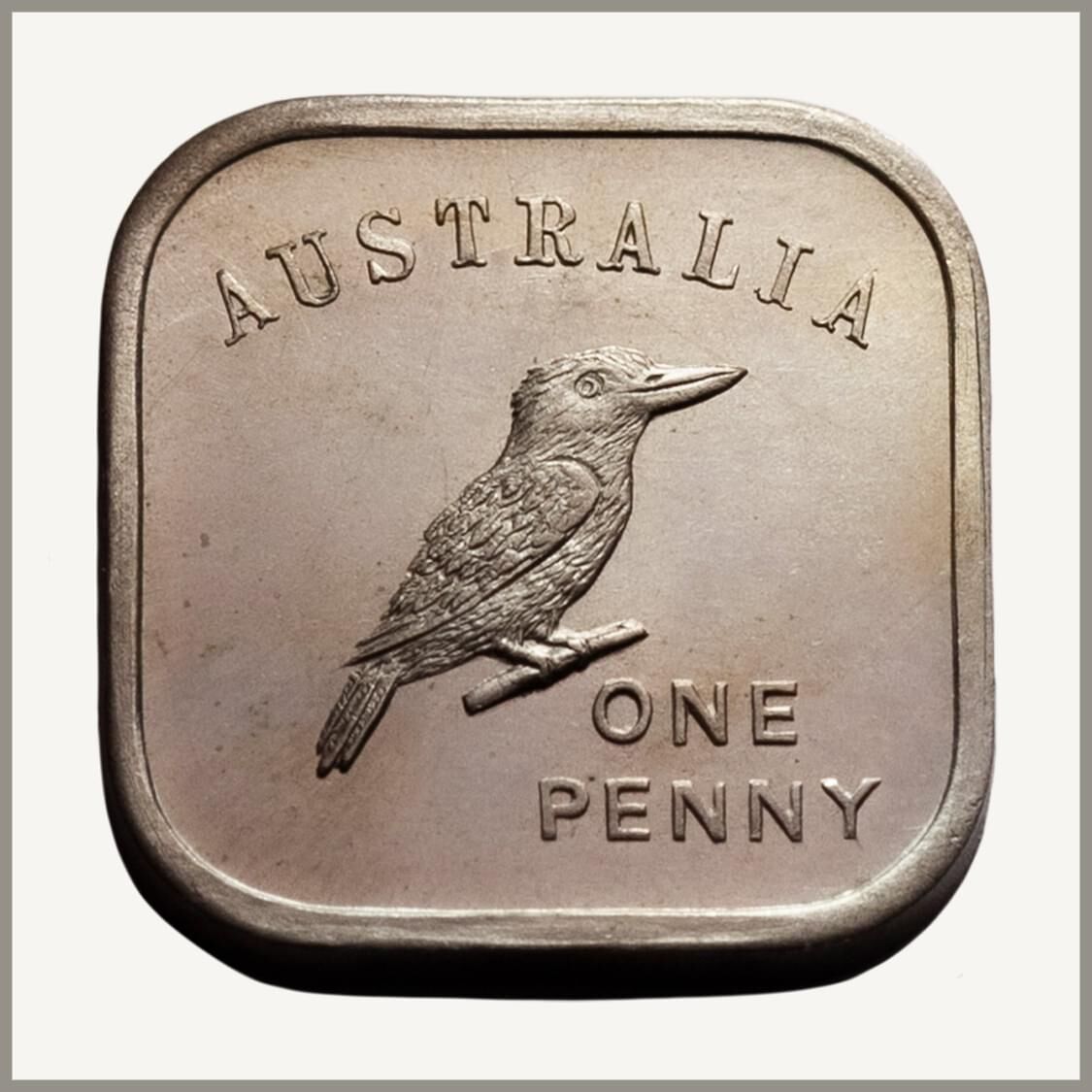
Reverse - The Type 3 has a unique reverse, the kookaburra design only used on this coin. The bird is slender, three feathers in the tail, the eye incuse. And the issuing authority and value is presented in a unique style. The word 'AUSTRALIA' is slightly curved across the top of the coin, detailed in a serif font, the words 'ONE PENNY' over two lines in a contrasting modern, sleek sans serif font. This break from tradition in using two fonts was not used on any other coin.
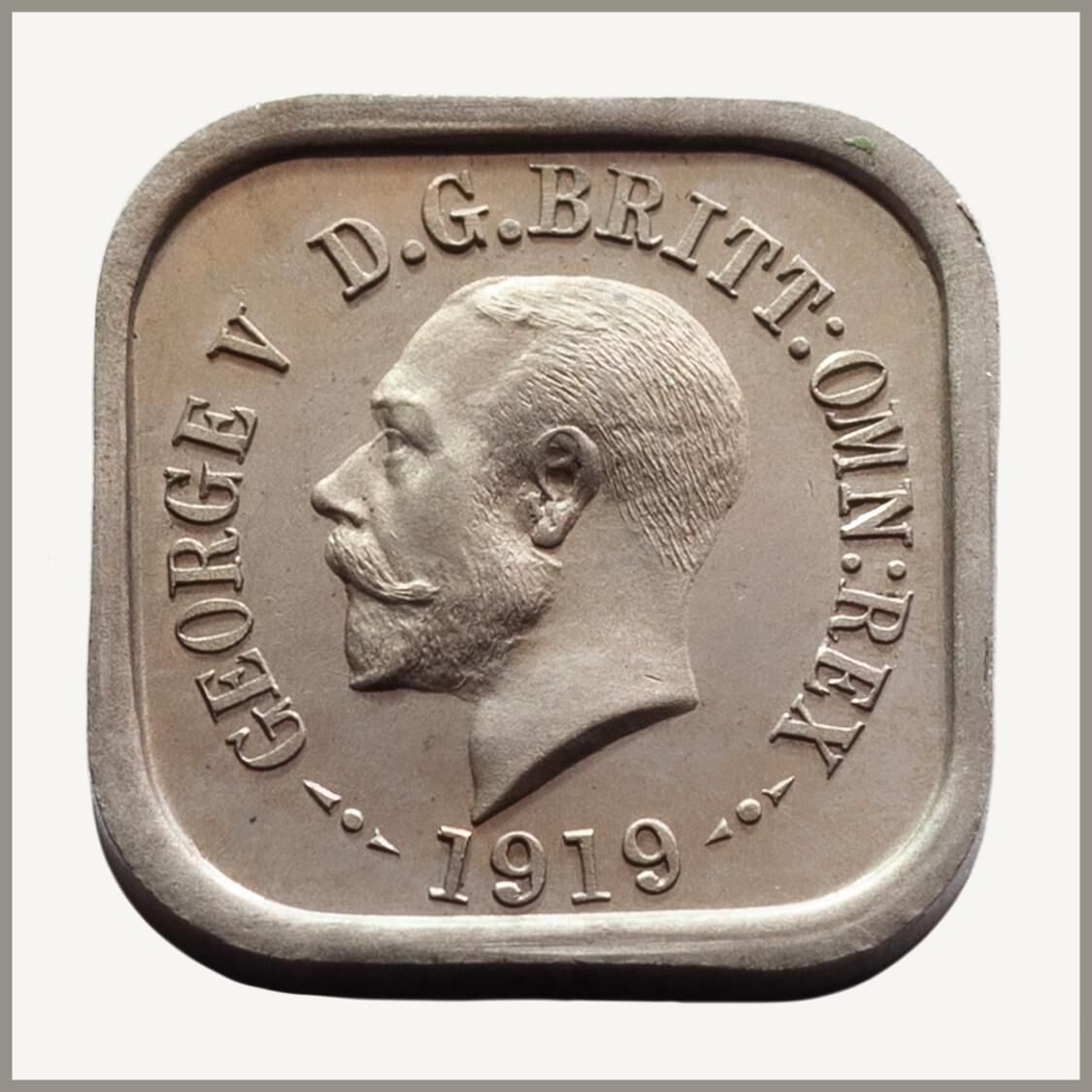
Obverse - Uncrowned effigy of George V was reduced from a metal die supplied by Australian manufacturer, Stokes & Son. The legend reads, GEORGE V D. G. BRITT: OMN:REX. The date appears under the portrait with ornamental stops separating it from the legend. The obverse design, portrait and legend, is shared with the Type 4 and Type 5 Kookaburra Penny.
The Melbourne Mint commenced striking Australia's Commonwealth copper pennies in 1919. No sooner had the mint started issuing coins, than it was directed by Treasury to commence testing an entirely new penny concept, a square coin made from cupro-nickel.
The Melbourne Mint was established in 1872, and was a producer of gold and silver coins and had just commenced production of bronze pennies in 1919. While new to the mint, the striking of nickel coinage as legal tender had been incorporated into the Commonwealth's Coinage Act of 1909 (No. 6 of 1909), passed after Federation.
The period 1919 to 1921, sits squarely in the post–World War I period, the first years of peace after immense war-time loss. And an experimental era when Australia was rebuilding its national confidence and defining its own national identity through design. Or through whatever means it could.
For many Australians, it was a time for breaking out, of questioning and changing old values and behaviour and enjoying the good life. It was a time of great change. People forgot the old and embraced the new in an attempt to leave the hardship and struggles of the war behind them. New technology was being created, like toasters and cars, things that today we take for granted. The fashion world was exploding, Australians embracing great change in their styles of dress.
Australians were identifying with their own culture, keen to lessen the emotional and cultural ties with Great Britain. The Government wanted to tap into this nationalistic sentiment and create a new, totally Australian coinage, the Kookaburra Penny and Kookaburra Halfpenny, envisaging coins that would be unique to Australia.
It was one of the instruments the Government believed would give us a greater awareness, and appreciation, of all things Australian. A mechanism to promote national spirit.
The proposal was contentious in that King George V was depicted on the obverse without a crown. It is noted that all coins struck under the newly formed Commonwealth of Australia depicted a crowned monarch.
Contentious also the use of the word 'Australia' in the design and not 'Commonwealth of Australia'. It was a hard road to Federation, uniting the six colonies under one banner, involving decades of negotiation and intense debate. Ultimately, the six separate British colonies united under the banner Commonwealth of Australia on January 1, 1901. Again it is noted that Australia's bronze pennies and halfpennies issued by the newly formed Commonwealth of Australia acknowledged the nation's federated status in the legend.
Trials commenced at the Melbourne Mint in 1919 and continued until 1921, the mint producing different designs, each a variation of the one theme of a kookaburra sitting on a branch and on the other side, an uncrowned portrait of George V. The test pieces ultimately passed to dignitaries and Government officials to assess their reaction.
The program of testing did not move forward beyond 1921. And the coins did not move into production. It is believed that over the three-year period two hundred pieces, of various designs, were produced, of which we estimate, one hundred and fifty are available to collectors.
There is no consensus as to why the coins did not move into production. The resignation in 1920 of Treasurer, William Watts, a supporter of the Kookaburra coinage did not impact on the program as his replacement Sir Joseph Cook was strongly in favour. That vending machines required a circular coin is also refuted as is the claim that it was unpopular with the general population.
Our view is that it was simply too soon in the national psyche.
While shaping our identity was politically expedient, uniting the states under the banner of Commonwealth of Australia was deemed a higher and more important priority. And the reality is the words 'Commonwealth of Australia' could never have been incorporated into the kookaburra design, given the size of the coins.
The quest to define Australia's national identity began with the Kookaburra Pennies and Halfpennies. It was Australia's first attempt at independent design in our coinage, a currency that was Australian in imagery, concept and form.
Transitioning to a more independent identity commenced in 1937/1938. And was extended in 1966, when Australia changed to decimal currency. On the five denominations, one, two, five, ten and twenty cent, the word 'Australia' appeared on the obverse and animals native to Australia appeared on the reverse.
For many collectors the fascination with the Kookaburra Penny and Halfpenny takes them on a journey to acquire more than one example. The coins are engaging and their rarity offers collectors the challenge they so often seek.
© Copyright: Coinworks