Proof 1931 Penny struck as a Coin of Record at the Melbourne Mint

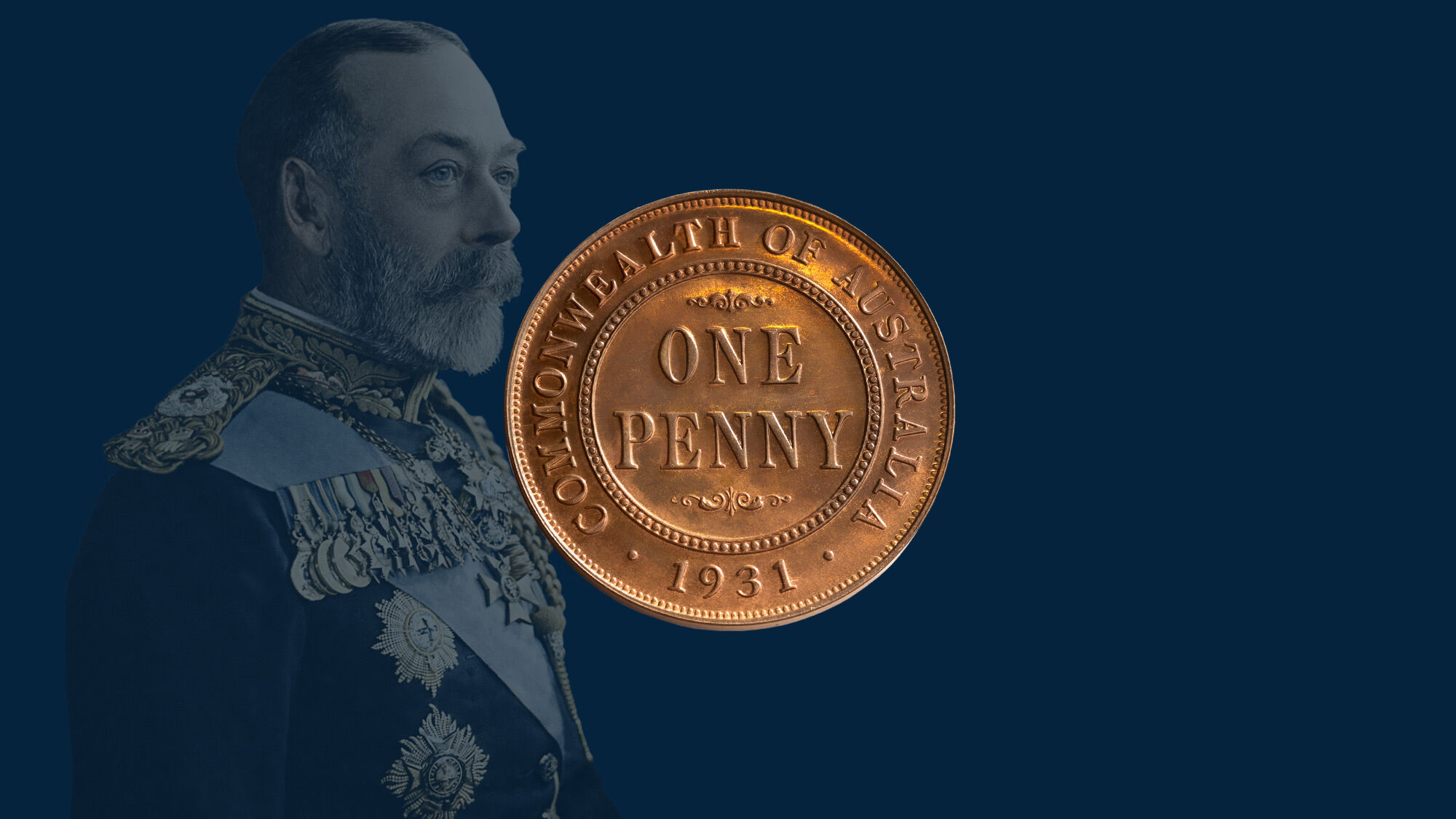
Proof coins are numismatic royalty. They are the pieces that are exhibited. They are the coins that are held with pride by museums. And as we saw recently with the Perth Mint's purchase of the 1899 Proof Half Sovereign, they are the coins that are acquired by institutions. They are also the coins that are lingered over and savoured by collectors, held as prized possessions.
This Proof 1931 Penny is unequivocally, numismatic royalty.
Our photograph is good. But the camera lens cannot capture what you see in the flesh. Full brilliance on both obverse and reverse. It is as though you are looking at a copper mirror! The camera lens has however captured the strength of the design detail, the upper and lower scrolls, the inner beading and the edge denticles. And the king's portrait. Crisp, pristine.
This is simply a great coin.
Coins of this ilk tend to have a history; a narrative that involves a person that is numismatically influential, a VIP or a Government dignitary. A story that helps us understand why the quality is so extraordinary. And in the case of this Proof 1931 Penny the person is Roy Farman. It was acquired in the 1950s from Farman, the exceptional quality of the coin said to have been a consequence of his close relationship with Albert Le Souef, a former Deputy Master of the Melbourne Mint.
This Proof 1931 Penny was housed in a small collection of George V copper proofs that was originally owned by Roy Farman.
The collection changed hands in the 1950s and was eventually offered at a public auction in 2001 and 2002, by Melbourne based Australian Coin Auctions (ACA). Proofs of the following dates were sold under the hammer, 1920, 1926, 1928, 1929, 1931, 1932 and 1936.
We attended the auction. The coins were extraordinary and to both collectors and dealers, the quality was nothing like we had seen before. Bidding was frenetic, the industry abuzz.
Barrie Winsor referred to the coins as 'super-proofs', they were so superior to those normally seen.
The industry contends that the exceptional quality of these proofs was a consequence of Farman’s close relationship with Albert Le Souef, Deputy Master of the Melbourne Mint 1921 - 1926. Le Souef maintained a strong relationship with the mint even after his retirement. In the Farman/Le Souef era, Coins of Record were (theoretically) out of reach of collectors. You had to have a strong connection into minting circles to gain access to them. And if you did have that connection, you would almost certainly be guaranteed the best quality. It became a matter of pride.
And it is important to note that, in this era, proofs had no commercial value over and above their face-value. They were simply collector's items! P.S. Today, proofs are still very much collector's items, but with a definite commercial twist.
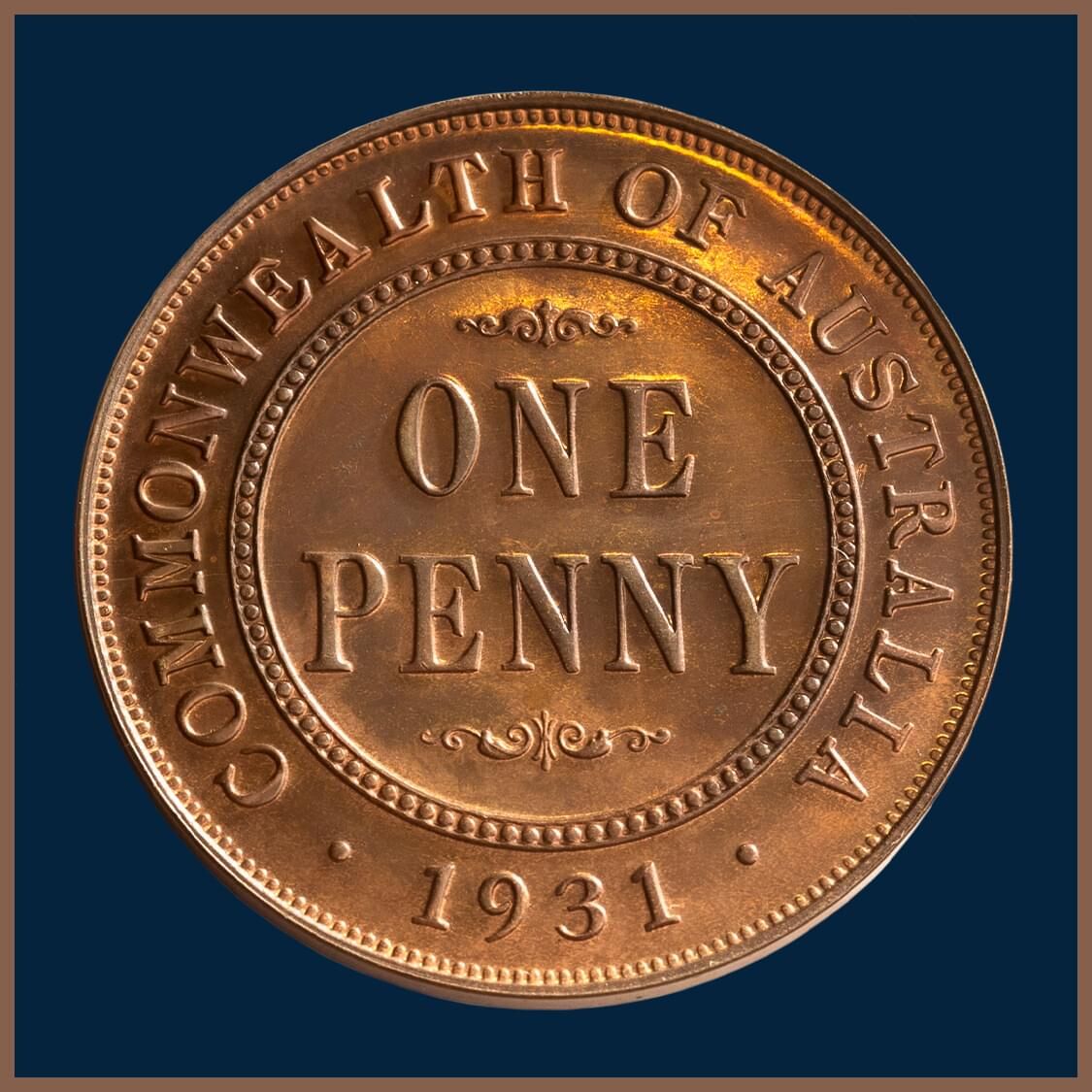
1931 Proof Penny
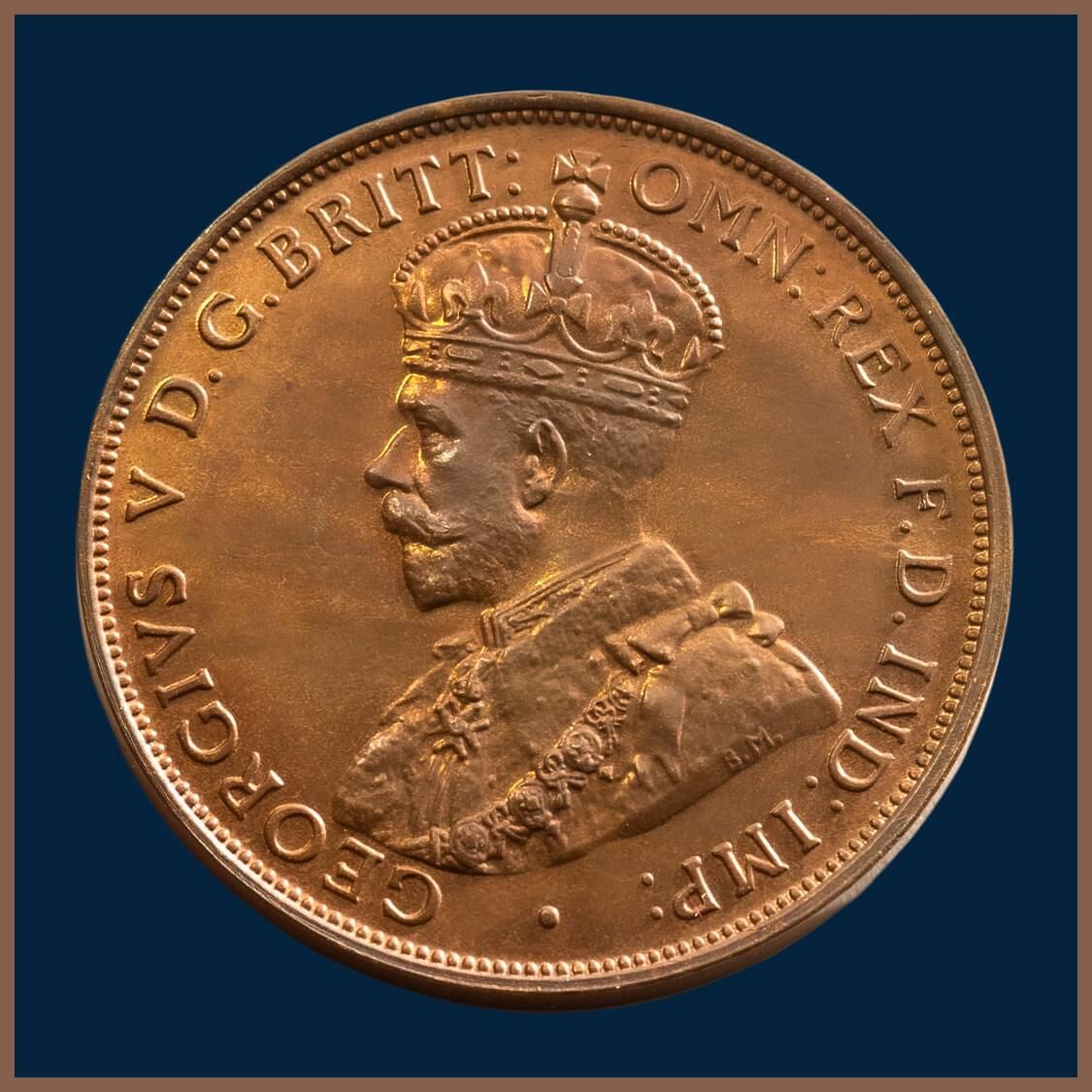
1931 Proof Penny
During the George V era, the Melbourne Mint struck circulating pennies from 1919 through to 1936, annual mintages averaging 4.5 million coins.
Three dates come in for special attention in this era, 1925, 1930 and 1931, each of which had well below average mintages.
They are collectively referred to as the rare-date or key-date pennies.
The proofs of these rare-date pennies have special significance to the industry, none more so than the King of Australian coin rarities, the Proof 1930 Penny.
Ranking #1 of the rare date pennies, the Proof 1930 Penny, at the 'top of the tree' for importance. It is a proof striking of Australia's rarest circulating penny, the industry contending that 1500 pennies were accidentally struck in 1930 and released into circulation.
Three Proof 1930 Pennies are held by private collectors.
Ranking #2, and next in importance, the Proof 1925 Penny. A proof striking of Australia's second rarest circulating penny, the 1925 Penny, records indicating that 117,000 coins were struck and released into circulation.
Three Proof 1925 Pennies are held by private collectors.
Ranking #3, and third in line for importance, the Proof 1931 Penny, records indicating that 474,000 pennies were struck in 1931 for circulation.
Three Proof 1931 Pennies are held by private collectors, of which the coin offered above is the finest.
Ultimately, there is another reason why these three coins are so highly valued. Australians just love their copper coins. The penny is an evocative coin, producing memories, ideas, emotions and responses. The humble penny is as Australian as you can get and people from all walks of life, and across all incomes, identify with our nation's copper coins.
The Melbourne Mint was established in 1872 as an overseas Branch of the Royal Mint London, the purpose to strike sovereigns and half sovereigns. In 1916, the Melbourne Mint diversified its coining repertoire. While continuing to strike the nation's gold coins, it also minted coins of the newly formed Commonwealth of Australia.
The Melbourne Mint ceased its coining operations in 1964.
In keeping with Royal Mint traditions, the Melbourne Mint struck proofs of those coins its was minting for circulation, be they gold, silver or copper. They are collectively referred to as Coins of Record.
The term, Coin of Record is to a large extent self-explanatory. It is a coin that has been minted to put on record a date. Or to record a design.
There was no commercial angle in the production of Coins of Record. The mints were not out to make money from the exercise. Quite the reverse, striking a proof coin in our pre-decimal era was a very labour intensive (and hence costly) exercise that would have dented the mints annual budget quite considerably.
A Coin of Record is an artistic interpretation of coinage, a strikingly beautiful coin beyond ordinary currency. Individually crafted to standards far exceeding that required of a circulating coin, using special coining techniques.
Perfection in the design, highly detailed, expertly crafted. Perfection in the fields, achieved by hand selecting unblemished blanks, polished to create a mirror shine. Perfection in the edges to encase the design … exactly what a ‘picture frame does to a canvass’.
Whereas production of circulating coinage was dictated by Government, Coins of Record were struck at the discretion of the mint master. They were not produced every year and, as they were individually crafted, the process was time consuming and the mintages minuscule. For Melbourne Mint copper proofs, generally four to six pieces or less. Forget the notion of striking one thousand proofs, as collectors are accustomed to today.
For today’s collectors the Coins of Record offer a wonderful link to the past and are extremely rare, two reasons that make them so popular.
One of Australia’s most famous Coins of Record is the Proof 1930 Penny. Only six examples of the Proof 1930 Penny were struck, one of which was retained by the mint with one each being sent to the British Museum and the Art Gallery of South Australia, where they both still reside. How three examples out of the mintage of six ended up in collector’s hands is still unclear. The might of influential collectors, we suggest.
So, what happened to these Coins of Record? Where did they go? And if they were struck by the mints for their own use, how did they get into collector's hands?
In the main, Coins of Record ended up in the mint’s own archives, preserving its history for future generations.
Any Coins of Record that were surplus to a mint's requirements may also have been sent to a museum or public institution.
The Australian mints at Sydney, Melbourne and Perth were branches of the Royal Mint in London. To keep the mints in the Royal Mint circuit up to date it became common for the Australian mints to exchange Coins of Record with their London counterparts.
Coins of Record were also put on display at public Exhibitions. The two known examples of the Proof 1866 Sovereign and Proof 1866 Half Sovereign were especially struck to exhibit as ‘products of New South Wales’ as part of the Colonial Mints display at the International Colonial Exhibition of 1866 and the International Exposition in Paris, 1867. They were discovered in London in the early 1970s.
It is noted that many of the overseas mints have over time sold off Coins of Record that they considered excess to their requirements. The Royal Mint South Africa sold off several Australian gold proofs in the 1990s.
What is obvious when you look back through historical records is that influential collectors, those that were particularly close to a senior member of the mint’s personnel, were given limited access to Coins of Record.
© Copyright: Coinworks