1956 Proof Penny struck at the Perth Mint featuring the effigy of Queen Elizabeth II.


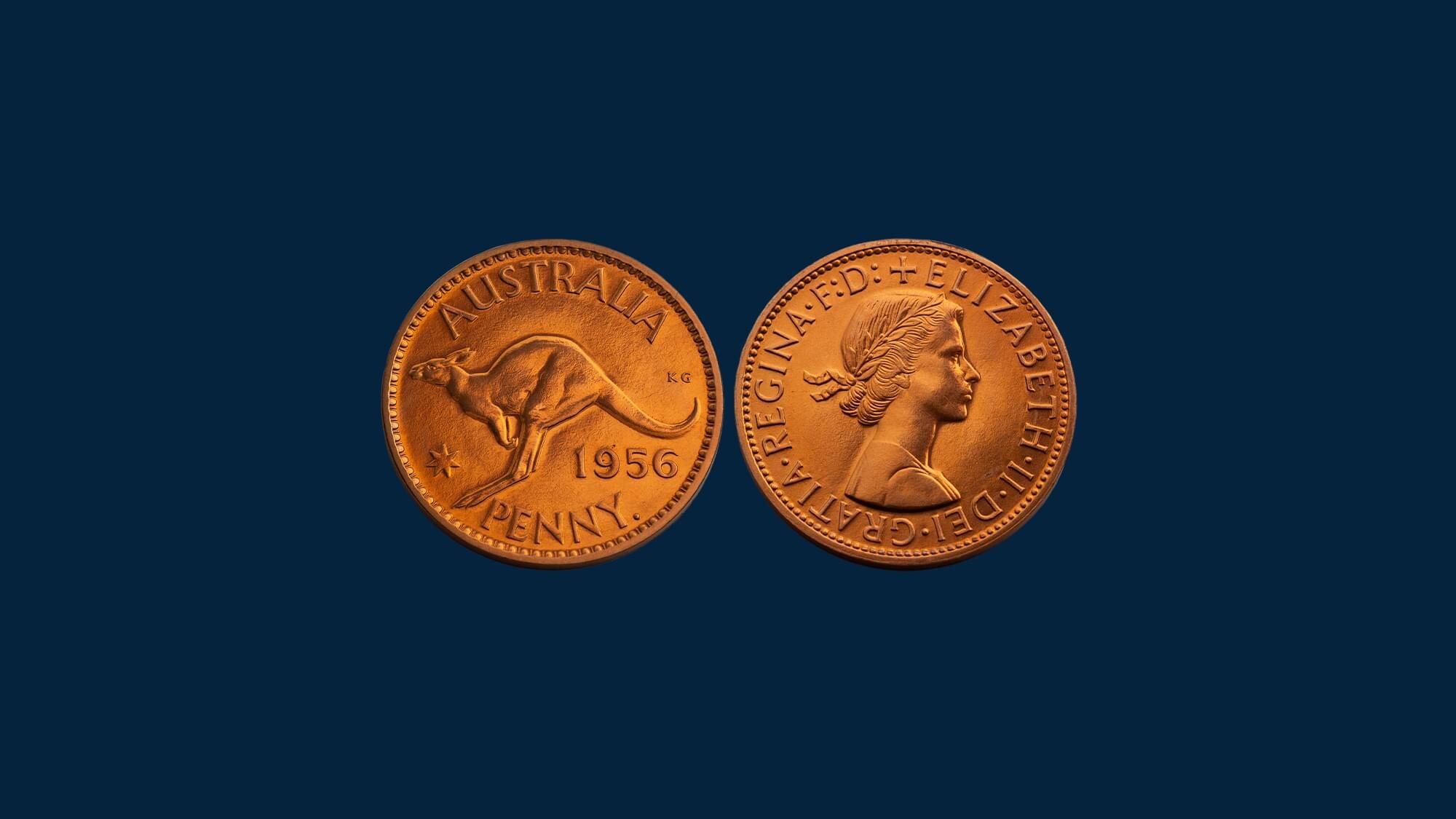
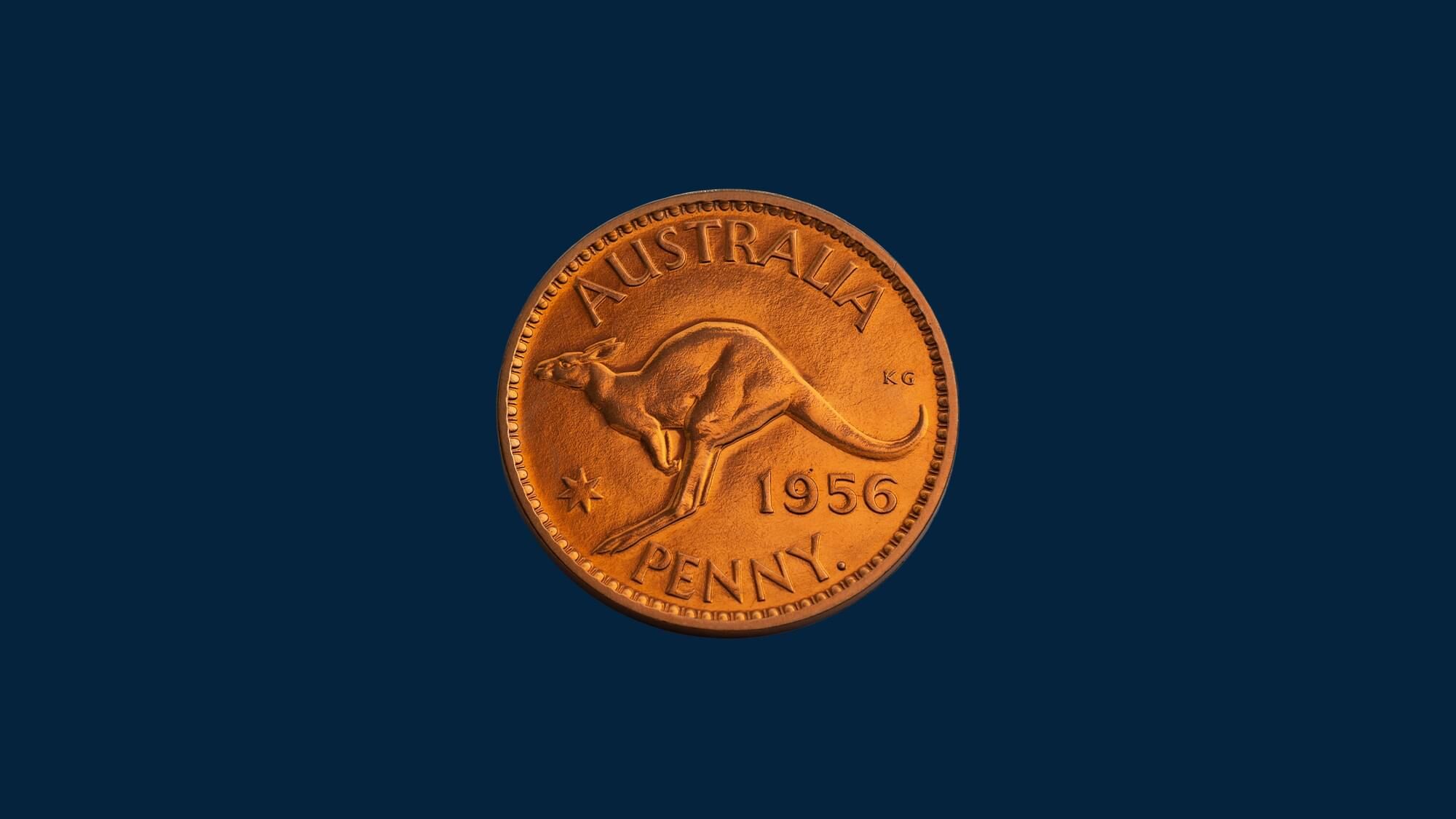
The intensity of this 1956 Perth Mint Proof Penny is amazing. It is an exceptional coin.
Just one glance and we knew that it could only have come from one of two sources, Melbourne collector Kevin Tierney or Country Victorian collector Dr Vince Verheyen. We checked our records and confirmed that it was the former. The coin was acquired by Tierney in 1989 while he was living in the U.S. from American coin dealer Karl Stephens. It had not seen the light of day for more than two decades. And it shows! Superb for quality and a solid blazing orange.
That this coin came from the U.S. is a further endorsement of its quality. It is known that the Perth Mint had developed a large export market for its early commercial proofs of 1955 to 1963 and American collectors were a prime target. And it is acknowledged that the quality of those coins sold into the U.S. were far superior to those sold locally.
In an article published in the Journal of the Numismatic Association of Australia 2005, renowned numismatist Paul Holland contends that the Perth Mint copper proofs were created for unaided vision. The point here that a collector would not need a magnifying glass to appreciate their beauty.
Looking at this 1956 Perth Mint Proof Penny you can only but agree!
Hollonds contends that the Perth Mint modelled their bronze proofs on the Royal Mint London’s 1951-PL proofs, for they, as a general rule, are stunning. Visually impactful.
Hollonds also comments that the Perth Mint went the extra yards with their production and ground the rims by hand to ensure they were high and squared-off.
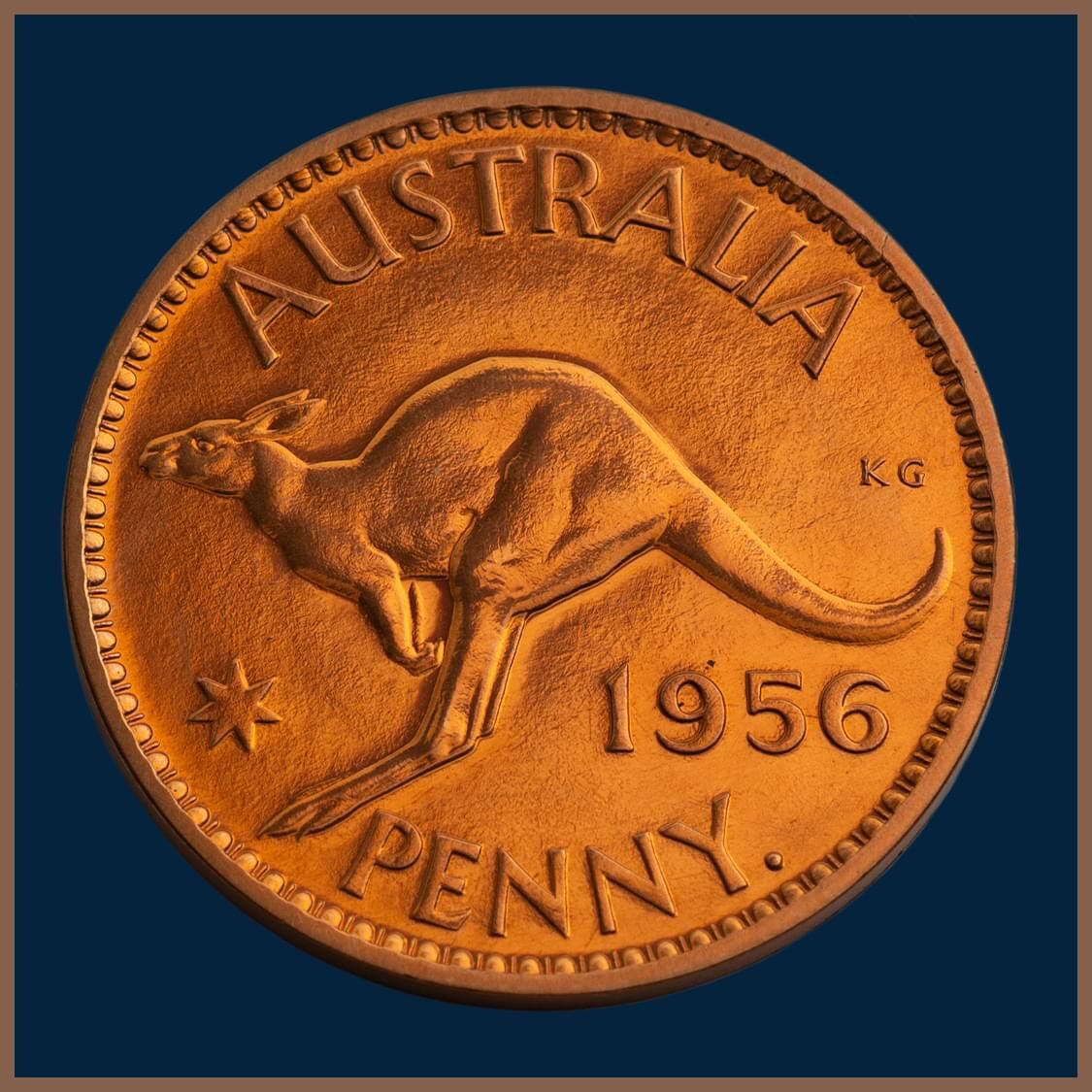
1956 Perth Mint Proof Penny
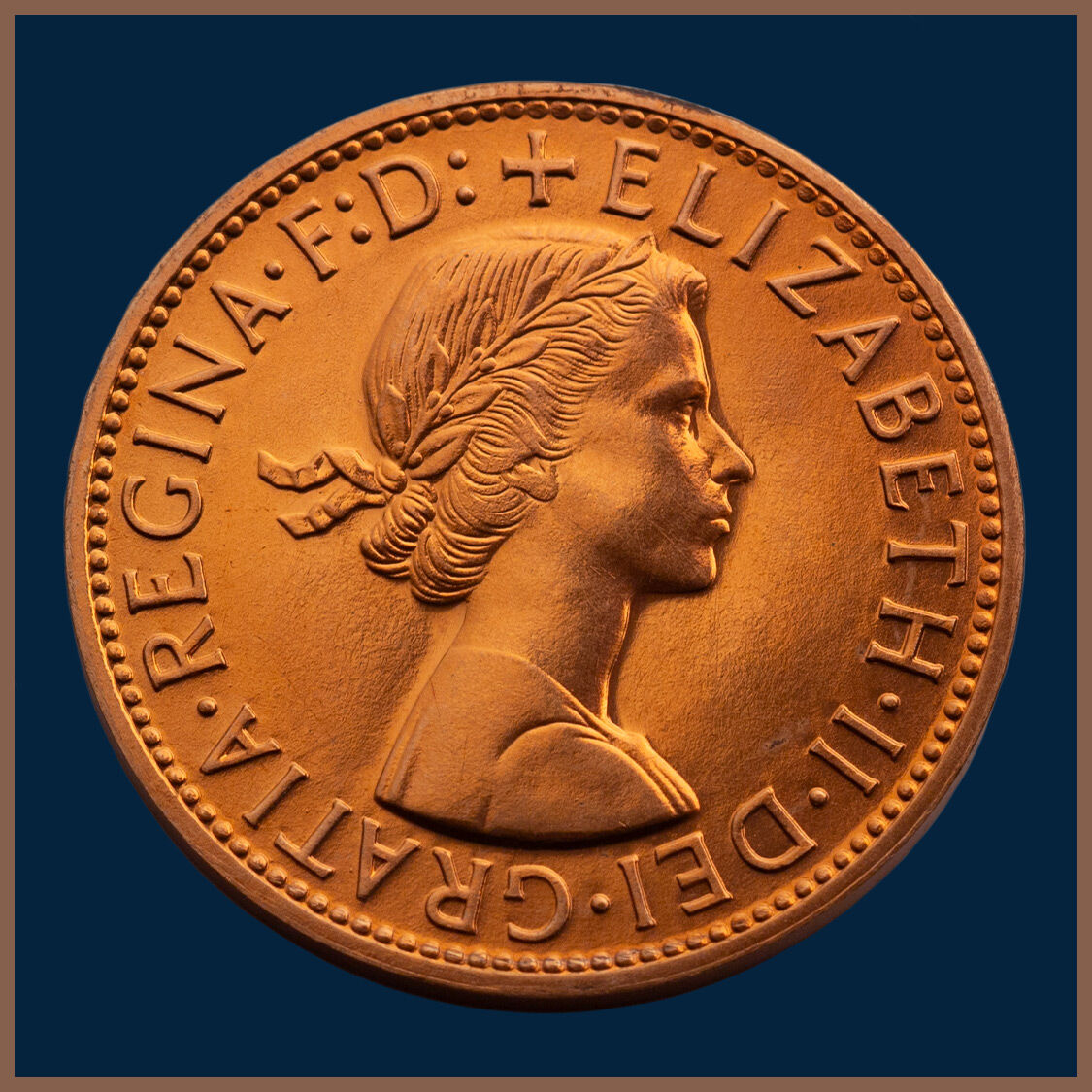
1956 Perth Mint Proof Penny
1956 Perth Mint Proof Penny
1956 Perth Mint Proof Penny
For collectors, the year 1955 is a key date. It was the first year the Perth Mint began a program of striking copper proofs in 'commercial quantities' to sell to collectors. The mintage in 1955 was 301.
The mintage in the second year, 1956, was 417.
By 1957, the series had really taken off and mintages increased to around the 1000+ level making the 1955 and 1956 coins the key coins, and the pick of the lot.
The series ran until 1963, stopping just prior to decimal currency changeover.
The mintage of 417, makes the coin in today's market extremely rare.
(Compare it to the Royal Australian Mint's and Perth Mint's current proof coin mintages of 5000, 10,000 and 50,000!)
Natural attrition has taken its toll on the original mintage for the coins were not encased in fancy packaging but housed only in small cellophane holders and despatched to collectors in an envelope. Many of the coins have filtered their way into circulation. Others severely damaged through mishandling making an already small mintage even smaller.
This a supreme proof!
There is a perception amongst collectors new to the market that all proofs are created equal. And therefore, should be valued the same. The notion is that because a coin is struck to a proof finish it has to be good. Those perceptions are incorrect. Correct handling and storage is a critical issue to preserving the value of proof coins. And this coin has been brilliantly preserved.
It's a key coin in a very popular series.
The series of Perth Mint Proof Coins struck between 1955 and 1963 is an important series in our numismatic history: a catalyst for the introduction of the proof coining program introduced by the Royal Australian Mint, Canberra in 1966. It also is an affordable one, making it one of the most popular collecting series in the Australian coin market.
As the Perth Mint is still producing coins, its narrative has not been confined to history. The mint is an on-going story with a collecting audience that is expanding through the production and export of decimal collector coins. So, the ‘Perth Mint’ message always remains strong, underpinning future interest in its earlier historical issues.
The proof coins produced at the Perth Mint in 1955 were specially struck and sold to collectors under provision of the Commonwealth Treasury, the sale price a premium of two shillings above face value.
The face value was paid to Treasury and the premium went to the mint.
The Government placed only one restriction on the mint. Only those coins they were striking for circulation could be struck as proofs and sold to collectors.
As the Perth Mint was striking copper circulating coins for Treasury, it could strike only copper proof coins for collectors. (See table.)
The Perth Mint’s coins were minted to exacting standards - from the selection and polishing of blanks, the preparation of dies and ultimately the actual striking.
The Perth Mint went the extra yards with their production and ground the rims by hand to ensure they were high and squared-off, said to be emulating the superb quality that came out of the Royal Mint London in the production of Australia’s 1951 PL penny and halfpenny.
Quality is paramount in this series, for while all the coins in the series were struck as proofs, their state of preservation today (how they have been handled) is critical to preserving their value and underpinning future capital growth.
Modern packaging is a product of our decimal era. There was no fancy packaging in the 1950s and 1960s with coins sent by mail, housed in small cellophane envelopes.
As each proof issue is a stand-alone rarity, there is no pressure on buyers to complete the series. Nine year sets, each coin struck as proofs, fourteen proof coins in total.
Be assured the series does present challenges if the coins are to be procured in top quality. But a complete collection is achievable and can be obtained over time by buying progressively, year by year, set by set.
Year Components Mintage
1955 1d & 1/2d (2 coins) 301
1956 1d (1 coin) 417
1957 1d (1 coin) 1112
1958 1d (1 coin) 1028
1959 1d (1 coin) 1030
1960 1d & 1/2d (2 coins) 1030
1961 1d & 1/2d (2 coins) 1040
1962 1d & 1/2d (2 coins) 1064
1963 1d & 1/2d (2 coins) 1100
© Copyright: Coinworks